

Experiments in health, endurance, and tech. Building @FeanorLabs.
San Francisco, CA
Joined May 2018
- Tweets2.3K
- Following300
- Followers1.1K
- Likes16.1K





Pinned Tweet
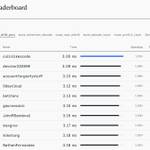
I’ve made Auri 4.0 Keyboard even better since this benchmark study.
It’s now #1 in voice dictation and only 0.8 points behind Apple in touch.
You can finally try it yourself:
apps.apple.com/us/app/auri-a…


"A rabbit hole of epic proportions because I can do whatever I want to do" podcast episodes are the best kind of podcast episode.

NEW podcast episode is up!
"Lucky #888 — My Tour of Designing Luck in China, Japan, and Korea"
For episode #888, I couldn’t resist going down a rabbit hole about the number eight. Join me for a nerdy tour of China, Japan, and Korea, including a million-dollar license plate, disappearing hotel floors, a casino room designed around one gambler’s birthday, and much, much more.
Please enjoy!

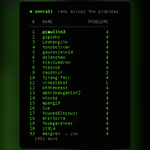
Finished the Kernel Track in 93rd place overall, with a 2.314× speedup over SGLang on the decode layer (and 63rd on bf16_proj at 1.600×, but that doesn't count).
Not quite where I expected myself to finish, but considering I didn't know what a kernel was going in, I'll take it.


We're launching a $100,000 challenge to see who can make Muse Spark run fastest: openkernelchallenge.dev/

I keep seeing these "No on G," "Yes on E," "Maybe on X" signs all over SF, and can't help but wonder, perhaps naively:
1. What's the point of electing government *representatives*, employing ~35,000 government workers, and spending ~$20,000 per capita if general population is then asked to make these decisions?
2. Who has the time and willingness to thoughtfully research all these props? Either the unemployed, actively involved in politics, or people generally not known for their acute decision-making.
What am I missing here.
Case in point teapawt.net/immad/status/211799242…


Lots of updates!
And yes, I'm still having too much fun with these opus-5.5 motion design videos.

🆕 What's new in v4.1.8:
◦ Improved and simplified the keyboard dictation flow.
◦ Fully optimized for iPhone Duo, including the keyboard.
◦ Significantly improved keyboard autocorrect and typing performance.
◦ Keyboard’s Fix Grammar, Translate, and Paraphrase features can now handle longer texts.
◦ You can now customize the keyboard writing tools, reorder them, and remove the ones you don’t use. Settings → Keyboard → Writing Tools.
◦ Now you can adjust how long the microphone stays ready for your next voice dictation: 1, 15, or 30 minutes, or 1, 3, or 8 hours. Settings → Magic Dictation → Keep Mic Ready.
◦ New keyboard theme: Auri Clear.
◦ Improved the Simplified Chinese 10-key and QWERTY keyboards.
◦ Improved Ask Auri with feedback options.
◦ Added emoji search in Chinese and Korean to their respective keyboards.
◦ Quality-of-life improvements across the app.
◦ Fewer bugs and improved performance.
Thank you for your feedback, feature requests, and bug reports!


This is fun

We're launching a $100,000 challenge to see who can make Muse Spark run fastest: openkernelchallenge.dev/


Ludovico Einaudi is the greatest composer of our lifetime, and it’s not even close.
Every live performance fills you with such a powerful sense of unfiltered awe that you can only experience in the presence of true greatness.

Here's how I connected each agent:
- Dot: an OAuth-authenticated MCP plugin.
- Grok Bot: an authenticated routine receives requests. Grok returns answers through a helper on its existing Mac connection, while Maestro carries recent conversation history between routine runs.
- Codex, Claude Code, and Pi: Herdr manages sessions. Codex uses its read-only app-server API, and Claude uses its SDK for final answers.
- Muse: the official muse-gadget-sdk.
I built a fun way to talk to all your agents (Grok @bot, Claude, Codex, Dot, @Muse, and Pi) from anywhere. Even while you're touching grass.
Meet Maestro, a handheld agent orchestrator powered by an ESP32-S3.
Pick a conversation, hold a button, and talk. Hear the reply or read it on the screen.
Each agent gets its own pixel character. Maestro buzzes when one replies.
It works even when your laptop is offline, so you can leave it behind and go outside.
The voice flow is straightforward, too:
Maestro uploads the recording to your Mac (or to a VPS if remote mode is on). whisper.cpp transcribes it, then the bridge sends the transcript to the selected agent, retrieves and saves its final answer, and streams speech (generated using Kokoro through ONNX Runtime) back to the device.