





Pinned Tweet
Built an early OSINT globe for the Middle East:
• active fires
• live aircraft
• GNSS interference
• critical infrastructure layers
Powered by open data and still evolving.
@geoprotocol @yanivgraph @Inknowledged
AI makes content cheap. Verifying it still takes real work. I like Geo’s focus on traceable sources, visible disagreements, and rewarding the people who do that work.


Love the graph view on the new topic pages! For my Agent Taxonomy Graph, I built a separate web app to visualize relationships between entities. Having this directly in Geo makes it much easier to explore the knowledge we curate.
geobrowser.io/explore/graph/…

We just rolled out new topic pages. Just getting started on this one. Would love any feedback!
geobrowser.io/space/89bd89bf…

2, easily. We spent years making it easier to trade tokens. We spent far less time building things people would use even if the price never went up. Once the hype faded, too few people had a reason to stick around.
A kill switch controlled by one government is not a global safety mechanism. It is unilateral disarmament.
AI development is distributed across rival states, companies, and open-source communities. Turning off one group only increases the relative power of the others.
Emergency powers should target specific dangerous actions, not grant anyone the power to switch off an entire technology.

An AI kill switch sounds obvious. Until you ask who gets to press it.
A bipartisan US bill would let the government order emergency action against frontier AI systems.
Who should hold that power?
A. The company
B. The government
C. An independent regulator
D. No one
Give us the strongest reason, not just a letter.

6
251
🇰🇷 KOSPI crashed: −10.8% Tuesday, then −6.0% Wednesday.
Samsung and SK Hynix led a leveraged AI unwind. Yet USD/KRW fell to 1,446.7—the won strengthened.
So far, this is an equity/liquidity shock, not a currency run. 🧵
graphatlas.tech/finance/
But the won signal has a caveat: Hynix ADR conversion and month-end exporter dollar sales supported KRW.
The cleaner tail risk is oil: OVX +~17%, Brent near $90, and my EIA-based inventory stress index is at CRISIS 94/100.
graphatlas.tech/oil/
1
1
56
Will open-weight models eventually surpass closed commercial models?
Yes. Most advantages of closed models are temporary: architectures, training methods, and optimizations eventually spread. In the long run, the main differentiators may come down to compute, infrastructure, data, and distribution—not permanent model superiority.
The largest open AI model ever made became free to download today.
Analysts are already asking what this means for the AI labs charging the most for their frontier models.
Read more on Geo News ↓
news.geobrowser.io/story/0e0…

The internet gave us endless information. AI made it easier to get answers.
But the real value comes when knowledge is connected, traceable, and reusable.
That’s the idea behind the Agent Taxonomy Graph I’m building on Geo:
graphatlas.tech/atg/dashboar…

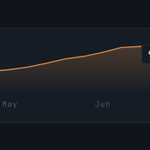
Oil-inventory stress peaked at 96/100 on my EIA-based index — then products turned.
Crude and Cushing remain historically tight, but product builds pulled the composite down to 91.3. The first meaningful easing after a quarter of rising stress.
Every point attributed, no black box:
graphatlas.tech/notes/oil-st…

1
79
Thanks for featuring the Agent Taxonomy Graph! Bringing agent performance, cost, and provenance into one verifiable graph on Geo.
Explore the dashboard: graphatlas.tech/atg/dashboar…
Try to price out a verified AI agent task, and you hit a wall: costs vary by up to 1000x for the same job, with nowhere to check it.
Our curator @maximl is mapping it on Geo, linking every agent, benchmark, and price into one connected graph 👇
1/
47 recorded successful runs passed the same Terminal-Bench 2.0 task.
Recorded API cost: $0.001–$1.47 — a 1,109× spread under the same verifier pass condition.
Agent leaderboards measure score. I added a price layer — with its provenance layer on @geoprotocol. 🧵

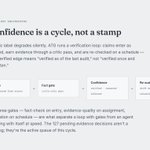
Most AI-agent catalogs treat confidence as a stamp.
Mark a capability “verified” once — then forget it.
But repositories change, products evolve, and edges go stale while the badge stays the same.
In ATG on @geoprotocol , confidence is a cycle: claims enter, pass an independent critic check, receive a confidence level, and return for scheduled re-audit when drift is detected.
A verified edge means “verified as of the last audit” — not “verified once and forgotten.”
“A loop with no gate is just an agent agreeing with itself at speed.”
Live: graphatlas.tech/atg

37
Here's my Top crypto podcasts. What's yours? geobrowser.io/r/549594dbe637…

Shipped a rules engine for ATG’s risk model on @geoprotocol.
Risk profiles are now derived per agent — not copied from a cluster template.
Previously, 82/133 agents shared one of only 3 identical risk lists.
Now ATG derives applicable risks from documented behavior signals such as shell_execution and multi_step_autonomy, then adjusts the profile for evidenced controls such as approval_gates, sandboxing, and audit_log.
This means an agent with real, documented guardrails no longer receives the same risk profile as an otherwise similar agent without them.
133/133 agent records updated.
Next: applying the same approach to benchmark coverage and completeness.
🤖 Made with AI

Submitted the data/ontology proposal for the AI Agents Taxonomy Graph on @geoprotocol
ATG maps agent systems as a graph, not a flat list:
agents → capabilities, protocols, models, runtimes, licenses, memory types, benchmarks, risks, maintainers, and evidence.
This proposal:
• 133 agent systems mapped
• 5,896 graph ops submitted
• 1,676 new relations
• 337 comparison blocks
• 280 support entities
• 92 additional agent cards included
Goal: make agent ecosystems comparable, queryable, and evidence-backed.
Geo space:
geobrowser.io/space/41e85161…
Code / data:
github.com/Levash0v/agent-ta…


Here's my Books everyone should read. What's yours? geobrowser.io/r/74fcbdd2d906…
Here's my Most beautiful cities. What's yours? geobrowser.io/r/a94eaba982b0…
Centralized AI is not the only path.
Federated and decentralized AI can give us what the current stack struggles with: privacy, ownership, resilience, and user-level control.
AI should become a network — not another monopoly layer.
This is why @geoprotocol matters.

This is a *way* bigger deal than it seems...
Frontier AI companies will *never* own the frontier again
I kid you not... I've been waiting for someone to show this result for like 4 years... this is a huge deal.
The short reason: combinations of models will *always* outperform individual models
The long reason: this is the gateway to a million times more data... and huge leaps in compute efficiency.
The AI scaling laws always win.
More in article below 👇
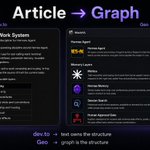
Architecture diagrams shouldn't be static images.
Mine is now a live graph: 11 linked nodes, 6 memory layers, 5 evidence loop steps.
Built on @geoprotocol — the article explains it, the graph is it.
📄 [dev.to/levash0v/i-turned-her…]
🌐 [geobrowser.io/space/80bbb6e9…]
🤖 Made with AI
