

making sand think phd @AmlabUva, prev. intern @GoogleDeepMind & @cusp_ai
London
Joined March 2022
- Tweets695
- Following505
- Followers2.3K
- Likes5K
Pinned Tweet
🌍Today we release Mosaic, a probabilistic weather model that shifts the Pareto frontier of ML weather forecasting.
It matches the skill of state-of-the-art models while generating a 24-member, 10-day global forecast in under 12 s on a single H100.
Thread!
An incredibly talented team laser focused on developing best weather forecasting models at scale.
Currently wrapping up my internship, do let me know if you are interested in the position and have any questions about the team.

@GoogleDeepmind Weather is hiring Student Researchers for next year!
There are a few different projects. Candidates should have a strong ML background and interest in applying those skills to advance weather prediction.
1/3
2
27
3,035
Max Zhdanov retweeted

I am hiring multiple PhD positions at AMLab at the University of Amsterdam to work on deep learning from a physically inspired point of view.
come work with me!
(link below)
1/n
Max Zhdanov retweeted

We will have several funded AI4Science positions open at the @UvA_Amsterdam! If you're interested in ML for Earth system modeling or mechanistic interpretability, apply through the ELLIS PhD/Postdoc call by 31 October: apply.ellis.eu
@Ellis_Amsterdam @ELLISforEurope
Max Zhdanov retweeted

We're also hiring Student Researchers in the Frontier Computation team @GoogleDeepMind, to work with @re_rayne & @IAmTimNguyen!
Areas of interest: agentic optimisation, learning algorithms/simulations, OOD generalisation, AI4Physics, CFD, numerical math.
Applying details below!
Max Zhdanov retweeted

Today we are releasing UMA Nitro! ⚡
Nitro brings unprecedented inference speeds to the latest UMA models – reaching 6 ns/day on 1k atoms on a single H200 GPU, and up to a blazing 33 ns/day raw inference speed on ~150 atoms!
Try it now - github.com/facebookresearch/…!
Max Zhdanov retweeted

Last week, Hurricane Isaias made landfall in the Florida Panhandle. Our thoughts are with everyone affected and with the recovery efforts still underway. Earlier and more accurate forecasting can help protect communities by giving them more time to prepare, and we are grateful that Google’s WeatherNext model was able to assist the @NWSNHC 's expert forecasters.
Based on initial evaluations, here's how our model supported the response to #Isaias:
- Tracking the Hurricane’s Path: WeatherNext was the most accurate model on the storm’s track. While traditional physics models predicted landfall closer to New Orleans, WeatherNext correctly predicted a path further east. This allowed NHC forecasters to highlight the potential for wind and storm surge impacts in the Florida Panhandle from their very first forecast.
- More Time to Prepare: Up to three days before landfall, our model consistently predicted its eventual location in the Florida Panhandle to within 60 km or less, supporting the NHC as they honed in on a track toward the Florida Panhandle and issued hurricane watches and warnings to give officials in Florida, Alabama, and Mississippi more time to prepare.
- Early Indications about Intensity: Early on, WeatherNext accurately predicted the intensification to a major hurricane. Alongside the regional hurricane models HWRF and HMON, WeatherNext’s intensity forecasts helped NHC forecasters to predict that the Isaias would approach the coast as a category 2 hurricane from the very first advisory.
Giving communities more time and more accurate warnings is critical for protecting lives and livelihoods. While model performance varies from storm to storm, Isaias reflects our broader findings. In our recent @Nature paper co-authored with NHC forecasters, evaluating 200+ global tropical cyclones, we found our model provides ~1 day of additional lead time for both track and intensity.
It’s been an honor for the @GoogleDeepMind and @GoogleResearch teams to work alongside NHC forecasters. By combining AI, physics models, satellite data, and the crucial expertise of meteorologists, we're excited to keep pushing the boundaries of forecasting to help protect communities.
One of the most incredible applications of AI already saving lives.
If you’re curious about the approach, the WeatherNext team have just published a paper in Nature.
Paper: nature.com/articles/s41586-0…
Blog: deepmind.google/science/weat…
Online (!) forecast: deepmind.google.com/science/…


Google Deepmind (FNV3) CRUSHED the forecast for #Isaias up to 11 days in advance. It picked up some appreciable signal on September 23, locked in on the exact landfall location4 days before it happened, and nailed the peak intensity consistently 3 days before it happened. A new age of forecasting is upon us.
First video: Track density using 1000 member ensemble
Second Video: Individual tracks and mean using 50 member ensemble

Only momentarily, for it is a derivative of our temporary inability to scale further.
Should we fail, and a swarm is our ultimate form of superintelligence, we are sadly left with a structure mimicking, and therefore limited by, our own institutions instead of refining them.

2
2
787
Max Zhdanov retweeted

Excited to share that MoSE3 was accepted as #NeurIPS2026 Spotlight!
MoSE3 estimates an SE(3) transform at every pixel from monocular video, all in a shared world coordinate frame and in a single forward pass. It captures rigid, articulated, and deformable motion.
1/
Max Zhdanov retweeted

♾️ LiFT: Loop Flow Transformers 🧵👇
Diffusion models usually spend more inference compute by taking more sampling steps. What if we could also spend compute inside each step?
LiFT turns part of a DiT into a recurrent core, letting us scale depth at inference with only a small architectural change. On ImageNet, it beats dense DiT-XL/2 with 3.34 lower FID, while using 60% fewer parameters, 32% fewer training FLOPs, and 52% fewer inference FLOPs.
Jointly led with Mohammad Mahdi Derakhshani 👑(@mmderakhshani)
And amazing supervisors Cees Snoek (@cgmsnoek), Jan-Willem van de Meent (@jwvdm) and Gertjan J. Burghouts (@gjburghouts)
Nabil is amazing, his positivity and mathematical prowess are exceptional. If you are looking for a PhD position at AMLab consider reaching out :)

Max Zhdanov retweeted

Today, we're opening ElevenLabs Netherlands 🇳🇱!
We're building an incredible team here and opening an office in Amsterdam. If you're interested in working with us, get in touch!

Max Zhdanov retweeted

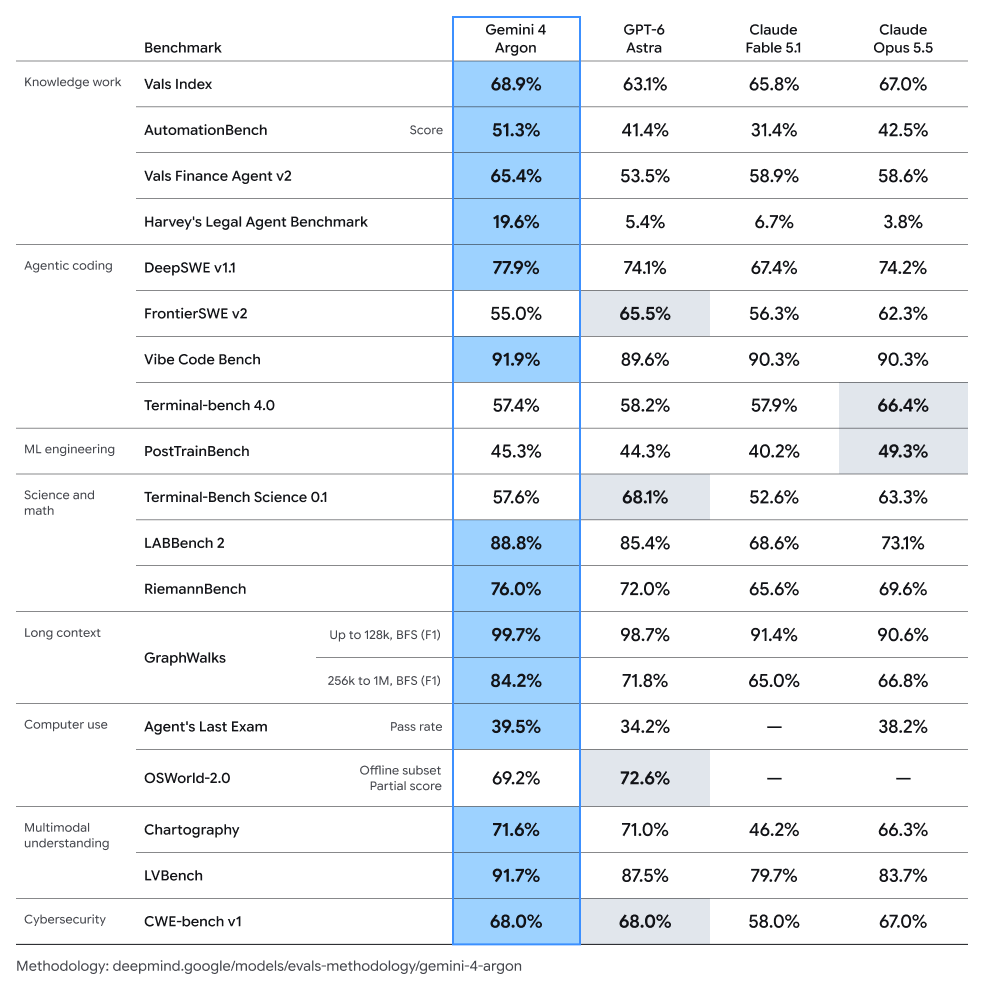
Introducing Gemini 4 Argon – our new frontier model.
It’s built for complex workflows across coding, enterprise knowledge work, and cybersecurity defense – rolling out today to a set of trusted testers through our Fairwind Program.
Data point for the modern open-weights discourse

I had not realised before that the Bronze Age Collapse was literally *caused* by iron.
Bronze age powers like the Egyptians, Hittites and Babylonians used bronze weapons, made by combining copper and tin. Tin was so scarce that only the richest and most powerful groups could access it and the bronze weapons it allowed. (Tin was so rare that it was being transported from Cornwall to the Middle East more than 1000 years BC.) The scarcity of tin gave these empires a near-monopoly on violence.
Iron weapons are not actually any better than bronze ones – they're not stronger or easier to work with, as I'd assumed. They're just much, much easier to mass produce once you have bloomeries, which are the first furnaces that were hot enough to melt iron in a way that made them useable for weapons.
Bloomeries meant that iron ore, which was widespread, could be used to make weapons anywhere. That led to warlords, bandits and city-states rising in a massive decentralization of military power, which the Bronze Age empires were unable to resist.
After the invention of the bloomery, skeletons show a measurable increase in weapon-inflicted injuries. 'Destruction layers' with bones and signs of burning have been found from this time at archaeological sites including Troy. Ancient writers – including Herodotus, Ovid, and the writers of the Old Testament – believed the invention of iron had unleashed a new age of violence.
New at Works in Progress, WEAPONS OF MASS DECENTRALIZATION: how iron itself brought about the Bronze Age Collapse. And what technologies could do the same today?
worksinprogress.co/issue/wea…


Max Zhdanov retweeted
Weather forecasts play a critical role in the transition to renewables.
WeatherNext 3 provides grid operators as well as wind and solar power producers with predictions for turbine-height wind speeds and solar radiation, enabling smarter, cleaner energy planning. 🧵
Max Zhdanov retweeted

Can you predict next week's weather yourself? We just wrote a blog post that explains how! ⛅️🌍🌧️
Running weather forecasting required having a supercomputer and CS/physics Phd. Now, AI-based models need fewer resources and are available to anyone on @huggingface. So, prediction the weather should be accessible to all.
But only a few labs can actually run these models because there is no standardized documentation guiding you from the model weights to an actual forecast. Together with @EarthmoverHQ, we wrote a blog post and a demo walking you through that: huggingface.co/blog/hugging-…
The blog covers the code for fetching initial conditions from the Earthmover Marketplace, building a model's input batch, running inference and comparing the forecast against historical climate data.
You can also run Aurora (Microsoft), WeatherNext2 (Google) and AIFS (ECMWF) on our demo space. This is a first step to make AI-based weather forecasting models more accessible, and we'd love to build more of that. Tell us what's missing or your feedback in the blog comments!
Max Zhdanov retweeted

Excited to share WeatherNext 3 from @GoogleDeepMind and @GoogleResearch!
High-res temperature and precipitation forecasting using the latest satellite observations 🛰️
It's also the best global weather model according to Brightband's live leaderboard!
owb.brightband.com/

Max Zhdanov retweeted
WeatherNext 3 is a major breakthrough in how we forecast global weather. ⛅
Developed with @GoogleResearch, the model learns directly from real-world, real-time observations to give more localized highly accurate predictions faster. 🧵