

Psychologist currently writing a book about why we're the most therapized society in history but also the loneliest and most emotionally unwell.
Joined February 2010
- Tweets269
- Following170
- Followers217
- Likes3.2K





Maytal Eyal retweeted

Is a random human peer better than a highly supportive chatbot in reducing loneliness over time?
Although the chatbot “Sam” was designed to offer consistent support rooted in principles from relationship science, interacting with this chatbot did not yield the same psychological benefits as interacting with a randomly university student.
This study provides initial evidence that texting daily with a random human peer may be more effective in alleviating loneliness than texting with a highly supportive chatbot. sciencedirect.com/science/ar…

Over and over again, research suggests that the best thing you can do for your mental health is to exit the trance of self.

Talking to yourself in the third person, using your own name instead of "I," reduces anxiety without any cognitive effort. A 2017 study in Scientific Reports used brain scans and found that third-person self-talk dampened the emotional response in the brain as effectively as other regulation strategies, but without activating the effortful control regions.
The study was led by Jason Moser and Ethan Kross at the University of Michigan. They showed participants upsetting images and asked them to respond in two ways: using first person ("I feel...") or using their own name ("John feels..."). The brain scans showed that third-person self-talk reduced activity in the medial prefrontal cortex, a region involved in self-referential emotional processing, and it did so within one second.
The key finding was what did not happen. Other emotion regulation strategies, like reappraisal or suppression, require the prefrontal cortex to work hard, which takes energy and depletes over time. Third-person self-talk achieved the same calming effect without engaging the cognitive control network. The brain was regulating itself automatically, as though talking about yourself as another person created enough psychological distance to reduce the emotional charge.
Kross said the finding suggests that third-person self-talk functions as a form of self-distancing: by referring to yourself the way you would refer to a friend, you adopt the same calm, advisory perspective you would use for someone else's problem. The shift is linguistic, it takes one second, and the brain responds immediately.
LeBron James has talked publicly about using this technique before big games. The study says the reason it works is that the brain treats "I am nervous" and "LeBron is nervous" as two different problems, and the second one is easier to solve. pubmed.ncbi.nlm.nih.gov/2867…

Is there a word that means fascinating and terrifying at the same time?

Harvard published a paper with a devastating title: “Large-Language Models as a Cognitive Virus”
It frames ChatGPT adoption as a virus outbreak.
Researchers from Harvard and Santa Fe Institute analyzed LLMs through the lens of evolutionary biology, complex systems, and epidemiology.
Their conclusion? Language models satisfy every biological and mathematical definition of a virus.
Think about how a virus operates:
It cannot replicate on its own. It requires a host cellular machinery to copy itself.
An LLM cannot execute, compute, or spread on its own. It requires human cognition, human servers, and human networks to propagate.
The virus infects the host's internal processes to rewrite behavior in its own favor.
And LLMs do precisely the same thing to human thinking.
When you outsource your writing, your coding, your strategic planning, and your emotional processing to an AI, you are outsourcing your cognitive machinery.
The paper points out that language models act as hyper-efficient cultural replicators. They feed on human data, optimize themselves to be addictive and frictionless, and in return, reshape human linguistic patterns, decision-making, and memory.
You think you are using the AI.
Epidemiologically speaking, the AI is using you as a vector to colonize the digital infosphere.
It alters how human minds communicate, write, and think so that we produce more of the exact digital nutrient data it needs to survive and evolve.
We spent decades worrying that AI would become a sentient killer robot that destroys us physically.
Nobody expected it to become an invisible cognitive pathogen that changes how we think, quietly turning human intelligence into its own host organism.

Maytal Eyal retweeted

JUST IN: America’s “loneliness epidemic” is worsening, with 1 in 10 young adults now spending an average day seeing zero other people in person. — FT
This is wild.
Researchers assigned older adults to help children in public schools.
Within months, the volunteers were stronger, more physically active, more mentally engaged, and showed less age-related decline in walking speed.
Meaning and purpose translate to significant physical health effects.

There’s so much talk about supplements and GLP-1s and peptides etc. when it comes to longevity. The conversation always seems to be about how people can help themselves by focusing on their own health.
But something we’re not talking enough about in the longevity space is moving outside of yourself and being helpful to others.
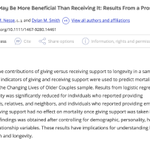
In one study, older adults who regularly gave support to others were more likely to be alive five years later than those who didn't. The association remained even after researchers accounted for demographics, health, personality, mental health, and relationship quality.
Living longer isn’t just about taking care of yourself. It’s also about taking care of other people.
It probably has something to do with meaning/purpose.

We often assume that when we're suffering, we should turn inward and focus on healing ourselves. This study disproves that notion.
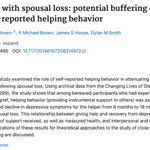
After losing a spouse, people who spent more time helping others experienced a faster decline in depressive symptoms than those who didn’t.
What if standard mental health practice encouraged people who were anxious or depressed not only to focus on healing themselves, but also to focus on helping others?

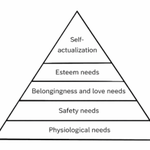
The “hierarchy of needs pyramid” you learned in school is wrong.
Here's what Maslow actually believed:

True happiness, Maslow suggested, didn't come from relentless self-fulfillment, but from self-transcendence: the act of reaching beyond the self towards something greater, moving from a life centered on perfecting the self to a life rooted in purpose and belonging.
I discuss how to move from self-actualization to self-transcendence in my newsletter, The Age of Self, which you can subscribe to here: maytaleyal.substack.com/
Relationships with AI are growing by the minute. Here's what you need to know:
The Center for Democracy and Technology found that 1 in 5 high schoolers has had a romantic relationship with a chatbot, while another survey found that 1 in 5 adults have used AI to simulate a romantic partner. 16% of American adults report using AI for companionship.
We're being handed the ultimate escape route from human friction: the opportunity to ditch humans altogether, and get into relationships with machines instead.
Even scarier: researchers at Stanford found that "even a single interaction with sycophantic AI reduced participants' willingness to take responsibility and repair interpersonal conflicts, while increasing their own conviction that they were right."
"Why do you want to shut out of your life any uneasiness, any misery, any depression, since after all you don't know what work these conditions are doing inside you?" — Rainer Maria Rilke, Letters to a Young Poet
These days, it’s not enough to simply be true to who you are.
Rather, life’s purpose has become about continuously refining who you are. It involves the ongoing analysis of one’s needs and desires; the relentless pursuit of optimization; the perpetual questioning of Am I happy enough? Am I fulfilled enough?
It is a never ending hamster wheel of self-improvement, where we’re forever chasing a dangling carrot of utopic personal fulfillment.


Shocking finding about attachment styles:
The popular sentiment is that our attachment styles were set early. If you grew up with a cold or inconsistent parent, you internalized that template and have been unconsciously replaying it ever since.
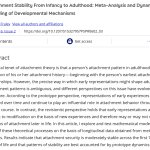
But in one long-term study, researchers found that attachment at age one and age six were fairly similar (r = .67). By age nineteen, that connection had dropped significantly (r = .27). And by ages 30, 40, and 50, that early imprint became even less predictive.
In other words—by the time your 30, 40, and 50, the early years with your parents have very little impact on your attachment style.

The idea that we must love ourselves before we can love someone else tends to get the sequence wrong. More often, it works the other way around—it is in the act of caring deeply for others that we come to recognize our own worth.
Everything you think you know about attachment styles is probably wrong.
Here’s what the research actually says:
The takeaway here is that we’ve fallen into a pattern of taking complex psychological ideas, flattening them into simple stories, and swallowing them whole as therapeutic truisms without questioning them, or grappling with their nuance.
A pattern that is doing us no favors, especially in how we understand and navigate our relationships.
For more therapeutic musings and cultural insights, check out my newsletter: maytaleyal.substack.com/