

Defense Researcher / Engineer @RANDCorporation | future tech, drones, air defense, Russia-Ukraine war | Husband, father, skier | Views my own. RT ≠ endorsement.
Joined March 2009
- Tweets3.1K
- Following567
- Followers4K
- Likes24.7K





Pinned Tweet
So I got a lot of questions about the A-50U and Russia. Here is an update that explains why these aircraft are so important for air defense. I'll also explain why Russia won't be getting replacements anytime soon
Airborne Early Warning and Control (AEW&C) aircraft are basically flying quarterbacks. They are able to see farther than most sensors. They can talk to almost everyone. Their crews can control many assets.
This all comes down to understanding the curvature of the Earth. The figure with the Red and Gray "blobs" is an annotated image of the reasonable area a radar can cover. Most radars must have a line of sight to the target. Because of the curvature of the Earth, a surface radar can only see a low flying object 10 to 20 miles away. An airborne radar can potentially see it from over 200 miles away.
This has two major implications. The first is it provides much earlier warning. Up to an hour for a strike drone and 10 to 30 minutes for a cruise missile. The second is it covers a much larger area easily replacing a dozen or more surface radars.
This means those ground radars can stay turned off until they need to target a missile. A radar that is turned off is much harder to find as there are no radar emissions to detect.
This line of sight advantage extends to communications as well. These aircraft have crews specially trained to control air and ground assets. They see and talk to almost everything.
Ukraine has spent considerable effort hitting these on the ground and the air. They take a lot of time to replace. The last A-50 was produced around 1992. Even with upgrades over the years, they have been out of production for a while. Note that the base IL-76 airframe is still produced, the radar requires special structures and reinforcements.
The replacement, the A-100, has still not entered serial production after over a decade. The radars are very expensive to build and require a lot of specialized parts. In 2025, Ukraine targeted one of the facilities with FP-1 drones, destroying the test aircraft and damaging the factory. Work has likely been on hold since.
New aircraft are unlikely for several years.
Russia is stuck with the half dozen or so they have for now. Basically just enough to protect Putin and occasionally help Russians fend off increasingly frequent Ukrainian FP-1 and FP-5 Flamingo cruise missiles. The fact Ukraine has sent UK Storm Shadow missiles at near max range into Russia shows how far these A-50U aircraft are kept from the front.
Until tomorrow. Have a nice Sunday.


Russia was able to use one of its last remaining A-50U airborne to provide aerial surveillance.
Its radar unobstructed by the curvature of the Earth was able to detect Ukrainian FP-5 Flamingo cruise missiles from far away and defeat them.
This employment is likely exploitable.
Ukraine spent significant effort over the past few years to destroy A-50 aircraft for this very reason. These are officially called "Airborne Early Warning and Control" AEW&C for a reason. There powerful radars can see far and their onboard crew is able to direct aircraft and other assets.
While the exact number operating is unknown, it is reportedly in the low single digits. You need 4 to keep one up 24/7 and with 7 you can almost keep 2 up 24/7.
Given Russia is now being tracked as using these, Ukraine can plan operations around them where before they had to take the risk the sircraft were in the air.
Now that Russia is using them, Ukraine's drone strikes will be less effective due to early warning, but Ukraine can also plan around it. It may be a wash in terms of air defense.
Examples of how social media is a Rorschach test.
Yesterday I made a post about Russian refinery capacity like I do every time there is a noticeable difference. I woke up to a lot of notifications.....
For those that are seeing this for the first time, I have a couple experimental OSINT collectors I have been working on. Readers assist by posting new sources and make suggestions.
An upfront reminder that per the Post-WWII United States Strategic Bombing Surveys (see reply) and subsequent studies, attacking a nation's refinery and petrochemical network is the most effective way to impact a war effort by degrading production and logistics. Either via bombing or sea interdiction.
My latest post was the first of my newest update that incorporated FIRMS satellite data into my existing system that was based on public reporting. It improved restart timelines to better match industry data. I always post 1 month at a time followed (pictured below) by a reply with a refinery-by-refinery list with sources.
One reader asked a simple question who didn't realize it was only for 1 month and asked about longer-term trends. I posted the second chart that started in January 2024.
Note that historical Russian domestic demand is in the yellow band.
In the longer chart you see the effects of a few 2024 hits plus planned shutdowns. In 2025, you see in full the effects of the fall 2025 refinery strike campaign that rapidly reduced Russian refinery capacity and maintained a constant reduction for several months before tapering off.
Ukraine's 2026 campaign was much more effective due to a combination of more effective and more frequent strikes. At the strike cadence, it reached a much deeper equilibrium.
@MalcontentmentT news does a great job of showing the region by region impacts on the fuel system. Every rapid drop such as Aug/Sept 2025 or May/July of 2026 shows a rapid system shock where distribution cannot adjust to the rapid decline. Fuel networks can't be rerouted fast enough, and export agreements can't be diverted quickly.
In the yellow band, the refinery networks are in a true deficit and either demand needs to fall or imports increase. Otherwise, you see localized outages. Check mid-to-late September maps from @MalcontentmentT .
The lower end of the yellow band is about how low demand has gotten when people tighten their belts. There is only so much reduction before demand cannot contract any further and you see factory shutdowns, etc.
This is standard assessment based on a variety of theories regarding large complex systems and supply and demand.
Ukraine's 2025 campaign was incredibly successful at disrupting refinery outputs to the point of disrupting long-term export contracts and local networks. The multi-month disruption helped ease battlefield pressure.
Ukraine's 2026 counter-refinery campaign reducing Russian refining to below the upper end of demand. The timeline was clearly a prelude to the success Operation Vivaldi that took advantage of reduced resupply and logistics to liberate occupied territory.
Ukraine devoted 1/4-1/3 of its strike capacity to this campaign. The remainder when to countering munition supply chains and large logistics facilities. Time will tell if they should have focused on the oil network. However, devoting the full weight of strikes against refineries likely would have caused the system to collapse.
I have used the strike campaigns to test AI tools I have been developing. These are to provide near real time OSINT data collection and processing. I try to post updates every 1-3 weeks per tool and plan to for the foreseeable future.
Reading the comments and quote tweets on yesterday's post was enlightening. There were a lot of "what does this mean". There were several that didn't realize it was a monthly snapshot showing a paused campaign. There were multiple "This supports Russia's narrative that strikes are ineffective", "This supports Ukraine's narrative that they will win", "This supports Russia's narrative that the cuts are too deep and harming X", "This supports Ukraine's narrative that they are helpless".
All four are contradictory and cannot be concurrently true.
At the end of the day, this is a war. Ukraine's strikes on Russia oil infrastructure are a proven strategy in modern war. Russia has done the same thing and already destroyed Ukrainian refineries. Ukraine has a land border with many refiners able to easily export. Russia does not.
We see the effects in the data.
I am just posting as accurate of data as possible in a world where we rarely see actual numbers.
xitter.cf/mbohnert/status/211393…


A brief update on the status of Russian oil refineries. As expected, production is up and now above Russian domestic historical demand.
I used the past 2-3 weeks to review and update my methodology. I found a few new reliable sources. I also included NASA FIRMS data directly into the model. For long time watchers, the net result was about a 0.3 mpd daily increase. Otherwise, little was changed.
The NASA FIRMS data has helped better pinpoint when refineries restart. Usually I can catch the flare, even during the day.

This is the post WWII US Strategic Bombing Survey report. I suggest you read it if you have the time. Very enlightening and highlights the effects of different targeting actions. airuniversity.af.edu/Portals…
A brief update on the status of Russian oil refineries. As expected, production is up and now above Russian domestic historical demand.
I used the past 2-3 weeks to review and update my methodology. I found a few new reliable sources. I also included NASA FIRMS data directly into the model. For long time watchers, the net result was about a 0.3 mpd daily increase. Otherwise, little was changed.
The NASA FIRMS data has helped better pinpoint when refineries restart. Usually I can catch the flare, even during the day.

I just love how Ukraine keeps finding uses for helicopters. For years we keep hearing about the loss of relevance on the modern battlefield. Yet again we keep seeing how high capacity rotary wing aircraft provide cargo flexibility and can operate almost anywhere.

Global first strike to any coastal city via low cost UAV.
Long endurance UUVs are more than just capable undersea platforms. We have seen what Ukraine has done with semisubmersibles in the Black Sea: disabled the Russian Black Sea Fleet. Ukraine has performed some UAV strikes from USVs as well.
UUV launched UAVs would have the advantage of the target having less time to react due to less early warning of the UUV.
The low cost makes this approachable to many states and even some non-state actors.
I’m glad I live inland.

Test of drone launch from the Australian unmanned underwater vehicle Ghost Shark.
Via @anduriltech
Michael Bohnert retweeted

Drones are speedrunning the history of military aviation: scouts, then bombers, then fighters to hunt them, then carriers and relays. And they keep branching into classes aviation never had.
Everything gets tested in combat. Only what works survives.


An anchor can hold billions of dollars of undersea infrastructure at risk. Attribution is often impossible.
Undersea infrastructure is one of the most consequential and least understood arenas of strategic competition.
97% of global communications run on roughly 300 underdefended cables. Fewer than 25 repair ships exist worldwide. Europe receives half its gas from Norway through a single undersea pipeline and chokepoint. The cross-sector exposure is on the order of $10 trillion. There are many single points of failure.
Low barriers to entry (an anchor can do real damage), delayed effects, poor observability, and chronically weak attribution make this domain cognitively different from others. A cut cable is known immediately; a damaged one may fail weeks or months later. Legal authorities are poorly defined outside catastrophic cases.
In a new RAND report, Winning the Undersea Knife Fight, we outline a deterrence framework structured around three interdependent variables: the level of attribution, the choice to reveal or conceal capabilities or knowledge, and the selection of actions ranging from passive defense to vertical escalation. Higher attribution enables more options; lower levels constrain responses to avoid unnecessary escalation.
Deterrence in the undersea domain is fundamentally different from conventional, nuclear, space, and cyber deterrence. The lack of sensing and information in the battlespace and low density of assets are defining factors.
Advantage accrues to states that can rapidly understand incidents, credibly demonstrate detection and response capabilities, and calibrate actions to shape adversary behavior without precipitating escalation. 1/

Good timing foe thos story. Here is an example of a system that is great for capabilities. At the same time, even though it has long endurance, searches by systems like these are slow. xitter.cf/thewarzonewire/status/…

Ghost Shark Extra-Large Uncrewed Underwater Vehicles’ Payload Bay Seen For First Time
Ghost Shark will deploy aerial drones, lay mines, and execute seabed resupply missions as part of Australia’s new undersea arsenal.
twz.com/sea/ghost-shark-extr…

The decision framework maps attribution level against reveal/conceal choices and available actions so operators and strategists can test options without defaulting to either pure denial or uncontrolled escalation.
For the full Winning the Undersea Knife Fight report:
rand.org/pubs/research_repor…

For my other reports on harnessing private sector innovation for defense, cruise missiles, and other analysis at @RANDCorporation see
rand.org/about/people/b/bohn…

Michael Bohnert retweeted

As someone that studied SAR for my master’s thesis, the fact that Russia chose a SAR satellite to mess with is kind of cool. Obviously I condemn the action, but ICEYE must be causing them a lot of trouble to do this.

Cosmos 2612 has been maneuvering closer to an ICEYE SAR satellite. Using OEL, I created these visualizations to help understand what’s going on.
The animation shows a 3D RIC frame animation of the recent motion
The second figure shows how individual parameters evolved over time. You can see that 2612 matched the orbital plane of the SAR satellite and closed the in-track separation.
The third figure shows that between gaps in TLEs the motion of 2612 changes in an unnatural manner. This indicates that a maneuver occurred.
The last figure shows 2D cuts of the 3D animation.
What do you think it’s up to?


This is a militarized space equivalent of a child playing the "I'm not touching you" as they move their finger incredibly close to your eye.
Getting this close and being this overt is not an inspection, it is signaling. It is demonstrating that COSMOS 2612 could hit ICEYE at any time.
Here is the problem, if the two satellites collide, you could get the Kessler Effect/Kessler Syndrome. The Kessler Syndrome is when space debris is created that keeps colliding in an uncontrolled manner. This could render that and other orbits unusable for a very long time.
This is a very dangerous action as one mistake has global implications for generations.
Nice work by @HamWa07 to stay on this and report so well. Do watch his video.

🛰️ Right now, a Russian satellite is flying in close formation with a Western commercial-ish radar satellite, and makes another close pass in the next ~10 minutes.
COSMOS 2612 has matched orbits with ICEYE-X36, a Finnish-built commercial-ish radar (SAR) satellite. They're circling the planet together under half a kilometer apart, making a close pass almost every orbit (~95 min), the next one around 01:38 UTC (18 Oct), every one at essentially zero relative velocity.
Being upfront: at these separations (sub-km, down to tens of meters), the exact distance is below the precision of public tracking, so treat specific metre figures as indicative. What ISN'T ambiguous is the orbit match and the ~0 m/s closing. This is deliberate, controlled formation flying, the behaviour associated with close-up inspection, not a chance conjunction (collision).
And it's targeted. Cosmos 2612 is the ONLY one of a six-satellite cluster (Cosmos 2609–2614) to have maneuvered: it raised its orbit in the public data ~47 km, drifted into phase with X36, then dropped back to settle alongside it. The other five never moved.

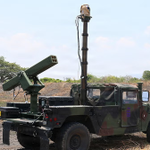
The Vampire system is probably the most cost effective existing solution against cruise missiles and high-speed jet drones. Here is why.
For those new to the system, it takes existing battle tested Hydra 70 mm rockets with seekers and off-the-shelf optics to make a capable SAM out to a few kilometers. It has optional integration with Link-16 for network coordination, electronic warfare systems for jamming+passive detection, and modern radars. The whole package can be mounted on any vehicle or physically deployed in a container.
The biggest advantage of these and similar systems is the off-the-shelf nature. The Hydra 70 rockets are an upgrade from a 1940s design with newer propellant that has been upgraded in 1972. It has a very proven track record with multiple producers of compatible rockets including the Canadian CRV7 and Turkish Cirit. Further, there are more than a half dozen seeker options by different developers. That is a very diverse supply chain by defense standards.
The cameras are also relatively common with multiple possible vendors. These could be stripped from other legacy military and commercial systems if necessary.
Latest costs are reported in the $20,000-$30,000 range per missile. This is a cost advantage over jet OWA drones.
Given that it can be put on the back of standard pickup trucks and small boats really lowers the threshold for force integration and costs. Defenses can be rapidly moves around populated areas for local point defense.
The small size of the rockets allows dozens of reloads to be carried in the truck. The ~25 pound weight also means a single person can reload the system. This is a major advantage over larger SAMs.
These systems can be stored for years in a compact form and deployed only when needed to defend cities.
A less mentioned advantage is it can be fired against ground and maritime targets. Same vehicle can provide defense against almost any mid-tier threat.
Its biggest drawback is lack of range. While Hydra missiles have a high peak velocity sufficient to stop cruise missiles, it has sufficient energy/g's over limited ranges ~1 km. Its range is longer versus lower speed Banderols and Geran-5s but jet drone interceptors can defend a wider area against those threats.
I expect more competitors soon, but the VAMPIRE and similar systems will likely be a very common battlefield and city defensive system. These are a "write the check" solution to jet drones.
Ukraine needs more and so will the West.


For more information on VAMPIRE and similar systems l3harris.com/all-capabilitie… en.wikipedia.org/wiki/Hydra_… and en.defence-ua.com/news/how_m…

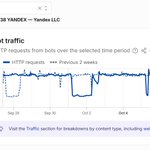
Ukrainian strikes on Yandex and Sber data centers are eroding Russia’s compute and data sovereignty.
These facilities do far more than host AI models. They handle large-scale data storage and retention, enable information flows between companies, and support corporate research, fraud detection, digital security, and the smaller services that keep everyday systems running.
Sber’s Balakovo site is not a minor backup. It is a multi-year expansion project intended to more than double Sber’s capacity. Construction began years ago and still has phases remaining.
Data-center equipment currently carries multi-year lead times. Replacing or expanding capacity at scale requires capital and time Russia is unlikely to spare. Russian businesses and government entities will face growing pressure to contract these services from outside the country.
The practical result is a further loss of domestic data-center and compute control. Chinese providers are the most likely to absorb the displaced demand. Looking at the included chart shows the top 10 countries with data center capacity. Russia isn't there. This is another concrete example of Russia continuing to fall behind in critical digital infrastructure.
Figure from @IDCAorg


This is the perfect example of military engineering.
As a defense engineering research, these types of creative adaptations are what I love seeing.
The camouflage is spot on. The angles are covered and the shape matches the flatness of the terrain. Even though the tank was made larger, the camouflage pattern broke up the characteristic dimensions.
Characteristic dimensions are the measurable aspects distinctive features of the system. The are often what is detected first and critical for classifying a target (realizing it is an armored vehicle) and identifying a target (it is an Abrams tank).
On this grassy terrain, the characteristic feature length has gone from the length of the tank to either the vertical height of the treds or the tank barrel. Easily a 10X reduction. The biggest signature is the grass moving behind it.
The cage has great separation from the vehicle with no clear angling that matches the angles of the tank nor direct positioning. An off-angle explosion does less damage.
As I have mentioned before, the biggest drawback isn't the limited mobility of the turret. It is lack of 360 degree firepower. I assume they have cameras on the sides to get 360 degree views.
These tanks must operate as part of a team. Either drones in the air, drones on the ground, or people. Given these are support vehicles, likely not a problem. However, it does make command and control slightly more complicated as the tank has to keep better dynamic positioning relative to its peers.
Overall, one of the better tank mods seen to date.
Finally, the biggest surprise is I didn't realize any Abrams tanks were still functioning in Ukraine.

And here is another video that includes a Bradley modified the same way xitter.cf/NOELreports/status/210…

Ukraine’s CODE 9.2 launched a mechanized raid toward Anishchyne and Vodiane, using a tank and Bradley equipped with specially designed anti-drone protection to fire directly on Russian forward positions. Reconnaissance and Vampire attack drones covered the armored vehicles, while a CODE 9.2 FPV intercepted and destroyed a Russian FPV approaching the tank. The unit says all objectives set by 475th Separate Assault Regiment commander Oleksandr Nastenko were achieved. #Ukraine