

Exploring the history of the medieval world. 🏰📜
European Union
Joined March 2010
- Tweets26.9K
- Following1.2K
- Followers10.1K
- Likes1.7K


Medieval History retweeted

Basílica de San Martiño de Mondoñedo (Lugo, Galicia). Considerada como la Catedral más antigua de España. En el S. IX fue sede de dos obispados. La iglesia actual es fruto de varias etapas constructivas comprendidas entre los S. X y XII.
⬇️⬇️⬇️
arteviajero.com/articulos/ba…

Medieval History retweeted

During it's long history, the Tower of London was home to some notable prisoners. There would be escape attempts made, some of them successful including Ranulf De Flambard, the widely hated Bishop of Durham, who made a daring escape in 1101 and the infamous Roger Mortimer who escaped during the reign of Edward II and later allied himself with Queen Isabella. One attempt that wasn't successful was that of Gruffudd ap Llywelyn ab Iorwerth with Matthew Paris describing the Welsh Prince's demise in 1244;
"Though his wife had received permission to visit him, yet he was deeply affected by the tedious and unaccustomed long imprisonment, and meditated much how he could escape from the place of his confinement. One night, then, having deceived his gaolers, and made a cord out of his sheets, tapestries, and table-cloths, he let himself down perpendicularly by means of the same rope from the top of the Tower. And when he had thus descended some distance, from the weight of his body, the cord snapped, and he fell from a great height; for he was a big man, and very corpulent; and in this way he broke his neck, and died; and his pitiable corpse was found in the morning near the wall of the Tower, and afforded a lamentable spectacle to all who saw it, as his head, together with his neck, was almost buried in his breast between the shoulders. When the king (Henry III) heard of it, he scolded and punished the guards for their negligence, and ordered that the son of the said Griffin, who had been incarcerated with his father, should be forthwith more narrowly guarded. The said Griffin, who fell from the Tower, as has been stated, died on the 1st of March."

Medieval History retweeted

In Torah portion Va-yetze (וַיֵּצֵא), we are told that Jacob slept at a place and dreamt of a ladder with angels ascending and descending.
#ParashahPictures
BL Add 27210; the 'Golden Haggadah'; 14th century; Spain, N.E.; f.4v @BL_HebrewMSS

Medieval History retweeted

In the 15th century, the Duchy of Burgundy emerged as one of Europe’s wealthiest, most culturally brilliant and politically powerful states. Ruled by a branch of the royal House of Valois, it operated virtually as an independent power between France and the Holy Roman Empire.

Medieval History retweeted

Gate in Volterra, Etruria by Alexander Alexandrovich Svedomsky.
Art Prints: archaeologyart.shop/products…

Medieval History retweeted

Our friends at @afc_journal have launched their own podcast - listen to the first episode 'A Day in Constantinople' at afterconstantineacademy.onli… #Byzantine
Medieval History retweeted
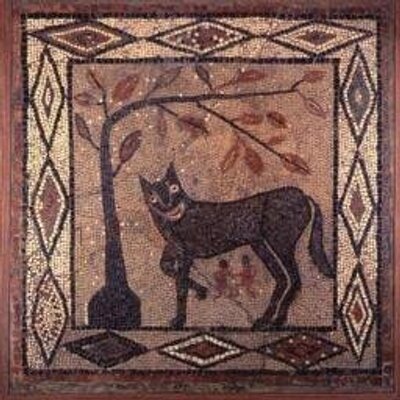
Today October 11th was the day of the Meditrinalia. It was a celebration of the tasting of the first new wine of the autumn vintage. The wine was offered to the gods as a libation. The Romans were more than happy to raise a glass to the benefits of wine

Medieval History retweeted
In 1428, the English laid siege to Orléans, a strategically vital city on the Loire. Its capture could have opened the way into southern France and crippled the cause of the Dauphin, Charles. Instead, the siege would become a turning point in the Hundred Years’ War.


Medieval History retweeted

Roman concrete could repair its own cracks.
Some Roman buildings have stood for 2,000 years, while modern concrete can start to crumble within decades. For a long time, scientists did not fully understand why.
The Romans made their concrete from lime, water and volcanic ash from the area around Pozzuoli, near Naples. The ash reacted with the lime and created a material that grew stronger over time instead of weaker.
In 2023, a team from MIT led by Admir Masic found another piece of the puzzle, small white lumps of lime scattered through the concrete.
Scientists had always thought these lumps were a sign of careless mixing. In fact, they were the repair kit. When a crack forms and rainwater gets in, the lime dissolves and refills the crack with new mineral, sealing it from the inside.
The secret was “hot mixing.” Instead of using slaked lime, the Romans added quicklime directly to the mix. It heated up as it reacted with water and left these lumps behind on purpose.
To test the idea, the team cracked samples of concrete made with the Roman method and let water run through them. Within two weeks, the cracks had sealed completely. In concrete made without the lime lumps, the water kept flowing.
Roman harbour concrete went even further. Pliny the Elder wrote that once it touched the waves, it became a single block of stone that grew stronger every day. In 2017, geologist Marie Jackson showed he was right, seawater slowly grows rare crystals inside the concrete that hold it together.


Medieval History retweeted

The rivalry between Leonardo da Vinci and Michelangelo Buonarroti was a famous clash of titans in Renaissance Florence, fueled by a 23-year age gap, contrasting personalities, and opposing artistic philosophies. Leonardo viewed painting as the highest, most intellectual art form based on nature and science, whereas Michelangelo considered sculpture the supreme art of revealing divine form trapped inside stone...
In 1503, the Florentine Republic staged one of the greatest artistic face-offs in history by commissioning Leonardo da Vinci and Michelangelo Buonarroti to paint massive military victory murals on opposite sides of the Council Hall (the Salone dei Cinquecento) in the Palazzo Vecchio. Leonardo was tasked with depicting the Battle of Anghiari, while Michelangelo was assigned the Battle of Cascina. The setup forced the two Renaissance titans to work practically shoulder to shoulder, fueling an intense rivalry driven by their starkly different personalities and artistic philosophies.
Their personal interactions were famously hostile. Leonardo, older and refined, favored delicate oil techniques and detailed anatomical observation, while the younger, hot-tempered Michelangelo believed true art lay strictly in sculpture and powerful, muscular human forms. Contemporary accounts record fierce verbal spats in the streets of Florence, where Michelangelo openly mocked Leonardo for never completing his projects, most notably a colossal horse statue in Milan. Working in the same hall only amplified this clash of egos, turning the project into a public spectator sport for the city's artists and citizens.
Ultimately, neither artist ever finished their fresco. Leonardo attempted an experimental oil technique on the wall that failed catastrophically, causing the paint to run, while Michelangelo was summoned to Rome by Pope Julius II before he could begin painting. Although both original masterpieces were lost or destroyed over time, the preparatory sketches each master left behind were praised as the "school of the world," forever defining the height of the High Renaissance.
While their rivalry is legendary, few realize that Michelangelo’s giant paper plan (cartoon) for his side of the wall created an unexpected logistical challenge: measuring over 1,200 square feet and made of more than 400 individual sheets of paper, it took five full days just to glue together. When Leonardo’s attempt to dry his wall experiment with braziers caused his paint to melt into a dripping mess, Michelangelo was unable to exploit the setback because he was abruptly summoned to Rome, leaving behind only his giant paper design, which local artists enthusiastically carved up into collectible study fragments.
#archaeohistories

Medieval History retweeted
In this stunning 13th-century French illumination, the Archangel Michael and his celestial host cast the Devil and the rebellious angels from Heaven, plunging them into the fiery jaws of the Hellmouth.


Medieval History retweeted

This ancient greek tombstone, adressing passersby in first person, describes the death of Aphrodisios, who died "the most pathetic death" because of his wife, "a dirty adulteress" and her secret lover, "who threw me from the heights like a discus"


Medieval History retweeted

Pour celles et ceux qui me suivent, vous aurez remarqué mon très grand intérêt pour Le Caravage.
Voici La Madone des palefreniers (1605-1606), exposée à la Galerie Borghèse, à Rome - avec ce noir qui fige cette scène représentant Marie et l'Enfant Jésus en train de tuer le serpent du péché originel en présence de sainte Anne.

Medieval History retweeted
A poignant detail from Domenico Ghirlandaio’s Adoration of the Magi, c. 1485. The kneeling child symbolizes one of the Holy Innocents—the infants of Bethlehem killed on King Herod’s orders. His white tunic contrasts starkly with the tiny drops of blood on his arm and neck.

