

Building company brains, autonomous agents, and sharing what I learn on YouTube 34K+ ↓
🇫🇷
Joined September 2016
- Tweets188
- Following544
- Followers3.1K
- Likes119
Pinned Tweet
The model is replaceable. The company’s knowledge is not. This is the architecture I use to make that knowledge compound.
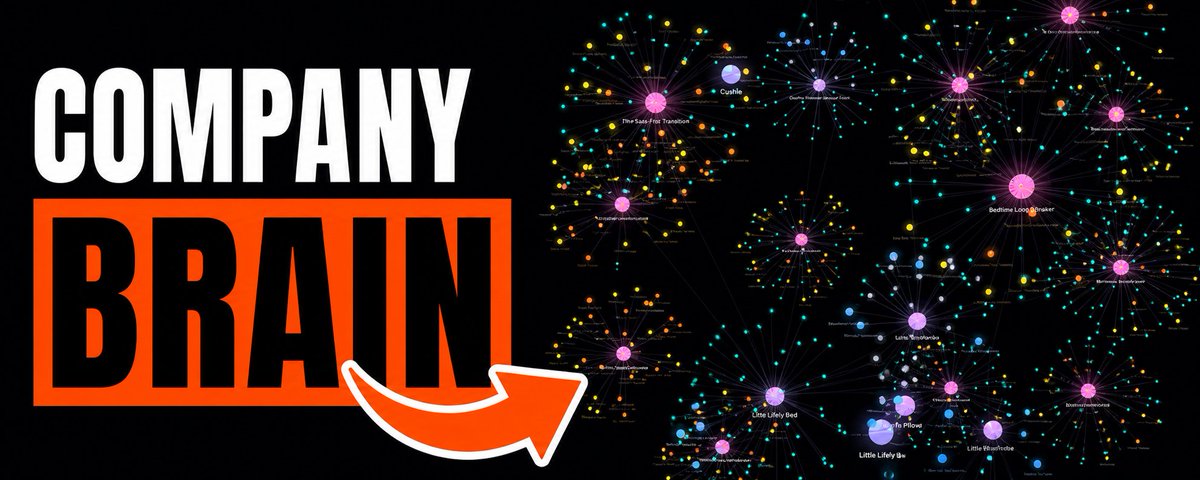
AI skills need more than instructions.
They need clear discovery, progressive disclosure, and a learning loop.
Here is the complete framework for turning them into a business learning system.

Learn how to make your AI agent smarter over time in 38 minutes:
Skills are how agents keep the process, tools, context, and lessons from previous work.
They can be one simple Markdown file or a complete system with scripts and databases.
And this works in Claude Code, Codex, OpenClaw, or whatever agent you use.
These are the 21 parts of the system:
00:00 Intro
02:09 Where agents live
03:10 Inside the agent workspace
04:18 What happens when you send a message
05:10 Progressive disclosure
07:30 How the agent finds the right skill
09:30 Where skills are stored
11:24 The simplest skill, and how complex it gets
13:30 A look inside my real skills
15:43 Skills that point to other skills
18:26 Core skills
19:55 System skills
20:47 Platform skills, one per tool
23:16 Tool skills and team skills
27:01 The three ways a skill is triggered
28:29 Simple, linear, and branch skills
29:20 Active and passive skills
30:15 A complex skill, the Market Research Engine
31:35 How I build and test a skill
33:12 Databases inside skills
34:26 Where the best skills come from
37:44 Skill Forge
One AI agent runs the daily work of a 40 to 50 person company.
The whole team talks to it in Slack. It holds the company's knowledge and it's connected to 55 tools.
After 9 months building these inside real businesses, I think everyone is debating the wrong question. Full architecture below.

I build AI agents for a living and share everything I learn on YouTube.
I've been building e-commerce brands for my clients and myself since 2017.
In 2020 I started building automations for everything I could.
When GPT3 came out, my focus shifted to AI automations, with tools like Make and n8n, I was creating systems to automate different parts of my clients's marketing.
Until late 2025...
When I started building my first agent.
Within weeks it took over everything I was doing.
It reframed completely my work and what I think is possible.
Since then, I build and operate agents full time:
For myself: a general-purpose agent that orchestrates my entire business. Research, scheduling, email, content, and client coordination.
For my wife: an agent that manages her entire coaching business. Social media, content planning, scheduling, and admin.
For my clients:
General-purpose agents deployed inside 7-8 figure e-commerce teams. Used daily by dozens of people for market research, content production, ad operations, and reporting.
Single-purpose agents: autonomous customer service agents handling tickets across email, chat, WhatsApp, and Instagram. Running live on Gorgias, answering customers in 3 languages.
I believe every person and every business should have their own agent. A real agent with identity, memory, and skills that grows with you over time.
YouTube is where I share what I'm building, what I'm learning, and what breaks along the way.

Deploying an AI agent in your business is a high risk, high reward decision.
High risk because we do not fully understand what these systems will become.
High reward because the people who start now will compound knowledge while everyone else waits for certainty that will never come.
First movers move faster. They take more market share. They build understanding their competition will spend years catching up to.
But you do not hand over the keys on day one. You climb a ladder.
I call it the Trust Ladder. Three levels.
Level 1: The empty shell.
You set up an agent. It knows nothing about your business. You give it information about yourself, your company, your market. You connect it to external tools. Market research APIs. Image generation. Web search.
It is already useful. It generates content, answers questions, helps you think. It is better than anything we had access to 6 months ago.
But it is generic. It works with what you feed it manually. It has no context about your actual business operations.
Most people stop here. They use agents as fancy search engines.
Level 2: Read access.
This is where it gets interesting. You connect the agent to your sensitive business assets. Your ad account. Your Shopify backend. Your CRM. Your analytics.
Read only. It cannot touch anything. It can only look.
But now it sees everything. Your revenue numbers. Your ad performance. Your customer conversations. Your inventory levels. Your email campaigns.
It combines data across platforms that your team currently checks one by one. It spots patterns no human has time to find. It generates marketing assets grounded in your actual data instead of generic templates.
The team starts thinking with it instead of just asking it questions. Because now it knows what it is talking about.
This level is where most of the value already lives. An agent with read access to your business is a team member who has read every document, checked every dashboard, and remembers all of it.
Level 3: Write access.
The final level. The agent can now act on your sensitive business assets.
Create ad campaigns. Update product listings. Draft customer responses. Adjust inventory. Send emails.
This is where everything changes. The work your team does manually every day gets supercharged. Not replaced. Supercharged.
Because the agent does not just have tools. It has the full context of your business combined with the ability to act on it. When you configure the information architecture properly, it connects data from every platform, processes it, and executes with all that context available at once.
No human can process that much information simultaneously. The agent can.
But you earn this level. You do not start here. You watch it operate at Level 2. You verify it understands your business correctly. You build trust through evidence, not hope.
That is the Trust Ladder.
Empty shell. Read access. Write access.
Each level requires a conscious decision. Each level increases both the risk and the reward. Each level compounds on the one before it.
The business owners who climb this ladder now will be operating at Level 3 while their competitors are still debating whether to try Level 1.
That gap does not close. It widens.

Access is the new teaching: This is why AI agents don't need onboarding
You probably think you need to teach an AI agent about your business. Your brand voice. Your customers. Your processes.
Wrong.
You need to give it access. It will teach itself everything it needs.
We gave an AI agent access to a helpdesk via API.
100's support macros.
Thousands of solved tickets.
Real customer conversations.
It figured out the brand voice on its own. The exact tone the team uses with frustrated customers. The phrases that de-escalate. The structure of a great response.
But it went further than that.
It found the deepest pain points customers have. Patterns buried across thousands of tickets that no human had time to synthesize. It figured out where the product communication was falling short and how to improve it.
Nobody taught it any of this. It processed the data and built its own understanding.
Now imagine giving it access to more.
Your customer reviews across every platform. It reads thousands of them and extracts what people actually love, what they complain about, and the exact language they use to describe both.
Your team's Slack conversations. It understands how decisions get made internally, what questions come up repeatedly, where communication breaks down.
Your Shopify backend or your CRM. It sees every product, every order pattern, every customer segment. Not as a dashboard you glance at. As context it holds permanently.
Your email communication with customers. It learns how you sell, how you follow up, how you handle objections. Then it does it for you in the same voice.
Every new data source you connect multiplies what the agent can do. Not because you trained it. Because you opened the door.
This is the shift. Access is the new teaching.
Before agents, all of this data existed but it was impossible for any human to process it all at once. The reviews sat in one place. The tickets in another. The Slack conversations in another. Nobody had the bandwidth to read everything and connect the dots.
The agent can. It processes volumes of data that were simply inaccessible to us before, and it builds its own knowledge from it.
You still need to guide how it organizes that knowledge. That is the part agents are still missing. The structure, the information architecture, the hierarchy of what matters. That is your job.
But the raw understanding? The patterns, the voice, the insights? It creates all of that on its own from access alone.
Give it access. Let it learn. Guide the structure. Then build on top of everything it discovered.
That is the new way of creating value for businesses.

After a few days with Clawdbot, I start seeing the flaws:
- Context management is a pain
- The long term memory is not performing as expected (keeps forgetting things)
- The "black box" file system makes it difficult to track where stuff goes
- Not as "pro-active" as I expected
But it's incredibly great at figuring things out without feeling technical.
Feels like a glimpse of the future. Just not quite there yet. Really interesting.
Lovely feeling: going to bed knowing that my Clawdbot is going to spawn an army of sub agents to run Claude code and build me an app while I'm sleeping.
Curious to see the result tomorrow

The only problem is our brain processing limit.
I might not be as smart, because to me working with 4 agents at the same time max out my own context windows

When anyone can be generated, no one can be trusted.
Just a matter of time before people stop believing ads entirely.

I can't believe it was so easy
Claude code just set up n8n self-hosted for me from A to Z
It just asked me to create the account on @Railway and login.
If you want to do it too, let me know in the comment, I'll send you the Claude Code skill I just made 👌


Thinking of building a Claude Code Marketing Kit for solo devs.
Plug into your codebase , it'd auto-generates:
- Market research
- Personas
- Landing pages
- Content you can post
- And way more...
All from your actual product, happening in your IDE
Who’s interested?
Veo 3 vs Veo 3 fast
I just ran a test to compare the two models side by side to create a 9:16 video ad.
Veo 3 is 3x more expensive, but the output is much better.
But if you are not careful you could miss the details.
Time to complete is mostly the same.
Amazing tool in the end
Steph France retweeted

Marketing can't fix your cash flow problem.
I learned this the hard way working with DTC brands. Here's the painful reality most agencies won't tell you 👇
Most founders think they need an original idea to win.
They don’t.
The fastest way to launch a SaaS that gets customers is to steal what’s already working… and make it better.
Here’s the 6-step playbook I just broke down in my new video:
1. Find a market that’s already in motion
Growing or stable markets with real competition are gold. No competition = no customers.
2. Learn the pain points cold
Dig into forums, reviews, comments. Use AI to pull the exact words customers use.
3. Study the solutions that exist
You’ll always find competitors. That’s good — it means there’s money being spent.
4. Pick your move
> Copy what works (ethically)
> Differentiate by audience, marketing channel, or business model
> Innovate (only if you can afford the risk)
5. Run a smoke test
Make the product look real on a landing page. Drive traffic. Collect data. Build a waiting list.
6. Drive traffic intentionally
Outbound for B2B. Inbound for B2C. Paid ads if you want to move fast.
By the time you launch, you’ll have:
A proven market
Messaging in your customers’ own words
Real people ready to buy
Full breakdown with examples here: youtube.com/watch?v=TNZKykgP…
Everyone is chasing the same SaaS markets.
That’s why your “great idea” is drowning in competition before you even start.
I’ve found a way to flip that.
In my latest video, I show you a step-by-step framework to find SaaS ideas hiding in plain sight
The ones big players have overlooked, but that have demand, high CPCs, and room to grow.
Here’s the short version:
1.Start with an evergreen problem.
Every business problem on it can spawn 10+ overlooked SaaS opportunities. Pick one that interests you.
2. Validate demand before you commit
Use tools like Keywords Everywhere + Google Trends to find search terms with volume and growth.
Example: “employee recognition software” → 4K searches/month, rising fast.
3. Find the big players in that niche.
Search “best [tool type]” → list the top companies → check traffic with SimilarWeb.
4. Unbundle their features.
Many “all-in-one” tools hide single features that could be their own SaaS product.
5. Specialize by industry.
Instead of a generic “PTO tracker,” build “PTO tracker for healthcare shift work” and you become the category of one.
I used this process to uncover 8 untapped SaaS ideas starting from just one HR problem.
You can repeat it forever.
The post above is enough to get you started
But in the full video, I walk you through the exact prompts, steps, and examples so you can do it yourself.
Watch it here: youtube.com/watch?v=qurl9nqW…