








Miki 🇪🇷 retweeted

Delighted to announce that my new article on Christian monasticism in western Arabia during the 5th-8th centuries is now published in Arabian Archaeology and Epigraphy: doi.org/10.1111/aae.70035.
I will be uploading the accepted version online once the embargo period ends.

Miki 🇪🇷 retweeted

talk about missing the obvious. the entire parables is enoch having visions of a distinct figure from himself until his ascension when he, still identified by a different title, has the messianic description of ዘተወልደ ለጽድቅ (born for righteousness). has he never read paul?

Clearly you have not read the text carefully. Yes, 71:14 uses ወልደ ብእሲ, but that is the same expression used for the exalted Son of Man in 62:5 and 69:29. Thus, 71:14 applies to Enoch the exact expression already applied to the eschatological Son of Man. So the lexical distinction you’re trying to make simply doesn’t work. But more importantly, context determines whether the expression is generic or messianic, and the context of 71:14 deliberately points back to the previously described eschatological Son of Man (cf. 46:3), not merely to “human offspring.” Watch the video you’re commenting on to learn more.
“When I hear any question dealt with by the Maphrian [St. Gregory Bar Hebraeus], it seems to me as if I were learning wisdom at the mouth of Aristotle, his great aim being to propound sound sense, not troubling about the sophisms which the teachers of our own times are apt to be obsessed with."


“The reason for which we are said to have become heirs of the curse and of condemnation and of death is not that the sin and condemnation and death passed to us, as if these fell to our nature by lot, for man's nature was from the beginning free from all these things, but that the method by which intercourse takes place derived its origin from sin, as I have said, a method which cut away the blessing of immortality, so that the race of men is preserved from dissolution by the procreation of children. We therefore were in consequence born mortal from a mortal father. These things are defined both by the holy John in the Commentary on the Epistle to the Romans, and by the holy Cyril in the letter to Succensus.”
— St. Severus of Antioch, Letter LXXVIII, to Conon the Silentiary.

Miki 🇪🇷 retweeted

If I deserve hellfire then tell me what Leo deserves for affirming quite literally the same thing in your screenshots of Nestorius.


Okay, so this was not the thesis of the video.
The video goes through various aspects of Nestorius’s Christology:
- the Theotokos-Antropotokos-Christotokos variance,
- his expression of two hypostases/physis
- his expression of two ousiai/physis
- his expression of one person.
- his expression of one hypostasis if it meant one person.
- his rejection of Cyril and Eutychius.
- his acceptance of Leo, his Tome, and Flavian.
The topic of the Theotokos is a small part of the whole.

The dispute over the title “Mother of God” precipitated the Nestorian controversy, but it was never the be-all and end-all of the issue. To reduce the controversy to that one title is revisionism, and Agen now seems to have unfortunately adopted precisely that revisionist line.
The real issue was, is, and remains Nestorius’ doctrine of the union in Christ: not a true hypostatic union, but what amounts to a merely moral conjunction of the divine and human. The dispute over Θεοτόκος was a mere symptom of that deeper Christological defect.

And Agen’s end point is that: Nestorius teaches one hypostasis when it is used for one person in the sense used in the Trinity, and two hypostases when it is used in the sense of a fully individual substance bearing its own individual and common properties.
Which is rather exactly what Theodoret explains to John of Aegea in his letter concerning his subscription to the creed of Chalcedon.
“Therefore, I do not generally seek this office for utility or propriety, nor can I, as is commonly thought, pride myself on so exalted a seat. Rather, I lament within myself that I bear no trace of apostolic perfection. I tremble not at touching this holy throne but at suffering while seated upon it. Let him who would glory in apostolic honors and jurisdictions conduct himself as an apostle and burn with zeal for the faith amid dangers. Otherwise, let him be mocked, for he wears a lion's skin
but is a tomb full of dead bones, whitewashed only on the outside (Matt. 23:27). How shall I, seated on the throne of Ignatius the God-bearer, attain his stature?
Does water differ from fire? My lax life is nothing like his fervent, heavenly one. I say nothing of Hippolytus, that bishop and martyr, whose perfection Rome sent us as a reward for Antioch's aid when Ignatius went there, suffered martyrdom, and strengthened the Christians. Let us flee vain glory, brothers, and at all times know ourselves. ‘For those who know themselves are wise’, as the proverb says. Let us despise the fleeting honors of this world and look to those that are eternal.”
— St. Severus of Antioch, Homily [9] on St. Gregory of Nazianzus and St. Basil the Great, delivered in the sanctuary of St. Ignatius of Antioch.


Miki 🇪🇷 retweeted

At just 12 years old, St. Mohrael chose Christ over earthly freedom, marriage, and even life itself. Her courage in the face of persecution remains a powerful witness to Christian faith.
Read her Akathist: orthodoxreflections.com/akat…

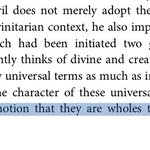
In a video concerning the ignorance of the hour and the day in Christ, @mattjhedges11 states that the Agnoetae were heretics, not for their belief in a real ignorance of Christ's humanity, but rather of his divine nature.
But is this true? The answer is *it is not*.*
I will further explain this down the thread 🧵.
1/11.

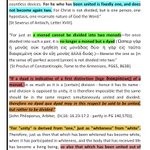
This is further reinforced by his letter to Pope St. Theodosius, wherein he states that he regards Christ as 'ignorant' and 'not ignorant' in the same way he regards him as 'passible' and 'impassible.' That is, ignorant and passible in his humanity, and omniscient and impassible in his deity.
Thus, on this basis, he undercuts @mattjhedges11's interpretation of the matter based on Isidore's rather faulty understanding of the matter.
7/11.


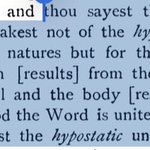
Coming back to the video, Matt makes a statement about how the Reformed and the Agnoetae teach different doctrines (see the screenshot). But seeing what I have shown in this thread, there seems to be no actual difference at all. At least not a meaningful one.
Link: youtu.be/WJcDAS4lmu8?is=hdMA….
I think this suffices for now. I have noticed a faulty reading of St. Cyril [among others] as well in the video, so I will make another moderate thread on his reading of the biblical proof texts on the topic.
11/11.
