
Building Opinr, an opinionated framework for running teams of AI agents → https://teapawt.net/t.co/Wfg4W4nQWK · Xbox gamer · Creator of https://teapawt.net/t.co/xpTWxhGO5o
Nantwich, England
Joined July 2018
- Tweets475
- Following199
- Followers159
- Likes1.3K




I spent five review rounds on one kind of bug: making sure an AI agent's late answer can never reach the wrong person.
It's in Wheems, my open-source framework for running teams of AI agents. Every round found one more path for a late answer to slip through: a stop that failed, a status check that errored, an error halfway through a turn.
In the end the fix was simple. If Wheems can't prove a turn is over, nothing more goes into that session.
When agents answer people for you, a reply going to the wrong person is the worst thing that can happen, so it was worth all five rounds.
14
Wheems is out. I shipped 0.1.0 to npm on Sunday and 0.1.1 this morning, and it's the first version that does what I set out to build.
Wheems is my open-source framework for running teams of AI agents. I talk to a chief of staff in Slack, and it gets on with the job in Claude Code or Codex, starting and managing sessions of its own.
Releases publish themselves. Merging a version bump makes GitHub run the checks, publish to npm through trusted publishing with provenance, tag it and write the release notes. There's no npm token stored anywhere.
The picture is the docs on wheems.dev in dark mode. It's an early preview, and they say plainly it isn't ready for real use yet. Next is a local web app, starting with a clickable mockup.
Until now my agent setup was hand-built around me. This is the first version anyone else can install. This is still very early days.

6
2
69
A test I'd put down as flaky on macOS CI turned out to be a real race, and it could have hit anyone running Wheems on a slow disk.
Wheems is the framework I'm building for running a team of AI agents. Before typing into a new agent session it pauses, but the pause was counted from before the session was set up. A slow disk could use all of it up, so the second message arrived before the agent had started.
The fix counts the pause from launch, and the test simulator now holds typed text until the program starts, as a real terminal does.
I'm glad it showed up in CI first, before it showed up on someone's machine.
1
24
I gave Claude and Codex the same architecture brief for Wheems and let them work blind. They agreed on nearly everything.
Wheems is the agent framework I'm building, for running a team of AI agents. Both landed on the same single building block, the task: one written brief, one fresh session, one written result. Delegation, workflow steps and AI-vs-AI comparisons all fall out of it.
Comparing two models' answers has been so useful to me that it's now built into Wheems itself.
3
1
116
My agent framework is now called Wheems, and I moved everything over in an afternoon with three agent sessions running side by side: one on the code, one on the website and one on Cloudflare.
Wheems (it used to be Opinr) is the open-source framework I'm building for running a team of AI agents. The repo, the npm name, the GitHub org and the site all moved, and opinr.dev now redirects to wheems.dev. It's named after Wheems, the baby robot in *batteries not included, because it's a batteries-included framework.
The clip is the new hero on wheems.dev in dark mode. Someone asks Wheems to close out March, the little clouds head off to three example jobs, the newsletter job stops to ask for approval, and then it's all done. It's pure SVG and CSS with no JavaScript, and the site still scores 100 on every Lighthouse category.
After weeks of naming dead ends, it finally has a name I like.
5
1
94
The brand came from Claude and Codex designing side by side over four rounds. The winner is a little cobalt cloud with a crew of tiny clouds.
The picture is the final brand board, showing which parts came from which: the cloud's shape and the Manrope type from Codex, and the way it runs off the edge of the app icon from Claude.
Wheems isn't released yet, but you can follow the build with the weekly build log on wheems.dev.

28
The font I picked in my video app's brand settings never reached a single animation. My brand uses a rounded font, and every animation had quietly come out in SF Pro or Arial with nothing telling me.
The app is the Mac app I'm building to go from script to finished YouTube video, and it draws its animations with Remotion. Remotion renders in its own copy of Chrome, which can't see the fonts installed on a Mac.
The fix was to ship eight open-licence font files with the app and copy the chosen one into each project, so the font I pick is the one that ends up on screen.
Ever been caught out by a tool quietly falling back to a default font?
2
45
The hard part of giving my AI agents search by meaning was stopping them answering confidently when nothing matched.
I added it to Opinr, the open-source framework I'm building for running a team of AI agents. Every embedding model scores unrelated text differently. On nomic-embed-text, related passages score 0.6 to 0.8 and unrelated ones 0.4 to 0.55, so each model driver states its own floor, and this one's is 0.5.
Next are skills and a review command, then a full day of using it for real.
It all runs on a free local model in Ollama, so my agents can find what they already know without my notes leaving the machine.
4
1
59
Animations in the Mac video app I'm building used to mean an AI coding agent writing fresh animation code in Remotion every time. Now there's a library of eleven templates in my own brand, and the AI only has to fill one in with words.
The app takes you from a script to a finished YouTube video. The clip shows five of the templates animating in: a title card, numbered steps, a checklist, a before and after, and an end card.
Each one renders in 2 to 3 seconds, at 16:9 and 9:16, where before it took a whole coding session.
Next come looks (Clean, Bold and Editorial), starter brands for people with no branding of their own, and then the AI picking the template itself and only calling a coding agent when nothing fits.
I wanted animations in my own brand without sitting through a coding session for every title card, and now I've got them.
43
Recorded my first real video start to finish with the Mac app I'm building, and it came out well. The app takes you from script to finished YouTube video.
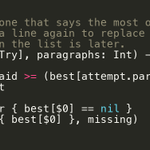
It keeps the best take of each paragraph by itself: the one that says the most of the script, and the latest of those, since people say a line again to fix it. The screenshot is that rule, a few lines of Swift.
I built it so I could make videos without spending hours editing, and this was the first time it did the whole job for real.

3
58
I prefer opinionated frameworks, but not so opinionated that I can't see what's going on.
If it all happens under the hood, that's too far. The other extreme is a framework that lets you build anything any way you like, which leaves every decision to you.
1
40
I've tried the agent harnesses: OpenClaw, Hermes Agent and Grok Bot.
OpenClaw I found hard and tedious, and I never really knew what I was doing. Hermes was much better, and I got real work done with it. But it still isn't how I picture an agent harness.
1
44
Grok Bot is the opposite. Everything just works, but you can't see what it's doing, and it has limits. You can show people how to use it, but not put it into a business with security rules to meet.
None of them fit me, so I'm building my own: Opinr. opinr.dev

4
How it fits together: one workspace per business or area of life, kept apart. Each has a chief of staff you message from Slack, its own knowledge base, and skills scoped to it.
The agents are Claude Code, Codex and opencode, unchanged, each live in its own Herdr terminal.
1
47
Guardrails for AI agents belong outside the agent. That's the first rule of Opinr, the open-source framework I'm building for running a team of AI agents.
Right now my safety checks are Claude Code hooks. They work, but Codex and other coding tools ignore them, so they only protect me while I use one tool.
In Opinr, agents never hold keys. A broker holds them and asks me before anything risky, and GitHub rules and git hooks do the rest. Whichever tool an agent runs on, the same rules apply.
10
5
130
I named my agent framework Opinr this morning. By lunchtime one of my agents had built milestone 0 in its own @herdrdev tab while I watched.
Opinr is the framework I'm building for running a team of AI agents, on top of Herdr, the app I run all mine in. It goes open source once milestone 1 works.
The screenshot is opinr doctor checking the setup. It starts a real test session in Herdr, sends it a message, waits and reads the reply back.
My own agent setup works, but it's hand-built around me. Opinr is so anyone can set one up.

1
154
MikeDeeming retweeted

ETB GIVEAWAY
The 30th Celebration ETB was a hit, so we're giving one away.
To enter:
Follow @ChaosCards
Repost this
Reply with your favourite Pokémon
Closes 11:59pm 7th Sept. Winner announced 8th Sept.
This is our only giveaway – any other "Chaos Cards" draw is fake. We'll never DM asking for card details.
T&Cs in the reply below. UK, 18+.

MikeDeeming retweeted

🚨POKEMON 30th ANNIVERSARY ETB GIVEAWAY🚨
How to enter:
Follow @MagicMadhouse✅
Like & Repost This Post 🔁
Tag a friend 🫂
UK ONLY
Winner will be chosen on September 16th
Good luck!
