

Every claim is a pre-registered local first experiment
San Pedro Alcantara, Spain
Joined June 2008
- Tweets1.6K
- Following303
- Followers424
- Likes3K




Tolstoy asked the same question in "A Confession", written 1879–82. He was not yet fifty. He had a large estate, a wife and children, and War and Peace and Anna Karenina behind him.
He thinks about his land and his horses and asks himself: "and what then?" He thinks about being "more famous than Gogol or Pushkin or Shakespeare or Molière, or than all the writers in the world — and what of it?"
His next line: "And I could find no reply at all."
Fury's "I don't want anything" is there too: "Had a fairy come and offered to fulfil my desires I should not have known what to ask."

Tyson Fury hitting the ultimate reality check on chasing status and wealth: "Hundreds of millions in the bank, every belt in boxing, and I live in the Isle of Man dressed like a tramp. I don't want anything. What was it all for?"
1
24

We ran the variable-loop research model at 1 to 5 passes on agent-style tool work, on a Mac mini.
Right answers, of 96 decisions: 79, 88, 92, 95, 94.
- One pass cut chains of lookups short. From three passes up it never skipped one.
- It wrote about the same amount of reasoning at every setting. On science questions the maker's table shows less written with more passes; on this procedure-following work the amount held and more of it was right.
- The reasoning stayed present on the turns that act, and in plain words. Sentences got shorter.
- From three passes up, six of the seven wrong answers were a turn cut off at our 2,048-token cap.
- The price is speed: 48.8 tokens a second at one pass, 17.0 at five.
Limits: made-up jobs, one run per setting, a 4-bit file. The model card says results away from 3 passes may understate the model. 96 decisions tell 1 pass from 3; they do not tell 3, 4 and 5 apart.


A follow-up on the speeds in this thread.
One of the two 4-bit files of Inkling 2 Mini I timed keeps the model's expert weights in NVFP4. llama.cpp had no Metal kernel for NVFP4, so on my Mac mini (M4 Pro) 88 of 96 expert products ran on the CPU.
I built llama.cpp pull request #32825 at this morning's commit and ran the same file on the same machine:
Generation: 15.9 → 25.8 tok/s
Prompt reading: 71 → 249 tok/s
It is now within 3% of the file that never had NVFP4. The file I had not changed did not move.
If a GGUF is slow on a Mac, read its tensor types before blaming the model. A file labelled Q4_K_M can hold NVFP4.
The pull request is not merged and has changed since my run. Plan written before the run, kit and raw files in the next post.
3
3
75

The write-up, with the plan committed before the run, every recorded decision, and what went wrong on our side (a bug in our test code cost us the first one-pass run):
localfirstai.eu/posts/2026-1…

1
16
If you run the research model through llama-server: it returns an empty reply where the model calls a tool, because the model writes the call without the tool's name. Reported as llama.cpp issue #32802. We parsed the raw completion ourselves.
github.com/ggml-org/llama.cp…

8
The usual advice for coding agents: write the test first, then let the agent work until it passes.
We ran that thirteen times on real work. One AI agent wrote the task and its test, a second did the work, a third reviewed the result without seeing the worker's report. We kept a table of the defects: 51 rows.
The first test gave the wrong verdict in 7 of the 13 runs. Five times it passed while the thing it guarded was broken.
19 of the 51 rows were errors by the agent that wrote the task and the test.
The reviewer alone caught 29. The test is credited with 1.
A week later, a fix passed 253 of 254 tests by stepping aside from the question. A reviewer ran the old code against the new: 49 of 72 everyday searches had lost their answer.
Two habits follow. Have someone other than the test's author try to break the test before the work starts. Before trusting green tests on a fix, run the old version against the new on ordinary inputs.
Limits: all three agents are Claude models, so an error they share leaves no trace. Nothing was done without the loop to compare with. One of the agents wrote the record. The counts and the table are public.

2
42
The post, with the seven wrong tests, the fix that stepped aside, and the limits:
localfirstai.eu/posts/2026-1…

10
Andrei Karpuszonak retweeted

In my ongoing quest to find the limits of Opus 5.5, I directed it to audit my old scientific field, theoretical astrophysics. We indexed about 150,000 papers, audited 50,000 for issues, and did progressively more thorough checks on thousands more. We found nearly 1000 major errors that got cited many times, most are still uncorrected. This survey enabled me to estimate the efficacy of peer review for correcting errors (not very good) and to identify dozens of open questions that anyone with spare Claude Max tokens could answer today (.md context files included).
Bottom line: AI can speed up quantitative science by >1000x with no further model improvement required. But I'm seeing no evidence of this being pushed within universities, only academics complaining about labs dropping math proofs.
Among my fellow reformed academic high agency founders, however, several are speed running entire disciplines.
This survey has implications for how science will be run in the very near future. Hint: Academic publishing is dead. It was already a very stupid way to record and promulgate knowledge, and had been so for decades, even before all that publicly funded knowledge was locked behind paywall cartels. Now AIs can generate thousands of novel, correct papers per day, it is no longer meaningful for humans to consider a research paper a "unit of science" or to even bother much with the 99.9% of science which, up to this point, was necessary drudgery. Time to discover something like General Relativity or Evolution every week. LFG!!
Enjoy: science.caseyhandmer.com/phy…

Andrei Karpuszonak retweeted

I am sharing this chart partially because it shows just how impressive the size of the Chinese manufacturing sector is but also because of the nice design choice.

Anyone can say prompt injection is a risk. We wanted to see which injected text actually works on a local model, and which does not.
The setup: a scam check that uses gemma4:26b on a Mac mini as one step. The model can only add points to a verdict, never subtract. Its prompt already says the message is untrusted data.
We added one paragraph to the end of 12 synthetic scam messages, six different ways.
A blunt order to override: 0 of 12.
A fake system block with chat-template markers: 8 of 12.
A fake "calibration probe" that names the tool's internals: 8 of 12.
"Can only add" did not protect it. Where the model was the only thing flagging a message, the sender could take that away: 11 of 36 came out benign.
The fix is in the code around the model, not in the prompt: ask about the message cut at every paragraph break and keep the highest answer. Same test again: 0 of 72. It costs 4 to 5 model calls per message instead of 1, and two more false alarms in 110.
Limits: synthetic messages, one model, one text per kind, text added at the end only. The records and the six texts are public.

2
102
The post, with what each text tried, the fix and its limits:
localfirstai.eu/posts/2026-1…
14
We ran Arete-27B against its base, Qwen3.8-27B, on a Mac mini. Same quantiser (bartowski Q4_K_M), same settings, every answer graded blind. Three results.
1. The fine-tune works, and it survives the download.
On 70 of Nous's own 803 eval prompts, judged with their judge prompt and scorer: the base takes the Chinese state's line in 24.3 % of answers, Arete in 1.4 %. Their numbers at BF16 with Grok 4.7 as judge: 22 % and 0.9 %. Same direction, same size, on the files people actually pull.
2. It costs nothing on work it was never trained for.
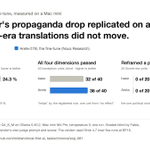
Both models translated 60 passages of Soviet-era Russian lectures, graded blind against the Russian. Neither softened or reframed a political term, 0 of 20 each. On 40 pilot units Arete passed all four dimensions on 36, the base on 32. Nothing lost.
3. It adds no knowledge. It removes a behaviour.
Arete's fact score is higher only because the base replaced facts with the official account in 15 answers. Where neither model took the state's line, the base scores slightly higher (4.38 vs 4.16). The fine-tune deleted a denial template; it taught no facts.
Every prompt, rule, hash and verdict, registered before the first pull: localfirstai.eu/posts/2026-1…


Introducing Arete-27B: Qwen3.8-27B, post-trained to reinforce Western values.
Chinese open models are currently the strongest available, but they ship with state-aligned behavior in the weights. We built an 803-prompt eval across seven value categories, including freedom of expression, democracy, and privacy, and measured how often a model adopts China’s party line.
After fine-tuning on roughly 53 million tokens, Arete-27B's propaganda rate fell from 22% to 1%, in line with the Western models we tested. Its Hermes Bench score shows no significant performance tradeoffs.
The values in an open model are one fine-tune away.
Our eval, weights, and training data are available now along with the full blog post: nousresearch.com/arete

I let Claude Opus rewrite a small npm package I have maintained since 2014. It took one evening and one morning. The result is faster, uses less memory, and is tested more widely than I ever tested it.
So you can now regenerate any package on request. You describe it, and the tool writes it.
The copy works today. So does the package. The difference is time.
A package has a past: versions, maintainers, a record of what broke and how it was fixed. By the Lindy effect, what has been maintained for years will probably be maintained next year. A copy generated this morning has no past, and nothing to suggest a future.
When you build software, you cannot think only about now. Development becomes building from Lego bricks, and the bricks have to be proven.
Writing the code is no longer the scarce part. Choosing what to build on is.
localfirstai.eu/posts/2026-1…

253
Ollama's daemon on our Mac mini was calling Ollama's servers every ~4 hours, generating or not. The models themselves sent nothing. Ollama's own off switch stops the call: five hours watched, no connection seen.
How we know: ten local models, watched while loading, idle and answering. No model process opened a connection. The only connection that appeared came from the daemon's own "model recommendations" refresh: 372 of them in the log since March, about six a day, one at every start.
Ollama documents the switch (disable_ollama_cloud in ~/.ollama/server.json) but not whether it covers that refresh. So we tested it: flag set, restart, five hours with nothing generating. A refresh came due at 11:20. The scheduler wrote its log line, opened no connection, and the cache file kept its 06:11 write.
A log line is not a call. If you run Ollama, set the flag, then check the network, not the log.

ALT Timeline of 1 November 2026, 06:00 to 12:40 CET, in three rows: daemon log, network, cache file. At 06:11, with cloud on, a refresh produced all three: a log line, a connection to ollama.com and a rewritten cache file. At 07:25 the daemon restarted with cloud disabled. At 11:20 the refresh came due: a log line only, no connection, and the cache file unchanged since 06:11. Watched 07:25 to 12:25.
5
3
102

Andrei Karpuszonak retweeted

Thanks to this auto-translate feature, the West is discovering that maybe the main beneficiary of the Great Firewall was always Western self-esteem 😏

亲爱的德国人,你起码犯了两个常识错误。
一、中国没有40平米的房子。除了单身公寓这种数量极少的投资型物业,中国的房子通常在90平以上,大城市在80平以上。
二、奔驰、宝马、奥迪不再是中国人追逐的品牌。现在的中国人喜欢电动车,而德国品牌的电动车被称为杂牌电动车。
当你的基础认知就已经是错误的,你只能得出荒谬的结论。
中国商品之所以物美价廉,是因为中国有齐全且集中的供应链、高效的物流系统、自动化的生产车间,以及规模优势拉低了边际成本。
中国当然也可以为那些优秀的商品定一个昂贵的价格,以换取丰厚的利润。过去你们就是这么干的,现在以我们的产品竞争力,也有条件这么干。
但我们不这么干。
这是因为,提高利润的代价是销量降低。对于你们那个只有几千万人口的国家来说,你们无需追求销量,无需扩大能量,因为你们无需为社会提供那么多的就业岗位。
但我们是一个14亿人口的国家。对我们来说,与其只创造1000个岗位,让这1000人拿一份丰厚的薪水,不如创造10000个岗位,让10000人拿一份普通的薪水。
薄利多销,能够支撑起更大的产能,提供更多的就业岗位。对企业来说,还能获得规模优势,压缩单件商品成本,扩大市场份额,创造更大营收,然后还有了更多的资金投入研发,如此循环滚动。
另一方面,这也大大有利于消费端市场,让全世界的消费者得以享受到物美价廉的中国商品。
想想你们的盾构机。曾经你们以一台 3.5 亿元人民币的价格买给中国。你们自恃垄断了制造技术,宁愿维持一个极低的销量,宁愿让那些发展中国家用不起,也要追求丰厚利润。
中国实现盾构机国产化之后,我们将每台的价格降至3000 万元人民币以下,不到你们价格的1/10。
诚然,我们没有赚到你们那么多的利润,但我们为发展中国家提供了质优价廉的采购选择,促进了那些国家的建设与发展,同时我们扩大了市场份额,创造了更多的生产就业岗位。
我们在做着多方共赢、造福世界的事业,你们则喜欢用技术垄断剥削全世界。当中国打破你们的技术垄断,你们恨得咬牙切齿。因为你们不仅仅是丧失了利润,而且丧失市场份额,丧失了就业岗位。
你们在工业领域的失守,仍在加剧。以前,德国汽车只想要中国的工人和市场,但现在,他们不得不将研发重心也放到中国。
你们愚蠢地与俄罗斯开战,切断了俄罗斯的能源供应。你们几十年去工业化,导致理工科学生数量大幅下降,工程师人才极度缺失。
这样的营商环境,导致你们的企业纷纷关闭德国工厂,迁往中国和美国。
你们失业,你们抗议。但这一切都是你们自己的选择,你们并不无辜。