
PhD @Mila_Quebec working on science⇄llms
Montreal, QC
Joined December 2017
- Tweets348
- Following617
- Followers353
- Likes589




This is an important problem that IMO is under-addressed because of how difficult it is to measure. Unlike most physical sciences, we can measure things fully and losslessly, but distilling this into measurements that are both interpretable and meaningful is the real challenge.

In film, "we'll fix it in post" is what you say when something went wrong on set and you don't want to redo it. AI research has made it our entire methodology: train the model, then patch whatever comes out. Our new ICML oral argues this can't be the basis of a science of AI. 🧵

4
13
1,722


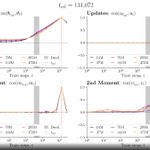
Strange things are afoot in the geometry of LLM training dynamics. This is looking at alignment between weights/updates/moments throughout training. Anybody have relevant works they could point me towards?

So it turns out that you can find most of these on common crawl! mirandrom.github.io/bourdain…

There's something bitter sweet about seeing people online, like the creator of this compilation, try and find these lost pieces of Bourdain old.reddit.com/r/AnthonyBour…
598
Today I realized how ephemeral the Internet can be. Anthony Bourdain had ~30 li.st posts between 2015-2016 of which almost half are, so far, lost. Which is a shame. Luckily, the other half have been recovered and compiled here: bourdain.greg.technology/

1
172
There's something bitter sweet about seeing people online, like the creator of this compilation, try and find these lost pieces of Bourdain old.reddit.com/r/AnthonyBour…
"Road to the stars" was an absolute trip. It's a soviet film released right after Sputnik in 1957. Not sure how to describe it except as something between documentary, science fiction and propaganda... but it's unlike anything I've seen before. youtube.com/watch?v=9CX0oSjw…

7
274
Starts off cozily depicting the early life of Tsiolkovsky, the "founding father of modern rocketry and astronautics", as a mildly autistic/eccentric scientist with a single-minded passion and a love for children and teaching en.wikipedia.org/wiki/Konsta…

64
Point in case: "Insurers retreat from AI cover as risk of multibillion-dollar claims mounts" archive.md/SpAV5
There's a bottleneck to AI progress I haven't seen discussed: cost of errors. As companies try to apply AI to more economically valuable tasks, they're inevitably going to run into a long tail of increasingly costly errors. Easy to patch and move on for chatbots. Less so here.
1
1
301
Had a great week at the kick-off workshop for @SimonsFdn Collaboration on the Physics of Learning and Neural Computation.
So many brilliant people working on fascinating problems with a genuine passion for science. Thanks @SuryaGanguli and all the PIs for organizing!

New paper with the headline that AI generated abstracts are better than human-written abstracts. Super cool work, but a lot of people will latch onto that headline to ride the hype train, missing the fine print on expert vs non-expert differences.

(5/n) ‼️Results:
When the source of the abstract is unknown, authors perceive AI-written abstracts as more submittable with a lower intent to edit them, as compared to their human counterparts, which were taken from the original publication.
But:
Strong heterogeneity exists through research experience: Experts (PhD students) think the opposite; they feel no need to edit the human-written abstracts, whereas they extensively edit the AI-written ones.


Great example of the misalignment that can emerge between AI for science paths of least resistance and the actual, messy problems bottlenecking progress.

You have heard of AI slop in the context of short video creation. But the same principle applies when it comes to improving drug discovery: we absolutely do not need a deluge of new hypotheses; we need better predictive validity (as per @JackScannell13).
writingruxandrabio.com/p/wha…

On my way to Toronto for the week, and then Stanford the week after. DM me if you want to meet up and chat LLM learning dynamics or LLMs for science!
2
225
I'll be giving a talk on loss deceleration and zero-sum learning today 1PM EST for the Montreal MLOpt seminar series. Zoom link in thread!
mtl-mlopt.github.io/talks_en…
1
4
210

Are there any good resources on the history of science behind COVID-19 vaccines? Like what discoveries and innovations built on one-another, ultimately allowing us to so rapidly develop effective vaccines now. And how science policy/institutions/incentives influenced this.
4
227
e.g. I learned from youtube.com/watch?v=XPeeCyJR… that one of the earliest, foundational discoveries was in 1971 where researchers showed you can inject rabbit RNA in frogs to produce rabbit proteins, because why not (paper: sciencedirect.com/science/ar…)
77
There's a bottleneck to AI progress I haven't seen discussed: cost of errors. As companies try to apply AI to more economically valuable tasks, they're inevitably going to run into a long tail of increasingly costly errors. Easy to patch and move on for chatbots. Less so here.
I gave a talk on LLM zero-sum learning dynamics last week at MSR Montreal. I went over a few things that were not in the paper but that I'm particularly excited about; one of those is the connection between generalization and zero-sum learning. youtu.be/UyK3DgWY7yw
Getting the raw data from wandb logs to make your own plots can be a 🥙. Afaik it's not documented and downloading plot data from their API/UX can be finicky for larger plots. Here's a little util script I wrote to parse the protobuf from logs: github.com/mirandrom/zsl/blo…

3
168
Fun fact (unless you're a beaver), but beavers are also economically valuable as a Catholic loophole for eating meat on lent. I guess. Found this out at Nymphenburg palace in Munich where they one had a dedicated beaver keeper just for that.
scientificamerican.com/blog/…


Rich Sutton on iterating single step prediction for multi step problems: "it's a trap". Two reasons. 1) Prediction is fundamentally an approximation and imperfect -> compounding errors. 2) Search space is combinatorial -> intractable in longer horizons.
youtube.com/watch?t=1176&v=L…

243
reposting this bc it's cool and I never got to share these visualizations of how language modeling embeddings evolve throughout training. what I find crazy is that we have this super powerful/expressive, billion+ parameter backbone that we just slap a linear classifier on top of.
things get weird when there is a long tail. frequent tokens spread out to occupy the n bases of your embedding space, and the remaining infrequent tokens concentrate in a narrow hypercone. you can see this in the evolution of 3D PCA and 2D cosine similarities through training
1
2
200