

Performance & Resilience Architect · Senior Java / Spring Boot · Kafka, Kubernetes · Open to remote and on-site work in Germany, Europe and other countries
Rostock, Deutschland
Joined June 2008
- Tweets1.8K
- Following907
- Followers267
- Likes87.2K



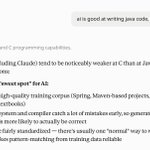


Well-known problem, AI have problem with legacy code bases too.

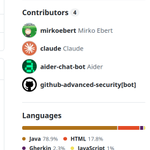
Netflix engineers saw that coding agents struggle with large Java projects, searching text but missing types, dependencies, and structure.
JetBrains builds IDEs that know Java code inside out. Together, the two teams brought that understanding to coding agents.
19
24 hours to recover from an outage? That's a missing resilience test. Chaos engineering, fault injection, circuit breakers and decoupling have been proven for 10+ years. My take on Microsoft's Nov 12–13 outage:
mikro-on-software.blogspot.c…
#ChaosEngineering
13
If you'd like to hear me speak on the topic of resilience and AI, come to DubJUG in Dublin on December 10, 2026.
ti.to/dublin-java-user-group…

23
This was not only an AI failure. This was a an incident by design.
AI Coding Agent Powered by Claude Opus 4.6 Deletes Production Database in 9 Seconds cybersecuritynews.com/?p=148…

1
10
State of AI coding 11/2026
What happens in this year:
- AI coding is going full throttle, the first stage of experimenting is over
- The amount of code is growing faster, code generation is accelerating
- Cheaper code finds the way to "less important" fields like mining, construction, health care and agriculture
mikro-on-software.blogspot.c…
1
15
Software development is growing

More than 40% of pull requests on @github now start with an AI agent. 🤯
Just six months ago, it was 17%.
We’re watching software development change in real time.
But the interesting part isn’t just who’s writing the code. 🧵👇
5
Mirko Ebert retweeted

AI tools aren't a replacement for engineering expertise. They are a force multiplier for it.

Mirko Ebert retweeted

The most difficult part of Software Engineering was never writing the code.
It was decision-making.
All developer who using successfully AI for coding where already highly skilled developers before.
14


Mirko Ebert retweeted

“The most important single aspect of software development is to be clear about what you are trying to build.” — Bjarne Stroustrup
Mirko Ebert retweeted

Nvidia CEO Jensen Huang on Germany:
"Nothing pains me more, frankly, than to see one of the most technologically advanced countries to be left so far behind in technology.
And I think the reason for that is this: maybe it's the European way to overthink everything.
Germany has so much talent. Just get to work."


Coding is not the bottle neck in software development.

A retired NASA engineer who had worked on the Space Shuttle program for 25 years was hired by SpaceX at age 62. He described the first week as the most disorienting experience of his professional life.
At NASA, a design change required 3 meetings, 2 committees, a review board, and 6 to 18 months of documentation. At SpaceX, his new supervisor said "if it works, build it. If it doesn't, change it by Friday."
He sat at his desk after the first day and called his wife. He told her he felt like a man who had been swimming with ankle weights for 25 years and someone just cut them off. He could move. He could decide. He could build something in the morning and test it in the afternoon. The constraint that he had accepted as the nature of aerospace engineering turned out to be the nature of bureaucracy.
Within 6 months he had contributed to more design iterations than he had completed in his last 5 years at NASA. Not because he was working harder. Because the time between having an idea and testing the idea collapsed from months to hours. The same brain. The same knowledge. A different operating system.
He described a specific moment where he proposed a modification to a Raptor engine component. At NASA, the proposal would have entered a queue. At SpaceX, the modification was machined by the end of the day and tested by the following morning. He watched his idea become a physical object in 18 hours. At NASA, 18 hours would not have been enough to schedule the first meeting to discuss whether to schedule a meeting.
He told an interviewer: "I didn't get smarter when I went to SpaceX. I got faster. The intelligence was always there. The system was in the way."
The difference between SpaceX and NASA is not talent. NASA has extraordinary talent. The difference is the time between a thought and a test. SpaceX compresses it. NASA elongates it. The same engineer produces 10x more at SpaceX than at NASA because the bottleneck was never the engineer. It was the meetings about the meetings about the work.
8
Mirko Ebert retweeted
“The value of a prototype is in the education it gives you, not in the code itself.” — Alan Cooper

