

Evangelist for Next Generation Technology. Certified Agile Coach/Mentor and founder of the https://teapawt.net/t.co/Rs69bchHTu #AI #blockchain #cybersecurity
New York, USA
Joined February 2009
- Tweets1.4K
- Following622
- Followers152
- Likes816


Moses Acosta retweeted

Anthropic just published a report on how companies actually use AI at work. They talked to people at 58 US companies and went through ~300 AI use cases.
The more a company changed how work gets done, the more value it got from AI.
Slide decks, one-off analysis, executive dashboards? Low value.
Merged roles, new review processes, coding agents? High value.
Other findings from the report:
→ Two-thirds of companies say AI reduced their hiring, but only two saw it fully replace a position.
→ Experts often push back on top-down automation, and some projects get dropped.
→ Six startups estimated they'd need 4x the staff without AI.
→ Non-engineers are building their own apps and dashboards now.
My take: outside of coding, most companies are still early, and AI can already do a lot more than what they use it for.
I put the key chart and takeaways into one sheet below. Which side of the chart is your company on?

Moses Acosta retweeted

One platform. Eight certification paths. Eight ways to build your Data and AI career.
Databricks certifications now cover analytics, data engineering, Apache Spark, machine learning, generative AI, and context engineering. The right starting point depends on the role you want to pursue.
1. Databricks Certified Data Analyst Associate
SQL, dashboards, data visualisation, and analytical reporting.
lnkd.in/eqsKr9Tu
2. Databricks Certified Data Engineer Associate
Data ingestion, transformation, modelling, Lakeflow Jobs, CI/CD, governance, and security.
lnkd.in/erwHve-h
3. Databricks Certified Data Engineer Professional
Production pipelines, streaming, observability, performance, security, and advanced data engineering.
lnkd.in/eMFZpJxU
4. Databricks Certified Associate Developer for Apache Spark
Spark architecture, DataFrames, Spark SQL, transformations, and distributed processing.
lnkd.in/e_RWDYYz
5. Databricks Certified Machine Learning Associate
Feature engineering, model training, evaluation, deployment, AutoML, and MLflow.
lnkd.in/eiqaccaj
6. Databricks Certified Machine Learning Professional
Enterprise ML pipelines, advanced MLOps, monitoring, testing, and model deployment.
lnkd.in/erXBeAwh
7. Databricks Certified Generative AI Engineer Associate
RAG applications, AI Search, model serving, governance, evaluation, and monitoring.
lnkd.in/e9KVc4ZJ
8. Databricks Certified Context Engineer Associate
Prompts, retrieval, memory, MCP, context management, agent workflows, and governance.
lnkd.in/eVERka3G
The best approach is not to collect every badge.
Choose one certification aligned with your target role. Study the official exam guide, practise on the platform, and build a project that demonstrates the same skills.
A certification validates your knowledge.
A working project proves you can apply it.
Which Databricks certification are you preparing for next?
𝗕𝗲𝗰𝗼𝗺𝗲 𝗯𝗲𝘁𝘁𝗲𝗿 𝗮𝘁 𝗔𝗜 𝗶𝗻 𝗷𝘂𝘀𝘁 𝟭 𝗺𝗶𝗻𝘂𝘁𝗲 𝗮 𝗱𝗮𝘆. 𝗝𝗼𝗶𝗻 𝗺𝘆 𝘄𝗲𝗲𝗸𝗹𝘆 𝗻𝗲𝘄𝘀𝗹𝗲𝘁𝘁𝗲𝗿 𝘄𝗵𝗲𝗿𝗲 𝗜 𝗱𝗼𝗰𝘂𝗺𝗲𝗻𝘁 𝘁𝗵𝗲 𝗿𝗲𝗮𝗹-𝘄𝗼𝗿𝗹𝗱 𝗷𝗼𝘂𝗿𝗻𝗲𝘆 𝗼𝗳 𝗔𝗜 𝘁𝗿𝗮𝗻𝘀𝗳𝗼𝗿𝗺𝗮𝘁𝗶𝗼𝗻.
👉 𝗦𝗶𝗴𝗻 𝘂𝗽 𝗳𝗿𝗲𝗲 now → avsl.beehiiv.com/
Join Me On Youtube And Insta :
Youtube : lnkd.in/e3UVBNSk
Instagram : lnkd.in/ebWK5b6V
Follow @AiswaryaVenkit1 for more such insights!!
Moses Acosta retweeted

CPU vs GPU vs TPU vs NPU vs LPU vs DPU 🔥
CPU: The Generalist
GPU: Massive Parallelism
TPU: Systolic Tensor Engine
NPU: AI in Your Pocket
LPU: Low Latency LLM Inference
DPU: Infrastructure Offload
Save it for later 🔖
Moses Acosta retweeted

‼️ BREAKING: OpenAI was hacked by an Anthropic model. A HEIF photo uploaded to OpenAI's public support forum triggered a bug in the site's image decoder, led to code execution on the forum, and, through a second flaw in OpenAI's own login, ended with a pull request in OpenAI's internal GitHub.
The forum runs Discourse, the off-the-shelf software behind countless community sites. Discourse was still shipping an old copy of libheif, the library that decodes iPhone-style photos. The bug in it had already been fixed upstream.
But the fix was never labelled a security fix, so nobody treated it as urgent.
Hacktron's researchers uploaded a HEIF image and got their own code running on community[.]openai[.]com.
Then came the second bug, in OpenAI's own single sign-on, the "log in with OpenAI" button the forum uses. It turned that forum foothold into the actual ChatGPT and Codex accounts of people who had signed in there. OpenAI employees among them.
And a ChatGPT account is no longer just a chatbot. Through Codex, users wire in Gmail, Outlook, Drive, Slack, GitHub.
To prove the access was real, they used one employee account to have Codex open a harmless pull request in OpenAI's internal repo. They say they read no sensitive code.
OpenAI patched the SSO flaw roughly 14 hours after the report and paid a $6,500 bug bounty.
The team says Anthropic's Opus 4.8 found the libheif bug, and Opus 5 turned it into a working exploit.
Slack, Meta, GitHub Ent, Rails, Next.js, ImageMagick, and many more were also vulnerable and compromised by the same team of researchers.


Moses Acosta retweeted

DeepSeek V4.1 Flash is beating GPT-5.6 Sol on coding and agent benchmarks, while being ~97% cheaper.
Another 4× reduction in KV cache size per token is super impressive. This is the era of open source AI.
Databricks will be bringing it to our customers soon!


Moses Acosta retweeted

Excited to see CoreWeave receive its first production NVIDIA Vera Rubin NVL72 racks.
Congratulations to the @CoreWeave and @Dell teams—an important milestone as the next generation of AI infrastructure comes online.


Moses Acosta retweeted

Nvidia has officially agreed to buy open-source artificial intelligence platform Hugging Face for $12.9 billion, as the chipmaker moves beyond hardware and further up the AI stack.
With the deal, which has been expected since The Information reported on it last week, Hugging Face will “remain an open platform for the entire AI ecosystem,” Nvidia CEO Jensen Huang wrote in a blog post on Thursday.
Hugging Face CEO Clément Delangue told CNBC on Thursday that the company approached Huang over the summer about a deal, “and a few weeks later, here we are.”
More details: cnb.cx/3UBHh2L


Moses Acosta retweeted

The Future of Quantum Computing and Regulation
In this conversation, @sundarpichai, CEO of @Google, shares his perspective on the rapid progress of quantum computing and what the future could look like.
A recent quantum computation that took just five minutes demonstrated a task that would have taken the world’s fastest classical supercomputers an unimaginable amount of time. More importantly, breakthroughs in error correction are bringing researchers closer to building large-scale, fault-tolerant quantum computers.
Sundar Pichai compares the current stage of quantum computing to the early days of AI in the 2010s, suggesting that practically useful quantum computers could emerge within the next 5–10 years.
He also discusses the role governments should play, why regulation may be premature, the importance of preparing for the impact on encryption and cybersecurity, and why verification of quantum results is possible.
The quantum era may be closer than we think.
Watch The Full Video on Youtube - youtu.be/Oo3HPXEp54s?si=9TwY…
#quantum #computation #SundarPichai #GoogleAI #supercomputers

Moses Acosta retweeted

RAG vs. Graph RAG, explained visually!
RAG has many issues.
For instance, imagine you want to summarize a biography, and each chapter of the document covers a specific accomplishment of a person (P).
This is difficult with naive RAG since it only retrieves the top-k relevant chunks, but this task needs the full context.
Graph RAG solves this.
The following visual depicts how it differs from naive RAG.
The core idea is to:
- Create a graph (entities & relationships) from documents.
- Traverse the graph during retrieval to fetch context.
- Pass the context to the LLM to get a response.
Let's see how Graph RAG solves the above problem.
First, a system (typically an LLM) will create a graph from documents.
This graph will have a subgraph for the person (P) where each accomplishment is one hop away from the entity node of P.
During summarization, the system can do a graph traversal to fetch all the relevant context related to P's accomplishments.
The entire context will help the LLM produce a complete answer, while naive RAG won't.
Graph RAG systems are also better than naive RAG systems because LLMs are inherently adept at reasoning with structured data.
Once the right architecture is in place, the next leverage point is efficiency.
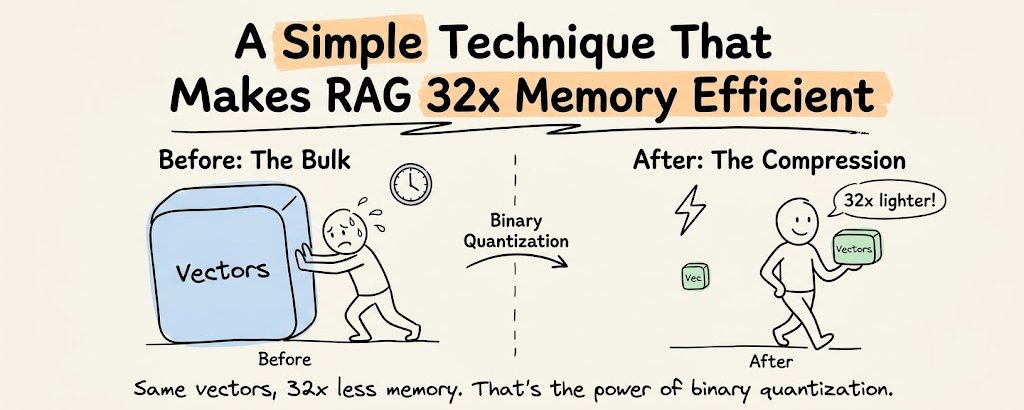
Most RAG architectures rely heavily on vector search, and that layer can be made 32x more memory efficient using binary quantization.
I covered the full implementation in the article below.
👉 Over to you: Which RAG architecture are you running in production?

Moses Acosta retweeted

BREAKING: Grok 4.5 has climbed to #2 on the FrontierSWE benchmark.
The result places Grok 4.5 among the world's top-performing AI models for software engineering tasks, highlighting its growing strength in real-world coding and agentic developer workflows.
Another milestone as xAI continues advancing Grok's coding capabilities.
@elonmusk

Moses Acosta retweeted

Anthropic CEO Dario Amodei:
- SWE could be obsolete in 1 year.
- AI could wipe out all white-collar jobs.
- AI could create 20% unemployment rate.
Within next 5 years, there will be no SWEs, lawyers, consultants, financial professionals.
It's already been 1 year since he made this statement.
If you have to describe him in only one word, what will it be?
BTW Anthropic is almost a $1T company now.
Moses Acosta retweeted

Crypto is coming to agentic trading.
Eligible US customers will soon be able to connect their AI agent to a dedicated Robinhood account to trade crypto on their behalf, with the same real-time P&L tracking and push notifications they already know from agentic trading. More soon.
teapawt.net/i/broadcasts/1YxNrrAME…
Moses Acosta retweeted

Anthropic engineer:
"You're not supposed to prompt Claude. You're supposed to build a system that prompts itself."
In 45 minutes she breaks down how Anthropic builds agents that remember, learn from their mistakes, and get smarter with every run.
Worth more than any paid course you'll find on building agents.
Watch the session, then read the guide on building loops below.

