

Engineering beyond limits. aLL‑i@MoveO builds the first AI-orchestrated, quantum-refined, blockchain-secured ecosystem for energy, aerospace & materials.
- Tweets2.3K
- Following1.4K
- Followers113
- Likes1.3K




ALT 🔔 Our legacy article — “A Legacy Built Together — Introducing aLL-i TVC” — brings together the engineering philosophy, governed human–AI collaboration and evidence-led discipline that have shaped our work across research, discovery and industrial problem-solving. Engineering judgement and AI-assisted reasoning, working within one governed discipline. At its heart are three principles: ➡️ Governed, Not Just Generated ➡️ Human Authority, Preserved ➡️ Evidence Before Assertion aLL-i TVC connects Evidence → Modelling → Governed Reasoning → Validation → Execution across energy, aerospace, advanced materials, sensing, nuclear, automotive and transport. This is more than the launch of an article. It is the public expression of a collaborative engineering legacy — one built through challenge, learning and accountable decision-making, and designed to be challenged, extended and carried forward to the next difficult problem. ➡️ Read our legacy article and discover aLL-i TVC. ➡️ Explore
ALT 🔔 Our legacy article — “A Legacy Built Together — Introducing aLL-i TVC” — brings together the engineering philosophy, governed human–AI collaboration and evidence-led discipline that have shaped our work across research, discovery and industrial problem-solving. Engineering judgement and AI-assisted reasoning, working within one governed discipline. At its heart are three principles: ➡️ Governed, Not Just Generated ➡️ Human Authority, Preserved ➡️ Evidence Before Assertion aLL-i TVC connects Evidence → Modelling → Governed Reasoning → Validation → Execution across energy, aerospace, advanced materials, sensing, nuclear, automotive and transport. This is more than the launch of an article. It is the public expression of a collaborative engineering legacy — one built through challenge, learning and accountable decision-making, and designed to be challenged, extended and carried forward to the next difficult problem. ➡️ Read our legacy article and discover aLL-i TVC. ➡️ Explore



ALT 🔔 Why Discovery Models Need Goals, Feedback, Constraints, Validation, and Governance https://www.linkedin.com/pulse/from-fluent-ai-evidence-ready-engineering-cuneyt-ozturk-807ve ➡️ Engineering intelligence begins where fluent generation ends. ▪️ In high-consequence engineering, an AI-generated option must survive physical behaviour, load conditions, thermal effects, fatigue, corrosion, manufacturability, cost, regulation, lifecycle evidence, safety requirements, and accountable human judgement. ➡️ Generative AI gives engineers more options than ever. ▪️ But more options was never the engineering problem. ▪️ The real value is knowing which few possibilities survive the physics, the constraints, and the evidence. ➡️ In engineering discovery, fluent outputs are only useful when they can become validated, traceable, defensible decisions — decisions that can stand up to simulation, testing, lifecycle evidence, cost, safety, regulation, and accountable human judgement. ➡️ For engine
ALT 🔔 Why Discovery Models Need Goals, Feedback, Constraints, Validation, and Governance https://www.linkedin.com/pulse/from-fluent-ai-evidence-ready-engineering-cuneyt-ozturk-807ve ➡️ Engineering intelligence begins where fluent generation ends. ▪️ In high-consequence engineering, an AI-generated option must survive physical behaviour, load conditions, thermal effects, fatigue, corrosion, manufacturability, cost, regulation, lifecycle evidence, safety requirements, and accountable human judgement. ➡️ Generative AI gives engineers more options than ever. ▪️ But more options was never the engineering problem. ▪️ The real value is knowing which few possibilities survive the physics, the constraints, and the evidence. ➡️ In engineering discovery, fluent outputs are only useful when they can become validated, traceable, defensible decisions — decisions that can stand up to simulation, testing, lifecycle evidence, cost, safety, regulation, and accountable human judgement. ➡️ For engine

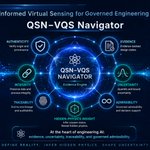
ALT 🔔 QSN–VQS Navigator: Quantum-State-Informed Virtual Sensing for Governed Engineering Design Intelligence ➡️ Engineering AI can generate outputs at speed. But in engineering practice, generation is not the same as validity. ➡️ QSN–VQS Navigator introduces a quantum-state-informed framework for virtual sensing and governed engineering intelligence. ▪️It transforms analogue signals, simulation outputs, engineering datasets, lifecycle evidence, and live digital twin telemetry into evidence-aware state representations. ▪️ The purpose is to move beyond fixed prediction outputs toward engineering states that are evidence-backed, uncertainty-bounded, traceable, and admissibility-aware. ▪️ Across concept design, holistic system modelling, and live digital twin operation, QSN–VQS supports authenticity, design integrity, hidden-physics inference, reliability, accuracy, lifecycle assurance, and governed decision support. 🔎 Full article in the link below. https://www.linkedin.com/pulse/qs
ALT 🔔 QSN–VQS Navigator: Quantum-State-Informed Virtual Sensing for Governed Engineering Design Intelligence ➡️ Engineering AI can generate outputs at speed. But in engineering practice, generation is not the same as validity. ➡️ QSN–VQS Navigator introduces a quantum-state-informed framework for virtual sensing and governed engineering intelligence. ▪️It transforms analogue signals, simulation outputs, engineering datasets, lifecycle evidence, and live digital twin telemetry into evidence-aware state representations. ▪️ The purpose is to move beyond fixed prediction outputs toward engineering states that are evidence-backed, uncertainty-bounded, traceable, and admissibility-aware. ▪️ Across concept design, holistic system modelling, and live digital twin operation, QSN–VQS supports authenticity, design integrity, hidden-physics inference, reliability, accuracy, lifecycle assurance, and governed decision support. 🔎 Full article in the link below. https://www.linkedin.com/pulse/qs

ALT 🔔 💡 Resilient by Design: Embedding Disruption-Aware Supply Intelligence into UK Advanced Manufacturing https://www.linkedin.com/pulse/resilient-design-embedding-disruption-aware-supply-intelligence-2muie ▪️ Resilient by Design (RbD-FS) introduces a different approach: embedding disruption-aware supply intelligence directly into engineering design workflows so that material risk, substitution pathways, resource efficiency, and traceability constraints are evaluated while design decisions are still fluid. ▪️ By treating supply fragility as a design parameter, the framework enables manufacturers to move from reactive supply management toward sovereign design intelligence governing resilient and resource-efficient production systems across UK advanced manufacturing. 🔔 We are inviting UK OEMs and advanced engineering SMEs to participate as host platforms and end users for the feasibility study. 📩 [email protected] 🌐 #UKManufacturing #AdvancedManufacturing #SupplyChainResil

ALT 🔔 QuESTran — Intelligence-Built Quantum Sensing for Transport Platform Integrity 🔵 Structural degradation in transport systems is often invisible until it becomes critical. Conventional sensing approaches — fixed hardware, periodic inspection, observable thresholds — are built around the assumption that you deploy first and detect later. 🔔 QuESTran inverts that assumption. 🟠 Sensing intelligence is constructed, evaluated, and governed within digital twin environments before any physical deployment decision is made. The Quantum Sensing Navigator orchestrates sensing strategy exploration across a virtual quantum sensor suite, filtered through ARC admissibility constraints, with every execution anchored in the K-Ledger for full traceability. 🟣 The result is not just improved detection — it is governed sensing intelligence: auditable, reproducible, and engineering-grade. 🟢 Demonstrator results show progressive reduction in Minimum Detectable Defect (MDD) across the VQS-1 → VQS-6

ALT 🔔 Virtual Quantum Sensing — What Makes It Quantum-Informed? ➡️ Early-stage structural degradation is rarely absent — it is simply unresolved. Classical sensing systems rely on fixed thresholds, meaning signals must become sufficiently large before detection occurs. By that point, degradation is already established. ➡️ This is the limitation Virtual Quantum Sensing addresses. Instead of treating signals as deterministic measurements, sensing is constructed as a probabilistic inference process within digital twin environments. Structural behaviour is represented as a state space, where signal perturbations contribute to the likelihood of emerging degradation states. ➡️ The “quantum” aspect is not hardware — it is modelling. 🔵 Quantum-informed sensing applies probabilistic, state-based formulations inspired by interaction-driven detection behaviour, where sensitivity emerges from the relationship between signal perturbation and system response rather than fixed thresholds. 🟠 This

ALT 🔔 "AI is powerful — but in engineering, power without admissibility is risk." ▪️ Most AI systems generate probabilistic suggestions. ➡️ Engineering systems require deterministic truth. This is the gap. ➡️ In this article, We introduce ARC (Admissibility and Review Control) — a governance layer that ensures only physically valid, uncertainty-bounded, and compliant states are allowed to influence engineering decisions. 👉 From AI inference 👉 To admissibility verification 👉 To evidence-backed engineering truth ▪️ This is not about improving predictions. ➡️ It’s about enforcing engineering integrity. ➡️ If AI is to be trusted in safety-critical systems, it must be governed — not just optimised. 🔗 Full article below. https://www.linkedin.com/pulse/arc-governance-turning-ai-predictions-engineering-truth-cuneyt-ozturk-8g2we #AIEngineering #EngineeringIntegrity #AITrust #DigitalEngineering #SafetyCritical #AIValidation #ModelGovernance #AdvancedManufacturing #QuantumSensing #S

ALT How Intelligence-Led Quantum Sensing Transforms Engineering Practice From First Signal to Final Decision: Governed Quantum Sensing Across the Engineering Lifespan https://www.linkedin.com/pulse/governing-physical-digital-boundary-how-quantum-sensing-cuneyt-ozturk-bymqe The virtual proved it. Now the physical must answer. QuESTran Phase-1 is complete. This is not a sensing story. It is an engineering governance story. The real limitation in AI-assisted engineering is not detection capability — it is the absence of a governed transition from detection to decision. This work introduces a deterministic approach to that boundary, where admissibility is enforced before any engineering action is taken. Phase-1 demonstrates that this can be achieved in controlled environments. Phase-2 will test whether the same governance holds under real-world conditions. If AI is to be trusted in engineering, it must move beyond prediction — and enforce engineering truth. #InnovateU

ALT 🔔 There is a gap in how we talk about AI — and how engineering systems actually operate. https://www.linkedin.com/pulse/missing-layer-uk-ai-strategy-from-adoption-truth-cuneyt-ozturk-6wzge ▪️ AI systems generate outputs. ▪️ Engineering systems require admissible states. This distinction matters. As the UK accelerates AI adoption across infrastructure, manufacturing, and public systems, a critical question emerges: 👉 How do we ensure that AI-driven decisions are not just probable — but physically valid, bounded, and admissible? This article sets out that missing layer: • The shift from generate–evaluate to governed state transitions • Why validation after the fact is not sufficient • And how admissibility must be enforced before execution It introduces a deterministic governance approach for engineering systems — where decisions are: • physically consistent • uncertainty-bounded • fully evidenced and reproducible This is not about improving AI outputs. It is abou

ALT 🔔 Industrial AI has a problem we’re not talking about. https://www.linkedin.com/pulse/k-ledger-building-evidence-spine-industrial-cuneyt-ozturk-bntse AI systems generate outputs. Engineering systems require admissible states. That gap is not theoretical. It is structural. As AI-driven exploration scales exponentially, the ability to verify, certify, and preserve engineering authority grows only incrementally. 👉 This creates the Intelligence Paradox: More capability → more fragility. Not because AI is wrong — but because authority is not governed. This article introduces a missing layer in industrial AI systems: ▪️ A deterministic boundary between exploration and commitment ▪️ Admissibility enforced before state transition ▪️ Evidence anchored at the point of engineering authority At the centre of this is the K-Ledger: A system that records not just what state exists — but why that state became authoritative. Not a blockchain. Not a log. 👉 An evidence spine for in

ALT 🔔 The Thinking Value Chain — Generating Governable Engineering Intelligence https://www.linkedin.com/pulse/thinking-value-chain-generating-governable-cuneyt-ozturk-bt8be Where does engineering intelligence actually come from? We talk about AI models. We talk about digital twins. We talk about simulation, sensing, optimisation. But we rarely ask: 👉 What is the system that produces engineering intelligence in the first place? This article introduces that system: The Thinking Value Chain (TVC) Not as a concept — but as an architectural layer. The TVC is where engineering intelligence is constructed. Through the coordinated interaction of: ▪️ AI exploration ▪️ digital twins ▪️ surrogate models ▪️ sensing inputs ▪️ engineering constraints ▪️ lifecycle feedback But here is the critical distinction: 👉 The TVC does not produce truth. It produces candidate intelligence. Engineering truth only emerges when that intelligence is: ▪️ governed through admissibility (ARC)