

GovTech + SaaS operator. Built and exited companies in regulated markets. I write The GovTech Operator about what actually works when you build for government.
Las Vegas, NV
Joined August 2008
- Tweets1.1K
- Following617
- Followers503
- Likes872








It's pouring right now in Vegas. I love cracking the window and working to the sound (and smell) of the rain and thunder. It increases my productivity somehow.

66
Most SaaS benchmarks don't fit GovTech.
Procurement is slower. Sales cycles are longer. Trust costs more.
So your spend mix should look different too.
Here's a simplified model I've used as a benchmark for GovTech SaaS companies (as % of ARR):
*Early Stage ($1-5M ARR)
Companies here often operate at 200-300% of ARR burn. What matters most is the mix:
- R&D: 45-55% (building core platform + compliance)
- Sales: 20-25% (founder-led motion, early pilots)
- Marketing: 10-15% (education > ads)
- Customer Success: 10-15% (implementation-heavy)
- G&A: 5-10%
Focus → Get to product-market fit and 3+ reference customers.
*Growth Stage ($5-15M ARR)
- R&D: 30-35%
- Sales: 30-35%
- Marketing: 10-15%
- Customer Success: 10-15%
- G&A: 5-10%
Focus → Repeatable GTM, funding compliance, margin expansion.
*Scale Stage ($15M-50M ARR)
- R&D: 20-25%
- Sales: 35-40%
- Marketing: 10-12%
- Customer Success: 10-12%
- G&A: 8-10%
Focus → New markets, upsell/expansion, and automation to protect margin.
GovTech isn't built like commercial SaaS.
It scales slower… but locks in deeper.
If you're spending like a B2B SaaS company, you're probably burning trust faster than cash.
Every business is different but use these benchmarks as a guide.

1
50
Michael J Smith retweeted

Here are the most active VC firms globally and in the U.S. as of 2Q25.
As a founder, it's important to know who is actively writing checks into startups.
Given market conditions, there are many "walking-dead" VC firms who don't have anymore dry powder to make new investments.
On a first call, founders should be asking:
1) What number fund are you on?
2) How many more new investments will you be making out of that fund?
3) Do you do follow-ons post this round?
These questions will give you a good sense of how much capital the VC has left for you and whether they write follow-on checks to support you beyond your current round.
Below are the investors writing the most checks, according to @PitchBook.
Hopefully this helps some founders looking to raise!
If you're just going out, here are some guides that may help you:
9 essential pages in a fundraising ditch deck
lnkd.in/gRt2Cj-h
What’s inside an early-stage VC investment memo?
lnkd.in/gPd8-bYy
♻️ Repost to help a fist time founder!

Michael J Smith retweeted

Your customers will teach you how to go from $1m to $100m ARR, you just have to listen
True especially if your initial TAM seems quite small
AI didn’t kill outbound.
Automation didn’t kill email.
Short attention spans didn’t kill events.
Lazy execution did.
1
1
255
Michael J Smith retweeted

Here's the thing about fundraising that nobody talks about:
Many VCs won't even look at your deck unless someone they trust sends it to them.
At Draper, any founder can pitch us directly through our site.
We've already made 3 investments this year from founders who just... showed up in our inbox.
But here's what I keep seeing…
Founders spend weeks perfecting their pitch deck, only to receive their first real feedback when they're sitting across from an investor.
That's like practicing your wedding speech in front of the wedding guests.
So we built something called PitchLens.
It's an AI pitch coach trained on how we actually evaluate deals at Draper.
It'll tell you:
→ Where your story gets confusing
→ Which slides aren't pulling their weight
→ How to tighten your narrative before you hit send
We're still tweaking PitchLens based on founder feedback. What would make this most useful for you?
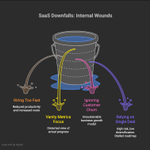
The biggest threats to a SaaS company usually aren't competitors.
They're the wounds we create ourselves.
I've lived this firsthand. Over the years I've seen (and made) the same mistakes:
* Hiring too fast and slowing the company down.
* Chasing vanity metrics instead of real traction.
* Ignoring churn because new deals looked shinier.
* Betting the farm on one "big logo" that didn't close.
The truth is, markets rarely kill you.
But a lack of discipline will.
👉 The companies that endure aren't the flashiest. They're the ones ruthless enough to get the basics right... over and over again.

1
1
21
Perks fade. Titles change. The only thing that compounds forever? The lessons burned into you along the way to scaling a winner...


2
37
EVERY SaaS founder wants AI to be their rocket fuel.
But here’s the thing...
* If your GTM motion leaks, AI just leaks faster.
* If your churn is creeping, AI just accelerates the churn.
* If your product doesn’t stick, AI just makes it fall off the wall harder.
AI is not a shortcut to greatness.
It’s a multiplier... of whatever you already are.
Fix the fundamentals first. Then light the boosters.

1
1
47
Scaling SaaS isn’t just about growth... it’s about discipline.
3 lessons scaling to $10M ARR:
1. Growth ≠ Headcount
2. PMF is a moving target
3. Discipline > Blitzscaling
It’s about building something sustainable - bookings are only a piece of the puzzle.
2
3
40
Michael J Smith retweeted
I was sent a funding deck the other day that was an ... almost.
The growth was almost good enough. The space was interesting, but not quite hot. The logos good, fine. The story was interesting, albeit not compelling. The team looked committed, but nothing stood out.
An almost.
And then I looked, and the deck said "March 2024" on it, not May.
That may sound small, but it's also a sign. A sign fundraising has been hard. A sign that for sure, I wasn't their first choice :). A sign of lack of attention to details that matter. A sign ... to not do the meeting.
When it's an almost, and you see little flags like this, you move on. You don't take the meeting.
If you're an "almost" in fundraising, make sure it's all great. Slow it down. Make sure it's all as polished, as clear, as direct as it can be.
Almosts do get meetings, and those meetings do get funded. You want to believe.
But there are just so many almosts.
Michael J Smith retweeted
HubSpot is at $2.3 Billion in ARR (!)
There's a lot to be impressed with, but #1 is that it is >still< growing its new customer count 23% a year
Even at 200,000+ customers
Even at $2,300,000,000 in ARR
This is the #1 KPI for me in SaaS. Net new customer growth.
When you have that, you will find a way.


Michael J Smith retweeted

Very useful Step by step guide to becoming a UX Designer in 2023! 🚀🔖
Start learning today!
Download the roadmap:
roadmap.sh/ux-design
Great work by @kamrify
#ux #ui #uxdesign #uidesign #userexperience #research #userresearch #usertesting #uxresearch #usabilitytesting #productdesign #design #visualdesign #webdesign #appdesign #uxstrategy #uxprocess #prototyping #business #startup #entrepreneur

Michael J Smith retweeted

Improve inter-station collaboration-
Sync-up with other first responders with instant status updates that clarify your needs.
For more info, visit us at buff.ly/3U5SlAD.

Michael J Smith retweeted

Please do not try scaling your startup before you've created a predictable and repeatable customer acquisition strategy because you'll explode.
Michael J Smith retweeted
Sync-up with other first responders with instant status updates that clarify your needs.
Improve inter-station collaboration immediately.
For more info, visit us at buff.ly/3U5SlAD.

Michael J Smith retweeted
So proud to serve @AZSurprise and their Police, Fire, and emergency management! Virtual EOC is just one of the many life-saving services @EvertelHQ provides to agencies in 22 states! govtech.com/em/safety/surpri…
