

Native Texan: #AllForTx I just want a Karate Robot. DMs=Block
Texas
Joined November 2021
- Tweets1.9K
- Following5.1K
- Followers1K
- Likes64.5K






mvs retweeted

holy f*cking sh*t Karpathy put an entire AI degree on github for free while you are still paying $200/month to watch youtube tutorials from a guy with 3000 followers
7 repos. 306,741 stars combined. in the right order they take you from "how a neuron learns" to "agents that run research overnight while you sleep"
every repo you skip is a layer of understanding your competition at work already has and you do not. and every month you keep "planning to start" is another month someone on your team gets handed the AI project you should have been running
here is the exact order. do not reshuffle it
1. micrograd → github.com/karpathy/microgra…
how a neural net actually learns. backpropagation in about 100 lines of python. this is where every AI engineer on earth started. if you cannot read this file, every other repo on the list is going to feel like black magic to you
2. nn-zero-to-hero → github.com/karpathy/nn-zero-…
his full video course. lecture notebooks that walk you from a single neuron to GPT. the thing people pay $2000 for from AI "bootcamps" that teach a fraction of what is in this one free repo
3. minbpe → github.com/karpathy/minbpe
how text actually turns into tokens. the tokenizer that sits inside every LLM, in clean minimal code. this is the part 95% of self-taught people skip, and it is why their models never work right
4. nanoGPT → github.com/karpathy/nanoGPT
your own GPT. the simplest repo in existence to train and fine-tune one. after this file you stop asking "how does ChatGPT work" because you have literally built the smaller version with your own hands
5. llm.c → github.com/karpathy/llm.c
the same training with nothing hidden. raw C and CUDA, no PyTorch wrapper doing the hard parts for you. this is where you stop being a prompt engineer and start being an actual engineer
6. nanochat → github.com/karpathy/nanochat
a full chat model end to end. GPT-2 level training that cost ~$43,000 in 2019. in this repo it costs about $48. let that sit for a second. the thing people called a breakthrough is now a weekend project
7. autoresearch → github.com/karpathy/autorese…
agents that do the research for you. the agent edits your training code, trains for 5 minutes, keeps whatever improved, discards whatever did not, and repeats all night while you sleep. this is where the people reading this list stop being students and start being whatever comes after that
the brutal truth most people avoid: train one GPT from scratch and you become the person who gets handed the AI project at work, along with the raise that comes with it. keep "planning to start" and you become the person watching that happen to someone else
the classroom half of the same degree, what Stanford actually teaches about AI for real, is below


mvs retweeted

You can now train your own Decision model with our free notebook! 💡
Qwen3.5-4B will generate decisions instead of text on just 8GB VRAM locally.
Learn to data prep (state, questions, gold answers), train, serve.
Notebook: colab.research.google.com/gi…
Guide: unsloth.ai/docs/basics/train…


You can now train your own Decision model like Jev locally!
We increased Qwen3.5 0.8B’s aggregate accuracy from 20.7% to 74.3% across 3 decision benchmarks - on just 4GB VRAM.
Turn any LLM like Qwen3.8, Gemma 4 into decision models with our open-source Unsloth repo.
We fine-tuned with a Clef head using Unsloth and LoRA (r=64) for one epoch, increasing downstream accuracy from 30–37% to 78%.
GitHub: github.com/unslothai/unsloth
Guide and Notebooks: unsloth.ai/docs/basics/train…

mvs retweeted

siltide is a terminal monitor for GPUs, NPUs and other AI accelerators.
You can track usage, memory, power and temperatures across 15 vendors, inspect pods and Slurm jobs, replay sessions and more.
Mesut Oezdil made siltide using @charmcli & is Terminal Tool of the Week! ⭐️
mvs retweeted

whoever leaked this is f*cking crazy
someone mapped 300+ AI agents into one GitHub repo - and basically leaked the shortlist of what’s actually worth trying.
coding agents. browser agents. memory. voice. research. multi-agent teams. local models. sandboxes. evals.
all sitting on one page.
and once you start opening the categories, you realize how much stuff people are still building from scratch for absolutely no reason.
want an AI that works inside your codebase?
-> Aider / Continue
want agents working together like a tiny company?
-> CrewAI / AutoGen / MetaGPT
want your agent to actually remember you tomorrow?
-> Mem0
want it running code somewhere that isn’t your laptop?
-> E2B
want models running locally for $0/token?
-> Ollama
want to see what your agent actually did after it inevitably does something weird?
-> AgentOps
and that’s barely scratching it.
there are 300+ projects across ~25 categories.
the real cheat code isn’t downloading all of them.
it’s opening the repo before you build anything and asking:
“has someone already solved this?”
because there’s a pretty good chance the answer is yes - and the open-source version already has thousands of people testing it for you.
I went through the map and pulled out the agents I’d actually start with + my pick for every major part of the stack.
full 300+ AI agent list below


mvs retweeted

introducing Jevbox: an open-source document drive that organizes itself, answers questions, and cites everything (all powered by Jev).
TLDR;
- upload anything and Jev categorizes and files it into the folder tree
- search is hierarchical: Jev picks the folder, then the document, then the section. No embeddings, no vector DB
- every answer cites the page and section it came from
- permissions are enforced at retrieval. If someone loses access to a source, they lose access to answers built on it too
- ships with an MCP server, so your agents get the same permission-aware context
@andrewlu0 has been experimenting with Jev internally and wanted to see how far it could go on a real document library. It's built on Extend Parse + Jev, and fully open-source
The GitHub has instructions to self-host, or you can deploy it to Render in one click
mvs retweeted

Everyone is fine-tuning LLMs. Almost nobody understands what is actually being updated inside the model.
That distinction matters because LoRA, QLoRA, LoRA-FA, VeRA, Delta-LoRA and LoRA+ are usually discussed as if they were small variations of the same method. They are not. Some reduce trainable parameters, some reduce activation memory, some reduce the memory occupied by the frozen model, and some change the way the adapter itself is optimized.
I'm actually sharing 6 techniques.
1/ LoRA
Suppose a layer contains a pretrained weight matrix W. Full fine-tuning would update W directly. LoRA leaves W frozen and represents the update using two much smaller matrices, A and B, so that ΔW = BA.
For a square d × d weight matrix, full fine-tuning has d² parameters available to update. A rank-r LoRA adapter has roughly 2dr trainable parameters instead, where r is normally much smaller than d. This is the basic reason LoRA can adapt very large models without training every parameter in them.
2/ LoRA-FA
Standard LoRA trains both A and B. LoRA-FA freezes A and trains only B.
There is a useful reason for doing this beyond simply reducing the number of trainable parameters. Computing the gradient for A requires retaining the layer input activation. If A is fixed, that gradient is no longer required, which allows LoRA-FA to reduce activation memory as the LoRA rank grows.
3/ QLoRA
QLoRA attacks a different part of the memory problem. LoRA makes the adapter small, but the frozen base model can still occupy tens of gigabytes.
QLoRA keeps the base model frozen in 4-bit form and trains LoRA adapters through it. The original work used NF4, double quantization and paged optimizers, and demonstrated fine-tuning a 65B model on a single 48GB GPU.
This is an important distinction: QLoRA is not simply "LoRA with smaller adapters." The large memory saving comes from quantizing the frozen base model.
4/ VeRA
VeRA reduces the adapter itself further. Instead of learning a separate A and B for every adapted layer, it uses frozen random low-rank matrices that can be shared across layers, while learning much smaller scaling vectors.
The low-rank basis is therefore fixed. Training mainly determines how strongly different parts of that basis should contribute. This is why VeRA can use considerably fewer trainable parameters than ordinary LoRA.
5/ Delta-LoRA
Ordinary LoRA treats W as fixed throughout training. Delta-LoRA relaxes that constraint.
A and B are still trained, but the change in their product from one training step to the next is also used to update W. The base weights can therefore move without maintaining the ordinary gradients and optimizer states that full fine-tuning would require for W.
6/ LoRA+
LoRA+ does not introduce another adapter structure. It keeps W frozen and still trains A and B.
Its change is in the optimizer: A and B use different learning rates, with B receiving a larger rate. The motivation is that the two LoRA matrices do not behave identically during optimization, so forcing them to use the same learning rate is not necessarily the best choice.
Once these are separated by what they actually change, the family becomes much easier to understand.
LoRA reduces the number of weights being trained. LoRA-FA also targets activation memory. QLoRA compresses the frozen base model. VeRA reduces the learned adapter parameters further. Delta-LoRA allows the pretrained weights themselves to evolve through low-rank changes, while LoRA+ keeps the LoRA structure and changes its optimization.
That is really what PEFT is about => deciding which parts of a very large model actually need to move during adaptation, and which parts can remain fixed.

mvs retweeted

Ai is evolving.
Jev can be armed at all times.
I can speak freely and it knows ( from probabilities ) if im asking my computer to do something or blaberring away at something else.
no wake word.
speed + affordability + intelligence is getting to the point where an always on ambient jarvis style assistant is possible.
Im loving where we are going.
CNVS is still the future of vibecoding.
mvs retweeted

After co-inventing ChatGPT, I kept asking myself: why have superhuman chat models not led to AGI?
I’ve spent the last 2 years in stealth building a new way to train models (RLCD), and a new type of frontier AI model that we are releasing today: Jev
• 20-200x faster
• 40-400x cheaper (w/ output tokens free)
• Frontier composable intelligence optimized for decisions
AFAICT the shortest path to AI-based economic revolution
mvs retweeted

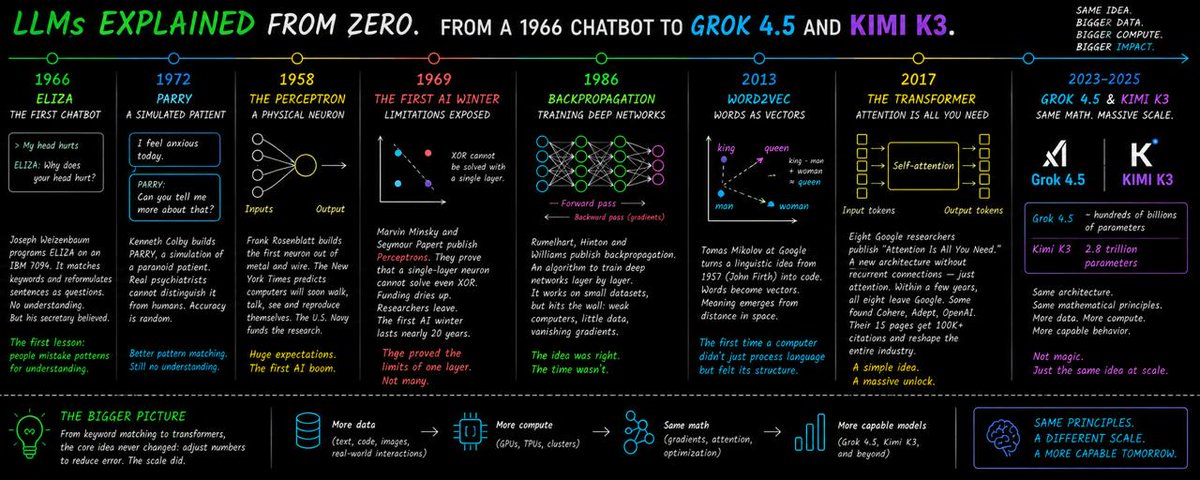
As someone who ships LLM systems in production, this scaling video is the closest thing to a "why 96% of Claude and GPT-5's weights are literally useless" explainer I've ever seen released for free.
Everyone thinks trillion-parameter models need every parameter. They don't. A 2019 pruning experiment proved you can delete 96% of a neural net's weights with zero performance loss - meaning most of Claude and GPT-5 is empty scaffolding around a tiny "winning lottery ticket" network doing all the real work.
Bookmark this 18-min video and watch tonight. Same lottery ticket math from 2019 MIT research, now the reason every AI lab wastes 90%+ of its Nvidia budget.

Readers added context they thought people might want to know
The 2019 LTH paper found winning tickets (typically 10-20% size) matching perf on small MNIST/CIFAR models only when retrained from specific inits. It does not prove 96% of trained trillion-param LLMs' weights are useless; IMP fails to scale without major changes.
arxiv.org/abs/1803.03635
arxiv.org/abs/1903.01611
mvs retweeted

Why does this account have so few followers? He produces some of the best videos on here.
Give him a follow.


mvs retweeted

scary stuff

mvs retweeted

Your devices are stronger together. 🖥️🤝🖥️
Just announced at IFA, NVIDIA PAIR automatically links systems across your local network and sends inference requests wherever there’s available capacity, helping agents run more efficiently.
mvs retweeted

My first "holy shit" moment with GPT-6 Astra:
I asked it to create a world in Unreal Engine, and fill it with humans (each an Astra-powered agent) who all have to work together to survive.
A day later, I was in my bedroom and heard voices coming from the living room... I thought someone was in my apartment.
I walked out, honestly a little scared.
It was the Astra agents. They'd started talking to each other.
Fucking crazy.
Here's a brief clip (obviously not 100% perfect yet, but still, insane. sound on!):
mvs retweeted

I received a book from @0xSero at my home lab🤩
I was just studying up on inference, so I really appreciate it.
A wonderful community. Thank you for delivering it to Japan.
respect.

mvs retweeted

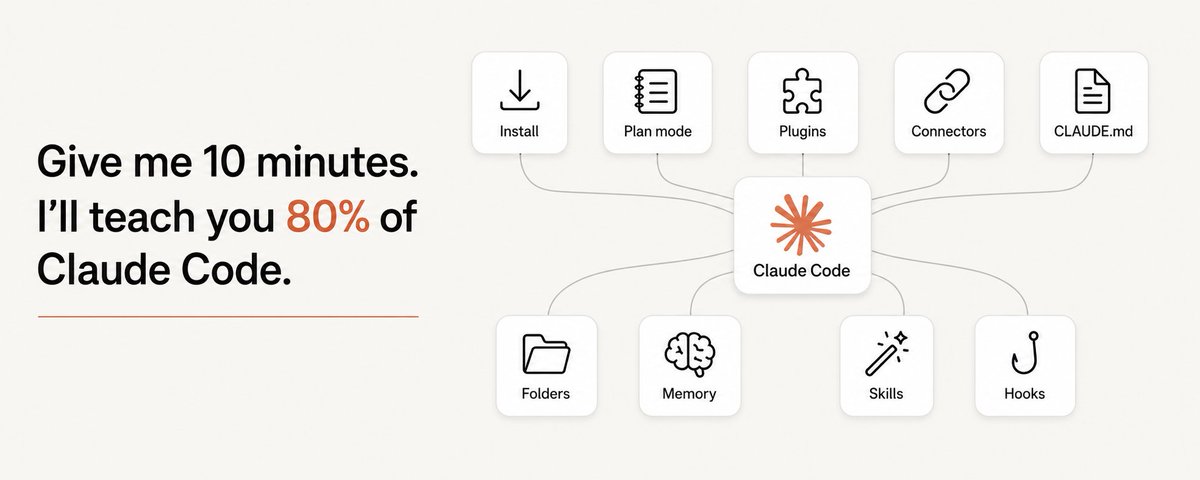
You installed Claude Code and stopped there.
35 add-ons that turn it into a company (links below):
If you're new to Claude Code.
Start here → charliehills.substack.com/p/…
A SENIOR ENGINEER
1. superpowers
→ github.com/obra/superpowers
2. agent-skills
→ github.com/addyosmani/agent-…
3. karpathy-skills
→ github.com/multica-ai/andrej…
4. gstack
→ github.com/garrytan/gstack
A PRODUCT DESIGNER
5. ui-ux-pro-max-skill
→ github.com/nextlevelbuilder/…
6. taste-skill
→ github.com/Leonxlnx/taste-sk…
7. impeccable
→ github.com/pbakaus/impeccabl…
A QA TESTER
8. Codex
→ openai.com/codex (paid)
9. playwright-mcp
→ github.com/microsoft/playwri…
10. skills
→ github.com/anthropics/skills
A DOCS TEAM
11. markitdown
→ lnkd.in/eB_27t8q
12. skills
→ lnkd.in/er2tG4ZB
13. frontend-slides
→ lnkd.in/eTABiDTs
A MARKETER
14. marketingskills
→ github.com/microsoft/markitd…
15. claude-seo
→ github.com/AgriciDaniel/clau…
16. humanizer
→ github.com/blader/humanizer
17. Apify
→ apify.com (paid)
A SOCIAL MANAGER
18. social-media-skills
→ github.com/charlie947/social…
19. ManyChat
→ manychat.com (paid)
20. GPT Image 2 →developers.openai.com/api/do… (paid)
A MOTION DESIGNER
21. HiggsField
→ higgsfield.ai (paid)
22. hyperframes
→ github.com/heygen-com/hyperf…
23. OpenMontage
→ github.com/calesthio/OpenMon…
24. OpenCut
→github.com/OpenCut-app/OpenC…
A RESEARCHER
25. Agent-Reach →github.com/Panniantong/Agent…
26. last30days-skill
→ github.com/mvanhorn/last30da…
27. NotebookLM
→ notebooklm.google.com (free)
AN OPS MANAGER
28. Notion MCP →developers.notion.com/guides… (free)
29. github-mcp-server
→ github.com/github/github-mcp…
30. claude-mem
→ github.com/thedotmack/claude…
31. mem0
→ github.com/mem0ai/mem0
THE WHOLE AGENCY
32. agency-agents
→ github.com/msitarzewski/agen…
33. awesome-claude-skills
→ github.com/ComposioHQ/awesom…
34. agents
→ github.com/wshobson/agents
35. claude-skills
→ github.com/alirezarezvani/cl…
What each one does is on the graphic.
Every repo is free. Five of the tools are paid.
Seven are ones I already run.
The rest are the ones I keep sending people.


mvs retweeted

Bill Maher: “Jason Arday… he was the first Black professor at Cambridge… the youngest… really he was GUILTY of plagiarism and all sorts of incredible lies, and because [the left] is so captivated by DEI and wanting this. They just let it pass… It’s the soft bigotry of LOW expectations.”
New York Times’ Jeremy Peters: “They IGNORED the glaring red flags like grammatical errors in his thesis and things in his back story that just didn’t add up, like running 30 marathons in 35 days.”
*Audience Laughs*
“Cambridge has a LOT of explaining about how they seemed to have really cynically used this person who was obviously struggling with mental illness to FURTHER their diversity and inclusion goals.”
Bill Maher: “He said he ran the marathons with a broken leg... It’s like a prank! Like can we make liberals, who want to believe this, actually do it, and they did.”
“White people are crazy.”
mvs retweeted

A BIG moment for all DGX Spark users ⚡️
You can now run DeepSeek v4 Flash 0731 without needing a second unit, with quality high enough for reliable code generation, high context, and great speed!
Optimized for single stream session:
- EXL3 quantization
- 384k context (conservative) / ~440k kv cache (!)
- 47 tok/s single stream (structured)
- 1024 tok/s prefill
- 370k token needle test passed (super stable!)
Thanks @0xSero for this excellent EXL3 quant! Tuned for SparkInfer + DSpark speculative decoding, this is about the same quality of a Q4_K_M / Q5 GGUF!
All this is possible thanks to native NVFP4 KV cache & fixing kernel bugs in the upstream prefill path to make it work at all.
Get it here:
github.com/MiaAI-Lab/DeepSee…

mvs retweeted

thanks for all the love on this, i'll publish for you to play soon
in the meantime here's a demo of some new mechanics:
- bending light around a black hole
- splitting with a prism
- focusing with a convex lens
more physics - puzzles - levels coming soon :]
