





Treble-Bleed Circuits, 1950s Wiring and No-Load Controls
Three passive guitar-electronics modifications address different aspects of tone control. Treble-bleed circuits preserve high frequencies as volume decreases, 1950s wiring changes volume/tone interaction, and no-load controls disconnect the tone circuit at maximum.
1. Treble-bleed circuits
Reducing a passive guitar’s volume can attenuate high frequencies through interactions between pickup impedance, potentiometer resistance and cable capacitance.
A treble-bleed network connects between the volume pot’s input and wiper, allowing high frequencies to bypass some attenuation.
Three common arrangements:
Capacitor only - Typically 680pF-1nF. Preserves treble but may produce excessive brightness.
Capacitor with parallel resistor - Example: 1nF + 150kΩ. Preserves highs while modifying volume taper.
Capacitor with series resistor - Example: 1nF + 130kΩ. Limits high-frequency bypass and changes the control response.
Component values depend on pickups, potentiometers and cable loading.
Factory example: 2017 Fender American Professional Telecaster, equipped with a treble-bleed circuit.
2. Gibson-style 1950s wiring
The difference between modern and 1950s wiring is where the tone circuit connects to the volume potentiometer.
Modern wiring connects the tone circuit to the pickup-input terminal.
1950s wiring connects it to the volume pot’s output or wiper.
This arrangement can retain more high frequencies as volume decreases, but volume and tone controls become more interactive.
Adjusting tone may influence output level, while changing volume alters the tone circuit’s response.
Historical example: 1959 Gibson Les Paul Standard. The arrangement is also used on modified Les Pauls, SGs and ES-series guitars.
No additional electronic components are required; the modification changes existing connections.
3. No-load tone controls
A conventional tone potentiometer remains electrically connected to its capacitor even when fully clockwise.
A no-load pot incorporates a break in its resistive track at maximum rotation.
At 10, the tone circuit disconnects, eliminating its residual loading and potentially increasing high-frequency response.
At settings 1-9, it operates as a conventional tone control.
Factory example: Fender American Series Stratocaster with Delta Tone electronics and a 250k no-load tone potentiometer.
No-load controls are intended for tone circuits rather than conventional volume applications.
4. Comparing the three
Treble bleed - Most noticeable when reducing volume. Possible tradeoff: excessive brightness or altered volume taper.
1950s wiring - Changes interaction between volume and tone controls. Often retains more treble at reduced volume.
No-load tone - Most noticeable with tone at 10. Removes the tone circuit’s loading, sometimes producing a subtle increase in brightness.
None provides active amplification or generates additional frequencies. Each changes how the existing signal is attenuated or loaded.
Results depend on pickup inductance, potentiometer values, capacitor selection, cable capacitance and amplifier input impedance.
Sources:
seymourduncan.com/blog/tips-…
premierguitar.com/pro-advice…
seymourduncan.com/blog/lates…
fender.com/

The Gibson Varitone Circuit - Inductors, Capacitors and Switching, 1959-2026
Introduced in 1959 on the Gibson ES-345 and offered on the ES-355TD-SV, the Varitone was an unusual approach to passive guitar tone control. Instead of simply reducing treble, it selectively attenuated frequency bands through a six-position rotary switch, capacitors and an inductor.
How the Varitone works
The original-style circuit uses an inductor, nominally 1.5 henries, in series with one of five selectable capacitors. This LC network provides a frequency-dependent path to ground, creating a resonant notch in the guitar’s frequency response.
Position 1 disconnects the filtering network. Positions 2-6 select progressively larger capacitors, shifting the notch toward lower frequencies.
The Varitone is entirely passive. It does not boost frequencies; it changes their relative balance through selective attenuation.
The six switch positions
1 - Bypass, no selected notch.
2 - 0.001µF, ~4,110Hz.
3 - 0.003µF, ~2,370Hz.
4 - 0.010µF, ~1,300Hz.
5 - 0.030µF, ~750Hz.
6 - 0.220µF, ~277Hz.
These frequencies are theoretical LC resonances calculated using f = 1/(2π√LC), assuming a 1.5H inductor. They are not measured notch frequencies from an actual guitar.
Inductors, capacitors and switching
The inductor, commonly called a choke, supplies the inductance required for resonance. Each selected capacitor determines a different resonant frequency.
Original-style circuits also employ high-value resistors, commonly 10MΩ, across capacitor switching paths to minimize audible switching pops.
Actual notch frequency, depth and bandwidth depend on pickup impedance, choke resistance, component tolerances, potentiometer settings, cable capacitance and amplifier loading.
Unlike a conventional tone potentiometer, which progressively attenuates treble, the Varitone targets selected frequency regions.
Gibson applications
1959 ES-345 - Introduced with Varitone switching and stereo output.
1959 ES-355TD-SV - Combined the ES-355 platform with stereo wiring and the Varitone circuit.
B.B. King Lucille - Later signature model incorporating Varitone switching and stereo-output features.
The Varitone and stereo wiring are independent systems. The Varitone changes frequency response; stereo wiring routes pickup signals to separate output channels.
Historical significance
The Varitone offered six repeatable tonal settings without batteries, transistors or active electronics. Its distinctive filtering resulted from resonant attenuation rather than ordinary treble reduction.
Resonant attenuation removes a specific range of frequencies from an electric guitar’s sound, changing its tone without simply turning down the treble or overall volume.
It remains an important example of passive frequency-selective filtering in electric-guitar design.
Sources:
premierguitar.com/pro-advice…
reverb.com/news/the-varitone…
artdavisguitars.com/tech/gib…

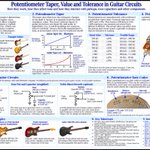
Potentiometer Taper, Value and Tolerance in Guitar Circuits
Potentiometers control more than volume and tone. Their resistance, taper and tolerance influence pickup loading, resonance and how a guitar responds as its controls are adjusted.
1. Potentiometer value
Resistance is measured in ohms. In passive circuits, higher-value pots generally load pickups less, preserving a stronger resonant peak and more high-frequency content. Lower-value pots provide greater loading, damping resonance and often producing a darker response.
250kΩ - Common in Fender Stratocasters, Telecasters and other passive single-coil guitars.
500kΩ - Common in Gibson Les Pauls, SGs, ES-335s and many P-90-equipped instruments.
1MΩ - Used in traditional Fender Jazzmaster lead circuits and certain other Fender designs.
25kΩ - Common in active EMG pickup systems, which have different impedance requirements.
These are typical applications, not universal specifications.
2. Potentiometer taper
Taper describes how resistance changes as the shaft rotates.
Linear taper produces an approximately proportional resistance change across its rotation.
Audio taper changes resistance nonlinearly, providing a progression often better suited to perceived loudness.
Two 500k pots with different tapers can produce different volume-control behavior, despite identical maximum resistance.
A commonly indicates audio taper and B linear taper, but conventions differ. Manufacturer specifications take precedence.
3. Manufacturing tolerance
Potentiometers are not manufactured to one exact resistance. Common tolerances include ±10% and ±20%.
A nominal 500k pot with ±20% tolerance may measure 400k-600k. A 250k pot with the same tolerance may measure 200k-300k.
These differences can alter pickup loading and resonance. Tolerance differs from taper accuracy: a pot can measure correctly at its endpoints yet have an inconsistent control curve.
4. Potentiometer construction
A conventional pot contains a resistive track, rotating shaft and movable wiper.
Its three terminals connect to the track’s ends and wiper. Circuit connections determine whether it functions as a voltage divider or variable resistance.
5. Volume, tone and treble bleed
Volume controls adjust the signal delivered to the amplifier while interacting with pickup impedance and cable capacitance.
Tone controls use a potentiometer and capacitor to create a variable high-frequency path to ground. Common capacitor values include 0.022µF and 0.047µF.
Optional treble-bleed networks connect a capacitor, sometimes combined with a resistor, across the volume control’s input and output. They can preserve high frequencies as volume decreases.
6. Potentiometer date codes
Manufacturers including CTS have used identification and production-date codes. A marking such as CTS 137-2312 identifies manufacturer code 137 and, under the common modern YYWW convention, week 12 of 2023.
Pot codes help date components, but cannot independently establish a guitar’s assembly date or originality.
7. Real-world examples
Fender Stratocaster - Typically 250k controls.
Gibson Les Paul Standard - Typically 500k controls.
Fender Jazzmaster - Traditionally 1M lead volume and tone, with separate rhythm controls commonly using 1M volume and 50k tone.
EMG-equipped guitar - Often 25k controls when specified for its active pickup system.
The essential distinction: Value determines resistive loading, taper determines control progression, and tolerance determines permissible resistance variation. All three interact with the complete guitar circuit.
Sources:
Fender - Stratocaster wiring
fender.com/articles/maintena…
Gibson - Les Paul models
gibson.com/
Seymour Duncan - Guitar potentiometers
seymourduncan.com/blog/lates…
DiMarzio - Potentiometers
dimarzio.com/
EMG - Active pickup electronics
emgpickups.com/
CTS - Potentiometers
ctscorp.com/products/potenti…

Noiseless Pickups - Stacked Coils, Split Coils, Dummy Coils and Side-by-Side Humbuckers
Traditional single-coil pickups convert string vibration into an electrical signal, but also collect electromagnetic interference from power wiring, transformers, lighting and nearby equipment. The resulting 50/60 Hz hum and its harmonics become particularly noticeable with distortion, compression and high-gain amplification.
Four principal hum-canceling architectures address this problem.
1. Stacked coils
Two coils are positioned vertically inside a single-coil-sized housing. The upper coil primarily senses string vibration, while the lower coil provides an opposing interference signal. Depending on the design, the lower coil may also detect some string movement.
Examples include Fender Noiseless, DiMarzio Area and Seymour Duncan Classic Stack Plus pickups.
Stacked construction preserves familiar pickup dimensions, although the additional coil changes the electrical and magnetic system.
2. Split coils
Two separate coils sense different groups of strings. Their magnetic and electrical polarities are arranged to cancel common electromagnetic interference while preserving the string signals.
Fender introduced the familiar split-coil Precision Bass pickup in 1957. One section senses the E and A strings; the other senses D and G.
Modern examples include Seymour Duncan SPB-series pickups and DiMarzio Split P.
Unlike conventional humbuckers, both coils do not sense the same string group. This arrangement is especially effective for bass pickups.
3. Dummy coils
A separate coil collects environmental interference without intentionally detecting string vibration. Its opposing electrical signal reduces hum from the active pickups.
Dummy coils can be mounted beneath pickguards, within body cavities or in specialized backplates.
Examples include Suhr SSC/SSCII and Ilitch Electronics systems.
These systems can retain the original pickups and magnetic sensing arrangement, although added circuitry may change electrical loading, resonance and output.
4. Side-by-side humbuckers
Two adjacent coils sense substantially the same string region. Opposing magnetic polarity and complementary electrical connections cancel common interference while preserving the string signal.
Compact examples include DiMarzio Fast Track and Seymour Duncan Hot Rails. Both fit conventional single-coil-sized mounting locations.
Their continuous steel rails replace individual pole pieces in many designs. The rails themselves do not cancel hum; cancellation results from the relationship between the two coils.
Traditional Gibson PAF-style humbuckers use the same fundamental principle in a larger housing.
Why do noiseless pickups sound different?
Coil dimensions, winding counts, inductance, distributed capacitance, magnets, magnetic coupling and connected electronics all affect frequency response.
Additional coils can shift resonance and change damping. Consequently, noiseless pickups do not necessarily reproduce the exact response of conventional single-coils.
Hum cancellation also depends on coil matching, interference orientation and installation. These systems reduce electromagnetic hum, but cannot eliminate every type of guitar noise.
The essential distinction: Stacked coils occupy different vertical levels; split coils sense different string groups; dummy coils detect interference separately; side-by-side humbuckers sense substantially the same string region.
All four use electromagnetic cancellation, but achieve it through different physical arrangements.
Sources:
Fender - Precision Bass history
fender.com/articles/behind-t…
Seymour Duncan - Classic Stack Plus
seymourduncan.com/single-pro…
Seymour Duncan - Hot Rails
seymourduncan.com/single-pro…
DiMarzio - Pickup catalog
dimarzio.com/pickups
Suhr - SSCII-equipped guitars
suhr.com/instruments/standar…
Ilitch Electronics - Hum-canceling systems
ilitchelectronics.com/

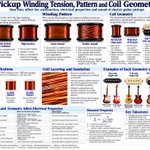
Pickup Winding Tension, Pattern and Coil Geometry
Electric guitar pickups with identical magnets, wire gauges and turn counts can exhibit different electrical characteristics because of winding tension, wire distribution and coil geometry. These construction variables influence inductance, distributed capacitance, resistance and resonant behavior.
Winding tension determines how tightly magnet wire settles onto the bobbin. Lower tension can produce looser windings and larger coil dimensions. Higher tension generally produces tighter packing, but excessive force risks stretching the wire, damaging insulation or causing breakage.
Consistent tension improves mechanical stability and manufacturing repeatability. There is no universally ideal tension: wire diameter, insulation, bobbin construction and winding equipment all matter.
Winding pattern describes how turns are distributed across the bobbin.
Layer winding arranges wire in comparatively orderly rows. Scatter winding distributes turns less regularly, creating additional crossings and different relationships between adjacent conductors.
Both methods can produce excellent pickups. Scatter winding is associated with numerous vintage-style designs, but it does not automatically produce brighter tone or lower capacitance. Electrical results depend on the actual arrangement of the turns.
Coil geometry concerns winding height, width, depth and the magnetic structure enclosed.
Stratocaster-style single-coils typically use relatively tall, narrow windings surrounding individual magnetic pole pieces. Examples include Fender Stratocasters and vintage-style Fender Mustangs.
P-90 pickups employ comparatively wide, shallow coils with steel pole screws and bar magnets underneath. Examples include Gibson Les Paul Specials, Juniors and Epiphone Casinos.
PAF-style humbuckers combine two adjacent coils with opposite magnetic polarity and appropriate electrical connections for hum cancellation. Examples include Gibson Les Paul Standards and ES-335 models.
Stacked noiseless pickups arrange coils vertically to reduce electromagnetic hum within a single-coil-sized housing. Examples include Fender Stratocasters equipped with Fender Noiseless pickups and DiMarzio Area-equipped instruments.
Magnet wire gauge adds another variable. Traditional guitar pickups commonly use 42 AWG, while 43 AWG and other gauges appear in numerous designs.
Higher AWG numbers indicate thinner wire. At a given DC resistance, thinner wire generally permits more turns, although the exact relationship depends on winding dimensions, temperature and conductor length.
Insulation thickness and material also influence winding density and distributed capacitance.
Resonant frequency is approximately:
f = 1 / (2π√LC)
L represents inductance; C represents effective circuit capacitance, including pickup, cable and connected electronics.
Resistance and electrical loading influence resonance amplitude and damping.
Importantly, coil geometry alone does not guarantee a particular inductance or resonant frequency. Comparisons require controlling turn count, wire gauge, magnetic materials and circuit loading.
The fundamental principle: Pickup tone emerges from the combined electrical and magnetic system. Winding tension, pattern and geometry influence that system, but none independently determines whether a pickup sounds bright, warm, powerful or detailed.
Sources:
Seymour Duncan - Pickup construction and winding
Lindy Fralin - Pickup design and coil geometry
DiMarzio - Pickup construction
Gibson - PAF humbucker history
Premier Guitar - Pickup winding and electrical behavior

The History of Out-of-Phase Electric Guitars, 1950s-2026
Peter Green’s 1959 Gibson Les Paul Standard, known as Greenie, became one of rock’s most recognizable examples of out-of-phase pickup operation. But the principle extends far beyond one instrument, encompassing decades of factory designs, experimental wiring and signature guitars.
1959 - Gibson ES-355TD-SV: Gibson’s stereo-equipped semi-hollowbody provided an early example of opposite-polarity pickup signals. Under certain mono connection arrangements, the pickups could produce an out-of-phase combination. This was not a dedicated phase-switching system.
1964 - Fender Mustang: Two three-position pickup switches permitted either pickup to operate in opposite electrical polarity. Selecting both pickups appropriately produced a thin, hollow out-of-phase sound. Unlike Greenie, this was an intentional factory feature.
1964 - Brian May’s Red Special: Built with his father, May’s guitar incorporated three single-coil pickups and six switches controlling individual pickup selection and phase. Its series wiring enabled numerous combinations, including the distinctive out-of-phase sounds subsequently associated with Queen.
Late 1960s - Peter Green’s Greenie: A reversed bar magnet inside the neck PAF created opposing string-signal polarity between the two humbuckers. Selecting both pickups produced frequency-dependent cancellation. Greenie’s historical importance came from demonstrating the musical potential of a fixed magnetic reversal, rather than inventing out-of-phase wiring.
1973 - Gibson L-6S: Designed with Bill Lawrence, the L-6S incorporated a six-position rotary selector offering series, parallel and out-of-phase combinations. It brought sophisticated pickup switching into a production solidbody.
1975 - Gibson S-1: Three single-coil pickups and four-position rotary switching extended Gibson’s experiments with unconventional pickup combinations, including phase-related arrangements.
1990s - Gibson Jimmy Page Signature: Expanded Les Paul switching offered coil splitting, series/parallel operation and phase reversal through push/pull controls, giving players access to multiple pickup relationships.
2020s - Gibson Kirk Hammett Greeny: Gibson recreated Greenie’s reversed-magnet neck pickup relationship with specially designed Greenybuckers, demonstrating how a historically unusual configuration became a repeatable production specification.
The distinction is electrical. Two pickups out of phase partially cancel shared string-signal components, creating a hollow, nasal response. The amount of cancellation depends on pickup placement, construction, height and relative output.
Reversing one humbucker’s bar magnet preserves its internal hum-canceling operation. Reversing electrical phase through suitable wiring can provide a selectable alternative.
Standard Stratocaster positions 2 and 4, by contrast, are normally electrically in phase.
Greenie’s enduring significance is that its sound helped turn an unusual pickup relationship into a deliberately reproducible guitar feature.
Sources: Fender - Mustang history; BrianMay.com - Red Special; Gibson - L-6S, S-1, Jimmy Page and Greeny; Seymour Duncan - Pickup polarity and phase; Premier Guitar - Peter Green’s tone.

Greenie - The Science Behind the Out-of-Phase Sound
Greenie’s distinctive sound originates from an unusual magnetic relationship between the two PAF humbuckers in Peter Green’s 1959 Gibson Les Paul Standard. The neck pickup contains a reversed bar magnet, producing an out-of-phase relationship with the bridge pickup when both are selected.
A conventional Les Paul combines its neck and bridge pickup signals in phase. Because the pickups detect string vibration at different positions, each captures different proportions of the fundamental frequency and harmonics, producing the familiar full middle-position sound.
Greenie operates differently. Reversing the neck pickup’s internal bar magnet reverses its string-generated signal polarity without changing its external wiring. When both pickups are selected, portions of their signals oppose one another, producing frequency-dependent cancellation.
This is not simply reduced volume. Frequencies represented similarly in both pickup signals undergo greater cancellation, while others survive more strongly. The resulting sound is hollow, nasal and vocal-like, with reduced bass and lower-midrange content and relatively prominent upper harmonics, resembling a wah pedal held at a particular position.
The reversed magnet is the critical component. Greenie’s neck pickup is also physically rotated, placing its adjustable pole pieces toward the bridge. That rotation does not itself reverse electrical phase. The internal magnet orientation creates the unusual relationship.
The reversal’s origin remains uncertain. Peter Green described pickup work that may have caused it. Guitar builder Jol Dantzig examined Greenie during Gary Moore’s ownership and discovered opposing magnetic polarities despite apparently conventional wiring. A factory assembly error or later modification remains possible.
Greenie retains its humbucking operation. Reversing the bar magnet changes the entire neck pickup’s string-signal polarity without disturbing the electrical relationship between its two coils. Each humbucker continues rejecting common electromagnetic interference independently.
The middle selector position is essential. With either pickup selected individually, the characteristic inter-pickup cancellation disappears. With both selected, their opposing signals interact.
The independent volume controls provide another variable. With comparable pickup levels, cancellation can be pronounced. Reducing either pickup’s volume changes their relative contributions, reducing cancellation and allowing the dominant pickup’s character to emerge.
Greenie’s effect is reproducible and has been reproduced in subsequent guitars. Reversing one humbucker’s internal bar magnet creates the same fundamental out-of-phase relationship while preserving humbucking operation. An appropriately wired phase-reversal switch can also reproduce it. Gibson incorporated the reversed-magnet configuration into its Kirk Hammett Greeny signature Les Paul models using specially designed Greenybucker pickups. Other pickup builders offer Peter Green-style modifications and phase-switching arrangements. Exact tonal reproduction also depends on pickup construction, height, electronics and amplification.
Greenie demonstrates that two conventional humbuckers can produce an extraordinary combined response through their magnetic and electrical relationship.
Its defining characteristic is selective harmonic cancellation between two pickups, not mismatched coils, increased output or a treble boost.
Sources:
Jol Dantzig - hamerfanclub.com
Guitar World - Peter Green’s Les Paul tone
Seymour Duncan - Pickup polarity and phase
Sweetwater - The Peter Green modification
Gibson - Greenie/Kirk Hammett


【#Fender Custom Shopギター紹介】『1963 JAGUAR JOURNEYMAN RELIC Super Faded Sherwood Green Metallic』
2026年7月のFender Factory Tourにて担当・八木が現地入札会で、手に入れた珠玉の1本!画像も改めて撮り直しましたので是非ご覧ください!
詳しくはコチラ↓
store.shimamura.co.jp/ec/pro…


KORG Mono/Poly 中古で入荷!!
4VCOの分厚いモノシンセながら、4ボイスのポリシンセとしても使用できる画期的な仕様!オシレータ・シンクやクロス・モジュレーションなどで多彩な音作りも可能!!80年代までのKORGアナログシンセの集大成的モデル!!
#KORG #キーボードマート新宿


🎸 2024 Gibson Custom Shop Made 2 Measure Firebird Custom Gloss Purple Sparkle #CS400415
💰 $5,850 · Excellent Condition
🔗 Link in bio
#guitar #guitarporn #collector #reverb #gibson #theguitarpit


伝統を踏襲しながらも現代的なスペックを随所に取り入れた、プレイヤーシリーズのストラトキャスターHSSモデル。
Fender / Player Series Stratocaster HSS Plus Top Aged Cherry Burst Maple Fingerboard 【S/N:MX21231278】
ishibashi.co.jp/ec/product/0…
#イシバシ楽器横浜店
#guitar
#Fender


