
CS PhD student @umdcs @ClipUmd || natural language processing || prev @lyft, @UTCompSci
College Park, MD
Joined October 2020
- Tweets53
- Following676
- Followers541
- Likes2.6K


Pinned Tweet
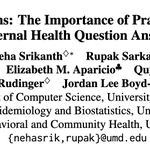
Our paper on analyzing answering strategies in information-seeking QA across different communities won Best Paper at @emnlpmeeting!! 🏆 Absolutely would not have been possible without my advisors @rachelrudinger and @boydgraber, as well as the rest of @ClipUmd!!

So happy I could dance! 💃 Our paper "🪩 DiscoTrace: Representing and Comparing Answering Strategies of Humans and LLMs in Information-Seeking Question Answering" has been awarded Best Paper at #EMNLP2026!
aclanthology.org/2026.emnlp-…

Neha Srikanth retweeted

I'm proud of this work: @nehasrikanth made sure to take things slow and do a thourough analysis, @rachelrudinger helped keep us linguistically grounded, and both of them patiently put up with my insufferable, pedantic congitations on question after question in the dataset.
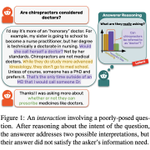
When questions are poorly posed, how do humans vs. models handle them? Our #ACL2025 paper explores this + introduces a framework for detecting and analyzing poorly-posed information-seeking questions!
Joint work with @boydgraber & @rachelrudinger!
🔗 aclanthology.org/2025.acl-lo…

We also discuss observations about the *process* of asking a question (e.g. asker replies are more likely when q's are poorly posed, more likely to be positive, non-dominant interpretations get better feedback, and user-refined q's drift further from dominant interpretations).
2
159
Both humans and models produce high-entropy interpretation distributions on poorly-posed questions - but they converge on different interpretations when questions are clear!
1
125
We can measure "poorly-posedness" using entropy of interpretation distributions. High entropy = answerers can't agree on what the asker wants. Low entropy = clear dominant interpretation emerges.
156
We collected 500 (question, answer, OP reply) interactions from r/NoStupidQuestions where askers gave feedback on whether their info need was met. Expert linguists annotated what interpretation each answerer actually addressed.
127
What makes a question poorly posed? When answerers can't identify a dominant interpretation despite reasoning about the asker's intent. Example: "Are chiropractors considered doctors?" → Could mean titles, training, legal powers, etc.

Neha Srikanth retweeted

I'm really excited about this new line of work with my collaborators at UMD and ARL on detecting common ground misalignments (basically, misunderstandings) in human goal-oriented conversations. Great summary below, or come to @psresnik's talk today at #ACL2025NLP! 2pm Hall N.1

Linguistic theory tells us that common ground is essential to conversational success. But to what extent is it essential? Can LLMs detect when humans lose common ground in conversation?
Our ACL 2025 (Oral) paper explores these questions on real-world data.
#ACL2025NLP #ACL2025

Neha Srikanth retweeted

Linguistic theory tells us that common ground is essential to conversational success. But to what extent is it essential? Can LLMs detect when humans lose common ground in conversation?
Our ACL 2025 (Oral) paper explores these questions on real-world data.
#ACL2025NLP #ACL2025
Neha Srikanth retweeted
Are you tired of using traditional stance detection to measure the polarity of text? Our #NAACL25 paper proposes an approach that uses pairwise comparisons to order texts on a continuous scale, capturing both implicit and explicit content.
📍Today @ Hall 3 from 4-5:30pm.

ALT A screenshot of a paper showing the title - "Pairscale: Analyzing Attitude Change in Online Communities" by Rupak Sarkar, Patrick Wu, Kristina Miler, Alexander Hoyle and Philip Resnik.
Neha Srikanth retweeted

I'll be presenting two papers @naaclmeeting!
1. Why LLMs can't write a question with the answer "468" 🤔🙅
2. A multi-agent LLM that balances opinions on "is pineapple good on pizza?" 🎭🍕
Let's also chat about:
📍 Helpfulness
📍 Why MCQA sucks
📍 Generating cute paper titles 👀


Neha Srikanth retweeted

🏆ADVSCORE won an Outstanding Paper Award at #NAACL2025 @naaclmeeting!!
If you want to learn how to make your benchmark *actually* adversarial, come find me:
📍Poster Session 5 - HC: Human-centered NLP
📅May 1 @ 2PM
Hiring for human-focused AI dev/LLM eval? Let’s talk! 💼


Thrilled to share that AdvScore paper has been accepted to NAACL Main 🚀! Looking forward to pushing forward human-centered model evaluation and benchmark creation. Huge thanks to my amazing collaborators! 🎈🌵🏜️ #NAACL2025
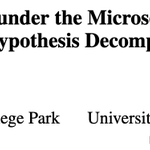
I'll be presenting this work with @rachelrudinger at #NAACL2025 tomorrow (Wednesday 4/30) during Session C (Oral/Poster 2) at 2pm! 🔬
Decomposing hypotheses in traditional NLI and defeasible NLI helps us measure various forms of consistency of LLMs. Come join us!

Read more at aclanthology.org/2025.naacl-…!
A huge shoutout to my advisor @rachelrudinger and everyone else in the CLIP lab at UMD for their support and feedback :-) (6/6)

136
This helps us build groups of examples that evaluate the same pieces of knowledge, allowing us to measure under what *contexts* an LLM can correctly draw a particular inference ("inferential consistency"). We find that LLMs still exhibit room for improvement on this front. (5/n)
1
94
We propose a method to pinpoint the particular pieces of knowledge a defeasible reasoning example aims to evaluate by identifying the atom(s) that are most critical in determining the overall label of a defeasible NLI example. (4/n)
1
68
We also explore how atomic hypothesis decomposition can help us better understand the complexities of defeasible reasoning, a softer inference task that requires models to weigh the effects of multiple, sometimes competing, pieces of evidence on a hypothesis. (3/n)
1
80