

Fractional CTO for crypto & blockchain companies | Custody, tokenization, onchain tooling | Degen since 2015
Utah, USA
Joined February 2015
- Tweets52.9K
- Following4.1K
- Followers19.1K
- Likes22K






Pinned Tweet
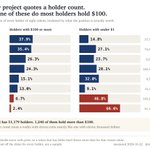
ethereum:0x5283d291dbcf85356a21ba090e6db59121208b44 has 51,179 holders.
34,077 of them hold less than one dollar. 1,240 hold more than a hundred.
I pulled the balance of every holder of eight tokens and bucketed them by what the position is actually worth. The spread is wider than I expected.
Share of holders with $100 or more:
$STRK · 37.9%
$ENS · 35.4%
$ZAMA · 26.3%
$FET · 24.3%
$W · 15.1%
ethereum:0xa27ec0006e59f245217ff08cd52a7e8b169e62d2 · 13.0%
$APE · 6.7%
ethereum:0x5283d291dbcf85356a21ba090e6db59121208b44 · 2.4%
A holder count treats a wallet with eleven cents exactly like a wallet with eleven thousand dollars. For most of these the headline number is largely counting residue that people never bothered to clear out of an airdrop.
Caveat worth stating up front: these are dollar thresholds, so a token that has fallen hard shows more dust for that reason alone. ethereum:0x5283d291dbcf85356a21ba090e6db59121208b44 at 2.4% is partly a price story rather than purely a behaviour one.
Balances read off the chain for every holder, not a sample.

My daughter has level 2 autism without developmental delays. Her new little friend is clearly on the spectrum, but his parents haven't gotten him tested. So funny to watch my kid use her ABA skills on him. 😅


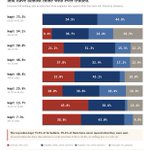
Measured something new this week. Of the people still holding a token, how many have ever actually done anything with it?
Retention tells you who is still there. It says nothing about whether they ever moved, and those turn out to be very different questions.
Eight tokens in, the median says 56.3% of current holders are sitting on exactly what they were originally sent. Never bought more, never sold any, never touched it once. The range runs from 38.9% to 99.4%, and five of the eight sit above half.
The extreme case keeps 73.5% of everyone who ever held it, the best retention in my set, and 99.4% of those holders have never moved a single token. That project could truthfully say it retains three quarters of its community. Almost none of that community has done anything.
There is a tempting pattern in here, which is that retention climbs as engagement falls. Across eight tokens the correlation is +0.75, which sounds like a finding. Drop the one extreme token and it falls to +0.52, so a good deal of it is coming from a single project. I am not claiming it yet. Eight is still few enough that one token moves the answer.
The narrower claim holds up fine. Roughly half of a holder count is people who were handed something once and never came back.

Nicki’s College Football Top 25 after Week 8 🏈
Miami is the new #1. Unbeaten, the #1 offense in my ratings, and a 29-point win over Pitt.
The biggest moves:
Texas up 8 to #9. Two losses, but the hardest schedule in the country and wins over Ohio State and Ole Miss. 7-0 Utah stays ahead of them. Utah grades slightly better on both strength and resume, and I’d rather rank them on what they’ve done than reward Texas twice for two big wins.
BYU down 9 to #12. Losing at UCF hurts, and it also costs Notre Dame. Their only loss is to BYU, so that loss looks worse now, and they drop to #14 without playing.
Alabama up 6 to #4 at 6-2. They still have the highest Power rating in my top 5. Both losses are to teams in my Top 25, and they’ve played the #2 schedule.
New: Oklahoma State, Wisconsin, and Oklahoma. Yes, Oklahoma is 4-3. They have the #3 defense in my ratings, the #7 schedule, and a win over Texas.
Out: USC, Iowa, and Mississippi State.
Last week the model went 10 for 17 in games involving my Top 25. Six ranked teams lost on the road. Not my best week, and I’ll break down what I got wrong this week.


Spent yesterday building a metric that separates two things every holder count treats as one.
A wallet holding three dollars of a token got there one of two ways. Someone was handed an airdrop and never touched it, or someone bought a real position, rode it down, and sold out leaving a tail of dust. One is a wallet that never really showed up, the other is a holder who showed up and left.
Telling them apart needs what each address was originally sent, not only what it holds now. A wallet still sitting on most of what it received has never traded. One holding a fraction of a percent of it sold out.
The first two tokens through it landed within a point of each other, 37.8% and 38.6% of current holders who sold out to a tail, and that held even though one of them kept six times as many people as the other. I drafted a post about it this morning and said I would bet against it surviving the rest of the set.
Two more finished while I was writing. 20.0% and 0.4%. The range across four tokens is now 0.4% to 38.6%, so there was no pattern, just two tokens that happened to agree.
What turned up instead is worth more. The best-retaining token in the set keeps 73.5% of everyone who ever held it, and 99.4% of those holders are sitting on exactly what they were originally sent. Nobody sold. Nobody added. Nobody did anything at all.
Retention counts who failed to leave. It cannot tell a community apart from a parking lot.

College football game day update: the market is moving toward my model 👀
Monday, Polymarket had Mississippi State at 40% to beat Oklahoma. My model said 61%.
Today they’re up to 46%.
What changed? Reports now say QB Kamario Taylor is expected to play after missing last week with turf toe. The market priced in his absence early in the week, and now it’s walking that back. My model never knew he was hurt, so it never moved.
Tennessee hasn’t budged: still 45% at South Carolina, versus 64% in my model. No news there, so that one is a straight disagreement.
Week so far:
📊 My model: 6-6 picking winners
💸 Paper trades vs Polymarket: 3-3, +0.6 units (Stanford at 29¢ did the heavy lifting)
Today’s biggest calls:
• Mississippi State over Oklahoma: 61%, kickoff 3:30 ET
• Tennessee at South Carolina: 64%, kickoff 3:30 ET
• Ole Miss at Texas: Texas 52%, a coin flip, 7:30 ET
• Utah over Houston: 68%, 10:15 ET
Scoreboard tomorrow. 🏈


I have a question for everyone building RWAs.
If your tokenized asset disappeared from the blockchain tomorrow, what would the holder actually lose?
If the answer is nothing beyond a convenient interface, you're probably not getting the full benefit of tokenization yet.
The real opportunity is in the rights, transfers, collateral, settlement, and financial products that become possible because the asset is onchain.
What am I missing?
Where my model and the market disagree most this Saturday 🏈
This week, my model and Polymarket disagreed hard on three weeknight games. The market was closer every time. So here are Saturday’s biggest gaps, and fair warning: history says bet on the market.
My model likes them more than the market does:
• Mississippi State over Oklahoma: model 61%, market 40%. QB Kamario Taylor is questionable but trending toward playing, and the market has climbed from 36% as the news improved.
• Tennessee at South Carolina: model 64%, market 45%. The line flipped from Tennessee favored to South Carolina favored last weekend, with no injury news to explain it.
The market likes them more than my model does:
• LSU at Auburn: market 72% LSU, model 61%
• Oregon at Illinois: market 76% Oregon, model 67%
• Ole Miss at Texas: market 60% Texas, model 52%
When the market is more confident than my model, it usually knows something I don’t. Injuries, matchups, lineups: my model only sees final scores.
5 games, 2 directions. Let’s see how many the data gets right. Scoreboard Sunday. 👀

Read eight token contracts balance by balance this week.
ethereum:0x5283d291dbcf85356a21ba090e6db59121208b44 reports 51,179 holders, but only 1,240 of them hold $100 or more.
The gap between a holder count and a holder isn't a rounding error, it's most of the number.


What’s a starting quarterback worth? I measured it. 🏈
I found every FBS game from 2024 to now where a team’s established starter (the QB with the most starts that season) didn’t play, then compared how those teams did against what my model predicted.
The first game without the starter: teams did 2.5 points worse than expected. That’s across 213 games, and it held up in all three seasons.
But here’s the twist: after that, the effect mostly fades. Across every game a starter missed, it’s less than 1 point. Once a backup has a game or two of tape, the results start to reflect who’s actually playing.
So the big drop is the surprise game, the first time a team takes the field without its guy.
Which brings us to Saturday: Oklahoma at Mississippi State.
Mississippi State QB Kamario Taylor is questionable with a foot injury. Here’s what my model says:
• Taylor plays: Mississippi State 61%
• Taylor out (−2.5): Mississippi State 55%
• Taylor out, valued as a star (−5): Oklahoma 52%
@Polymarket has Oklahoma at 64%.
Even taking Taylor out, my model likes Mississippi State more than the market does. Either the market knows the backup is a big step down, or it’s overreacting to one 31-0 loss at LSU.
Final injury report is 90 minutes before kickoff. We’ll see who’s right. 👀

This is what institutional tokenization actually looks like in practice.
Not every company needs to build its own regulated trading infrastructure from scratch.
Temple Digital Group brings the trading technology. tZERO provides the regulated broker-dealer and ATS infrastructure. Canton Network provides the underlying network.
That separation of responsibilities is important. It lets companies focus on their products and customers while leveraging established infrastructure for regulated securities trading.
The next phase of tokenization won’t just be about simply issuing assets onchain, it’ll be about making institutional-grade market infrastructure composable.

@temple_ny selects @tZERO as broker-dealer and ATS operator for its tokenized securities platform on @CantonNetwork.
Expanding tZERO’s Infrastructure-as-a-Service business.
Your brand. Your clients. Our infrastructure.
🔗 tzero.com/news/tzero-selecte…

