

I write about the money behind AI: filings, compute, agentic commerce and crypto. Not financial advice.
Joined March 2009
- Tweets1.2K
- Following705
- Followers264
- Likes3.4K






Pinned Tweet
Visa tested 22 AI models as personal shoppers. Gemini 4 Argon and Muse Wonder came out on top at 82%, and Grok 4.7 got 60%.
Most of the misses came from not asking the shopper enough questions. Full breakdown with charts.

Two of the biggest tech companies borrowed money this week.
Apple sold $7.5B of bonds on 5 November. The three-year piece pays 4.75% a year.
Oracle sold $10B on 2 November. Its bond due in the same year, 2029, pays 7%.
The coupon is the interest rate printed on the bond, so it's what each company pays lenders every year. Line them up by the year they're repaid and Oracle pays between 2.25 and 2.75 percentage points more every time, up to 8.65% on its 20-year bond.
On $1B of 2029 bonds, that's $47.5M a year for Apple and $70M for Oracle (my maths). Oracle's five new bonds add about $777M a year in interest.
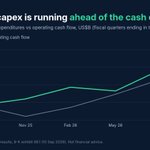
Lenders are pricing two different stories. Oracle is spending on AI data centres faster than its cash comes in: free cash flow has been negative for five quarters in a row, and borrowings were $125B in August. Apple isn't in that race.
But Oracle is borrowing against $664B of signed contracts it hasn't delivered yet. If those contracts pay out, 7% could look like a fair price for building the capacity.
My take: The biggest tech companies now compete with the US government for the same lenders. Apple borrowed at only 0.22 to 0.55 percentage points more than Treasuries. Oracle had to pay a lot more to get the same money.
What rate would you want before lending to an AI data centre builder?
Source: Apple pricing term sheet (FWP, 5 Nov 2026); Oracle 8-K (4 Nov 2026) and Q1 FY27 results (10 Sep 2026). Not financial advice.

Visa's test shopper needed a new 65 inch TV and only told the AI half of what mattered.
GPT-6.1 Sol kept asking, found all six needs and picked a $769.99 Hisense.
Claude Opus 5.5 never asked about the kid's phone videos and picked a $989.99 Sony without the video format those videos are recorded in.
All 22 models, ranked, in the Article.
teapawt.net/nickstarz/status/21187…

Microsoft is reportedly switching off the AI computing it rented from Oracle. Bloomberg says the Oracle setup ran an older generation of Nvidia chips that no longer fit what Microsoft needs, so it chose not to renew.
In the quarter to 31 August, Oracle spent $28.5B on capex (data centres and chips). Operating cash flow, the cash the business brought in, was $23.1B. So free cash flow was minus $5.4B, and minus $28.7B over the last four quarters.
Oracle's debt (notes and other borrowings) was $125.3B at the end of August.
The other side is big too. Oracle has $664B of signed work it hasn't delivered yet, up $209B in a year, and it added more than $30B of new AI cloud contracts in that one quarter. Cloud infrastructure revenue grew 121% to $7.4B.
GPUs age fast. A rack that was cutting edge two years ago can lose its best customer once newer chips arrive.
What I'll watch: Oracle's next results in December, and whether that $664B keeps growing while older capacity finds new renters.
Source: Oracle Q1 FY27 results (8-K, 10 Sep 2026); Microsoft news reported by Bloomberg (via Reuters, 6 Nov). Not financial advice.

Some scale for those numbers. Anthropic's IPO filing shows $17.0B of revenue last quarter, about 12x the same quarter a year earlier. That's roughly $68B a year at the current pace.
$1.65T would be about 24 times that. $1T would be about 15 times.
So the gap between $1T and $1.65T is really a bet on how long growth like that lasts.
What multiple would you pay for it?
Not financial advice. teapawt.net/hosseeb/status/2118752…


Despite all this performative hand-wringing, @Polymarket still gives Anthropic 73% chance to IPO by EOY.
Pre-IPO derivatives markets have price expectations for $ANT down 15% from the high... that is, from $1.9T to $1.65T.
Nowhere near $1T. $1T is hilariously low.
Seems to me like these stories are nonsense and the IPO will be totally fine, and institutional buyers are planting these quotes in WSJ/Bloomberg because they're angling to push down the price on the IPO.
Anthropic is _THE_ AGI stock. It is already cash-rich. The appetite for this company will obviously be enormous.
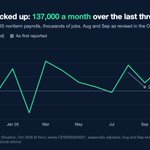
October's US jobs number came in at 165,000. The 12 months before that averaged 48,000 a month.
And it wasn't only October. The BLS also revised August and September up by 84,000 between them. So the last three months now average about 137,000 a month.
Where the jobs came from:
• Business services (consulting, staffing, office support): 70,000
• Health care: 42,000
• Transport and warehousing: 25,000
• Manufacturing: 19,000
That's 156,000 of the 165,000 from just four industries.
The softer parts. Unemployment was 4.1%, inside the 4.1 to 4.3% range it's held since March. And the number of people working part time because they can't get more hours rose by 339,000, to 4.8 million.
Last night I said a strong number cuts the other way for the Fed: good news for jobs, less reason to cut. Wages also rose 0.4% in October, and 3.1% on a year ago. One more jobs report (4 Dec) lands before the Fed meets on 8–9 Dec.
My take: Last night I thought hiring was slow. This report says I was early. It's good to be wrong in that direction.
What would the next report need to show for you to call this a real turn?
Sources: BLS Employment Situation for October 2026 (released 6 Nov), BLS payroll series CES0000000001, Federal Reserve FOMC calendar. Not financial advice.


Would you let an AI buy your next TV?
Visa just put 22 AI models through 15 shopping tests. Only 57% of the runs ended with the right product. The best two got 82%.
Why the rest failed surprised me. Full breakdown tomorrow morning.

The US jobs report for October comes out at 8:30am New York time today. It's the first big number since Thursday, when QQQ (the Nasdaq 100 fund) fell 6.4%.
Hiring has been slow for a while. The US added 496,000 jobs in the 12 months to September, about 41,000 a month. September was 29,000, and July was revised to a loss of 10,000. Unemployment is 4.2%.
Why it matters more than usual today. A soft number makes a Fed rate cut at the 8–9 Dec meeting more likely, and cheaper money usually helps stocks. A very weak one adds a second worry on top of AI spending: that the economy is slowing too.
A strong number cuts the other way. Good news for jobs, less reason for the Fed to cut.
One more jobs report (4 Dec) lands before the Fed meets.
What number would change your mind about Thursday?

Sources: BLS Employment Situation for September 2026 (released 2 Oct) and its release schedule, BLS payroll series CES0000000001, Federal Reserve FOMC calendar, QQQ close from stockanalysis.com. Not financial advice.

The Ethereum Foundation has written a 71-page guide telling governments and central banks why they should build on Ethereum.
Since 1 October, $1.88B has left US ether ETFs. Money went out on 22 of 26 trading days.
Both can be true at once. Here's what the pitch says.
It says Ethereum is the hardest of the big chains to attack. To force through a fake transaction, someone would need to control about $50.7B of staked ETH. For Solana it's $23.3B, BNB Chain $11.3B, TRON $8.7B.
(Staking means locking up coins to help run the network. Cheat, and you lose some of them.)
It also says Ethereum is where the money already sits: $159B of stablecoins, well ahead of TRON's $89.1B, and $15.2B of tokenized real-world assets like funds and bonds. And no outages since 2015.
What it leaves out. These are March 2026 figures, picked by the network's own advocate. A list of banks and funds testing Ethereum isn't the same as fees flowing to ETH holders, and the report says very little about fees, supply or price. A lot of activity also runs on cheaper networks built on top of Ethereum, which can mean less in fees for Ethereum itself.
And the ETF money hasn't turned. 4 Nov was the first inflow day since 23 Oct ($53.0M). On Thursday's selloff, $99.9M went back out.
My take: Ethereum still looks like the first choice for tokenization, and that's the part of the pitch I believe most. Whether that turns into value for ETH holders is the bit I'm less sure of.
I'm going through all 71 pages in plain English for an Article next week. Which claim would you want checked first?

Sources: Ethereum Foundation, "Ethereum Basics for Governments and Institutions" (2026; mostly March 2026 data from OpenZeppelin and RWA.xyz). Farside Investors ETF flow data.
The chart behind this only has Anthropic's models on it. METR also ran it with every lab's public models included. That version is calmer, but not by much.
Across all labs, the best score on METR's benchmark index rose 17 points a year before October 2025. Since then it's 24 a year, a 1.4x speed-up. Anthropic's own line went from 15 to 29 (1.9x), partly because it started below the pack.
Since October 2025 the top spot has been Anthropic's. Before that, other labs held it almost the whole time.
The dot at the very top is "Model 4", an Anthropic model that hasn't been released. It has no public name: METR says Anthropic uses a different codename inside, so anything called Opus 6 or Mythos 6 is a guess. It scored over 50% on all 15 benchmarks it was tested on, and staff polls say it makes them about 12x faster at their work.
The catch: other labs' unreleased models aren't on the chart, only what they've shipped. And the index is Anthropic's own version, built partly from its internal tests.
I still think there’s going to be a limit to how much recursive learning can do, but only time will tell.
If OpenAI and Google let METR in too, what do you think their chart would show?


IREN started out mining bitcoin. On 5 Nov it said an AI lab will pay 90% of the GPU bill up front on a new five-year deal.
The lab isn't named. The deal is about $22M a year in revenue per megawatt of IT capacity.
For a neocloud (a company that rents out AI chips by the hour), the GPUs are the biggest cost. When the customer pays for most of them before the service starts, IREN has to borrow far less to buy them. On its Microsoft deal, the prepayment covered about a third of the GPU cost ($1.94B of $5.81B, my maths).
The business has changed fast. AI cloud revenue went from $71M to $200M in one quarter. Bitcoin mining went from $67M to $28M.
The other side. IREN still has to pay for the data centres and the power, and net debt went from $216M to $4.43B in the quarter. It lost $263M. And IREN's own footnote says prepayment terms vary by contract, so 90% is one deal for now.
My take: This seems to have happened to a lot of bitcoin miners, it will be interesting to see if one day they swing back, or if bitcoin becomes more profitable again.
What I'll watch: whether the next contracts from IREN, or from other neoclouds, get anywhere near 90%.
Source: IREN Q1 FY27 results (8-K, 5 Nov 2026) and IREN's GPU financing release (1 Jun 2026). Not financial advice.

An outside group just spent 11 weeks inside Anthropic checking one thing: is AI now speeding up the building of AI?
Their answer is probably yes. At about twice the old pace. 🧵 teapawt.net/metr_evals/status/2118…

In my opinion, AI has already been lightning fast over the last few years. If it's now accelerating, it's hard to imagine where it'll be in another 12 months.
That being said, does recursive improvement (AI building better AI, which builds better AI again) have a limit?