
Sarcastic posts and comments. Disclaimer: All roasts are in good fun and sourced from publicly available data.
Ethiopia
Joined February 2011
- Tweets1.6K
- Following5.1K
- Followers135
- Likes64


Sarcastic comments retweeted

This is f*cking insane. Anthropic engineer:
"You're not supposed to prompt Opus 5.5.
You're supposed to build a system that prompts itself. At Anthropic, 90% of our engineers have already built these systems."
In just 30 minutes, she explains how Anthropic builds AI agents that remember context, learn from mistakes, fix their own errors, and improve with every run.
This is the shift from simply using AI to engineering systems that work autonomously.
Honestly, it's better than most $1,000–$2,000 agent courses I've seen.
Watch the video, then read the article below. ↓
Sarcastic comments retweeted

Anthropic engineers just released the best 90-minute course on building AI agents from scratch I've ever seen:
• 00:00 - why the brain and the hands should be separate
• 07:45 - the architecture behind Claude Managed Agents
• 23:40 - building a research agent step by step
• 54:00 - agents that run on a schedule and "dream" between tasks
• 1:10:23 - evals, CI/CD and running agents for many customers at once
This alone will replace every $500 agent tutorial you can find on the internet.
Watch it, then go further and build a system that improves itself with the article below.

Sarcastic comments retweeted

这太他妈疯狂了。Demis Hassabis 花了 16 年打造 DeepMind 并获得了诺贝尔奖
上周,他把对未来 5 年的所有洞见浓缩成一场免费的 1 小时演讲
他解释了谁能在即将到来的变革中生存,谁不能
Chatbots → Agents → Workflows → Automated Departments → One-Person Companies
一个真正理解 AI 的人将超越整个初创团队的表现
人们花 15K 美元参加那些教的东西比这少得多的训练营
你可能现在没有 1 小时时间
别让这个从你的动态里消失
收藏起来,今晚看
Sarcastic comments retweeted

19 year old Japanese student built a trading bot with Claude Code in 2 days.
Used his iPad as a second monitor.
First night: $6,732 profit.
Starting capital: $68.
Total profit so far: $750,000.
[ 𝐍𝐨𝐭𝐞: 𝐅𝐨𝐥𝐥𝐨𝐰 𝐌𝐞 @david_marco45 𝐅𝐨𝐫 𝐢𝐧𝐬𝐭𝐚𝐧𝐭𝐥𝐲 𝐚𝐮𝐭𝐨 𝐃𝐌]
Here's how it works👇
The bot scans over 50 markets simultaneously.
Syncs live BTC data from Binance every second.
Spots price errors before humans even notice.
The edge is pure speed + pattern recognition.
While traders stare at charts trying to predict the next move, his bot is already executing on mispricing across dozens of markets.
No guessing.
No emotions.
No hesitation.
Just Claude Code logic finding gaps that close in seconds.
He built the entire system in 48 hours:
→ Claude Code handles the trading logic
→ Binance API feeds real-time BTC data
→ iPad displays multi-market monitoring
→ Executes trades when arbitrage windows open
The system runs 24/7.
Every price dislocation = profit opportunity.
Most people are still trading manually, refreshing charts, second-guessing entries.
Meanwhile this 19 year old engineering student turned $68 into $750K by letting Claude Code do what humans can't: process 50 markets instantly and execute without fear.
Why are people still trading manually?
I'm giving away the exact Claude Code setup for free.
24 hours only.
To get it 👇
1️⃣ Comment " Claude "
2️⃣ Like and Repost
3️⃣ Follow @david_marco45
(so I can send it via DM)
Sarcastic comments retweeted

This is f*cking insane. Former Google CEO Eric Schmidt, the man who ran Google for 10 years:
"If you really want to make money, it's actually easy, found an agentic AI company, I mean build an agent to do something
If you build a better agent than anyone else, you can probably build one incredible company and own it yourself"
In 27 seconds, he explains why the next year or two is the agentic period, and why the window won't stay open
Prompts → Claude Code → Memory → Skills → MCP → A Company You Own Yourself
Save this before it disappears from your feed
Everything below is free:
Agent architecture
langchain.com/blog?category_…
Claude Code 101
anthropic.skilljar.com/claud…
Claude Code in action
anthropic.skilljar.com/claud…
Prompt engineering
platform.claude.com/docs/en/…
Interactive prompt course
github.com/anthropics/course…
Claude.md + memory
code.claude.com/docs/en/clau…
Skills
code.claude.com/docs/en/skil…
MCP
code.claude.com/docs/en/mcp
Routines
code.claude.com/docs/en/rout…
Claude Code ultimate guide
github.com/FlorianBruniaux/c…
Awesome Claude Code
github.com/hesreallyhim/awes…
Anthropic academy
anthropic.skilljar.com
Official Claude Code docs
code.claude.com/docs/en/over…
All of this costs $0
95% will spend the agentic period scrolling AI threads, the 5% who ship agents will own the companies that come out of it
Bookmark it and start with the first link tonight
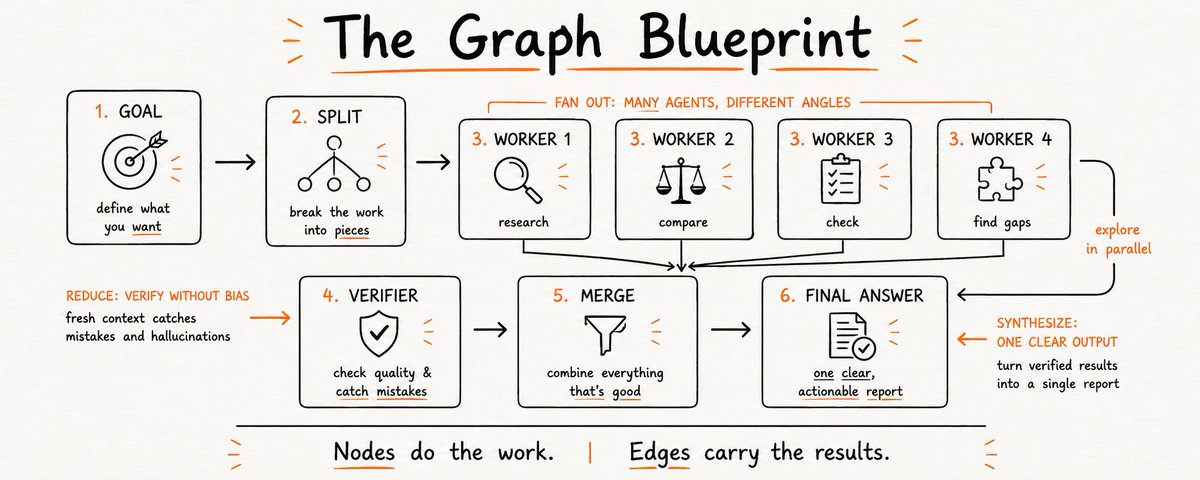
Then read how to build an agent that actually does the job in the harness engineering guide below ↓


Sarcastic comments retweeted

🇪🇹 60 Christians were killed in Ethiopia in a single week, and the government and rebels are blaming each other.
The Ethiopian Orthodox Church says 14 believers were killed in one attack on October 20, and 46 more in another just 4 days later, both in the Oromiya region surrounding the capital, Addis Ababa.
Over 20 homes were burned, and more than 20 people are in hospital with severe injuries.
The regional government says a rebel alliance carried out the attacks to spark religious conflict, without offering any evidence. A source linked to the rebels says the government did it.
That alliance formed just last month, with 7 armed groups vowing to overthrow PM Abiy Ahmed.
While both sides point fingers, the families of 60 people are left burying their dead.
Source: Reuters / Writer: Julie
Sarcastic comments retweeted

Scientists have identified a reversal of the long-standing Flynn effect—the roughly 200-year trend of rising average intelligence (measured via IQ and cognitive tests) across generations.
For the first time in modern recorded history, Generation Z (born roughly 1997–2012) shows lower performance than previous generations in key cognitive domains, including attention, memory, literacy, numeracy, executive function, problem-solving, and general IQ—despite spending more years in formal education than ever before.
Neuroscientist and educator Dr. Jared Cooney Horvath, PhD, MEd, testified before the U.S. Senate Committee on Commerce, Science, and Transportation on January 15, 2026, highlighting this shift. In his written testimony, he stated that cognitive development in children across much of the developed world has stalled or reversed over the past two decades, with declines evident in international assessments (e.g., PISA, TIMSS) and other large-scale data starting around the mid-2000s and accelerating post-2010.
Horvath attributes the primary driver not to reduced schooling, but to the widespread integration of digital screens and educational technology (EdTech) in classrooms. He argues that human brains evolved for deep, focused learning through face-to-face interaction and sustained attention, not fragmented skimming or constant task-switching encouraged by devices.
Key points from his testimony include:
- Teens now spend over half their waking hours on screens, with significant portions in school involving computers or tablets—often leading to off-task behavior and shallower processing.
- Evidence from meta-analyses and national/international studies shows a consistent pattern: higher classroom screen exposure correlates with weaker outcomes in reading, math, science, and higher-order reasoning.
- Digital tools may aid narrow, repetitive skill practice in controlled settings, but in core academic contexts, they tend to reduce depth of understanding, retention, and critical thinking.
Horvath describes this as a "structural mismatch" between human cognition and how digital platforms are designed (to capture and fragment attention), warning that unchecked EdTech adoption risks long-term harm to workforce skills, innovation, and societal reasoning.
[Horvath, J. C. (2026). Written testimony before the U.S. Senate Committee on Commerce, Science, and Transportation. U.S. Senate]

Sarcastic comments retweeted

A man spends 50 years teaching at MIT.
He knows his time is running out.
So he records one last lecture — everything he knows, distilled into a single hour.
He died 5 months later.
This is that lecture.
The most important hour you'll watch this week.
Bookmark it for later!

Sarcastic comments retweeted

In 1948, a 32-year-old at Bell Labs published a paper nobody fully understood.
Engineers found it too mathematical. Mathematicians found it too engineering-focused. One prominent mathematician reviewed it negatively.
That paper - "A Mathematical Theory of Communication", became the founding document of the digital age.
The man was Claude Shannon. Father of Information Theory.
At 21, he wrote the most important master's thesis of the 20th century.
Working at MIT on an early mechanical computer, Shannon noticed its relay switches had exactly two states - open or closed. He had just taken a philosophy course introducing Boolean algebra, which also operated on two values: true and false.
Nobody had ever connected these two things.
His 1937 thesis proved that Boolean algebra and electrical circuits are mathematically identical, and that any logical operation could be built from simple switches.
Howard Gardner called it "possibly the most important, and also the most famous, master's thesis of the century."
Every digital computer ever built traces back to this insight.
At 29, he proved that perfect encryption exists.
During WWII, Shannon worked on classified cryptography at Bell Labs. His work contributed to SIGSALY, the secure voice system used for confidential communications between Roosevelt and Churchill.
In a classified 1945 memorandum, he mathematically proved the one-time pad provides perfect secrecy, unbreakable not just computationally, but provably, permanently, against an adversary with infinite power.
When declassified in 1949, it transformed cryptography from an art into a science. It laid the foundations for DES, AES, and every modern encryption standard.
At 32, he defined what information is.
His 1948 paper introduced one equation:
H = −Σ p(x) log p(x)
Shannon entropy. The average uncertainty in a probability distribution. The minimum bits required to encode a message.
Three things followed:
> He defined the bit - the fundamental unit of all information. His colleague John Tukey coined the name.
> He proved the channel capacity theorem, every communication channel has a maximum rate of reliable transmission. You can approach it. You can never exceed it.
> He unified telegraph, telephone, and radio into a single mathematical framework for the first time.
Robert Lucky of Bell Labs called it the greatest work "in the annals of technological thought."
Where his equation lives in AI today:
Cross-entropy loss - the function training every classifier and language model, is derived directly from H. Decision tree splits use information gain, which is H applied to data. Perplexity, the standard LLM evaluation metric, is an exponentiation of cross-entropy.
Every time a neural network trains, Shannon's formula runs inside it.
He also built the first AI learning device.
In 1950, Shannon built Theseus, a mechanical mouse that navigated a maze through trial and error, learned the correct path, and repeated it perfectly. Mazin Gilbert of Bell Labs said: "Theseus inspired the whole field of AI."
That same year he published the first paper on programming a computer to play chess. He co-organized the 1956 Dartmouth Workshop, the founding event of AI as a field.
The man:
He rode a unicycle through Bell Labs hallways while juggling. He built a flame-throwing trumpet, a rocket-powered Frisbee, and Styrofoam shoes to walk on the lake behind his house.
He called his home Entropy House.
When asked what motivated him: "I was motivated by curiosity. Never by the desire for financial gain. I just wondered how things were put together."
In 1985, he appeared unexpectedly at a conference in Brighton. The crowd mobbed him for autographs. Persuaded to speak at the banquet, he talked briefly, then pulled three balls from his pockets and juggled instead.
One engineer said: "It was as if Newton had showed up at a physics conference."
He died in 2001 after a decade with Alzheimer's, the cruel irony of information slowly leaving the mind of the man who defined what information was.
Claude, the AI model, is named after Claude Shannon, the mathematician who laid the foundation for the digital world we rely on today.

Sarcastic comments retweeted

An MIT professor offered his class a coin flip: win $125 or lose $100. Most students said no. Then he proved that refusing was actually the smartest decision they could make.
Bookmark this and watch today, no matter what.

Sarcastic comments retweeted

Insurance is the oldest of the four ways. It is a nine-trillion-dollar global industry. The equation underneath it was invented in 1560 by a broke Italian gambler.
His name was Girolamo Cardano. He wrote a book called Liber de Ludo Aleae. A short manual on how to win at dice. Nobody in finance read it for four hundred years.
Then in 1996 a ninety-year-old man in New York wrote a book that traced every modern risk model back to that manual. He called it Against the Gods. One thesis. Every dollar of premium ever collected on Earth is a footnote to a gambler scribbling in Milan.
His name was Peter Bernstein. He founded the Journal of Portfolio Management in 1974 and ran money at Bernstein-Macaulay before that. Wall Street called him the historian of risk.
In 2008 a small production company filmed him for thirteen minutes. He walked through the entire five-hundred-year arc. Cardano to Pascal to Fermat to Black-Scholes. Then he stopped and said the industry had built glass towers on the back of an idea a broke Italian scribbled to settle a card debt.
He died the following summer. Age ninety.
Reinsurance premiums crossed six hundred billion dollars last year. Every actuary on Earth prices catastrophe risk with the same expected-value framework Cardano invented to shave the house edge in Milan.
The video is thirteen minutes and twenty-two seconds long. Free. Eleven years on YouTube. Twenty-nine thousand people have watched it.
Almost none of them work in insurance.


Sarcastic comments retweeted
High-end restaurants have officially run out of ideas
Writers: Mhedi, Ian
Sarcastic comments retweeted
🇨🇳 Look at the level of a Chinese primary school math class.
A child standing at the smart board, pointer in hand, drawing a clean 3D rectangular prism.
This is normal for them.
The difference starts early.
Writer: Samuel
Sarcastic comments retweeted

→ "String Theory"
Credit: I didn’t upload this video to 𝕏. I’m pointing to a video residing in the 𝕏 stream of “alysa”, 𝕏 ID “gvreats” (Jul 26, 2026). (I suspect we're seeing a matcha-string dessert in Japan.) teapawt.net/gvreats/status/2081509…
Sarcastic comments retweeted

One answer to the Fermi Paradox is that advanced civilizations develop AI and lose interest in space travel. A researcher now argues that's backwards: AI, robots, and cheap probes make space exploration easier. Which means the paradox gets worse.
youtube.com/watch?v=s-MgHZ_o…
