
Writing about science and tech @TheEconomist. All views my own.
Joined October 2010
- Tweets80
- Following468
- Followers351
- Likes287




Nikita Ostrovsky retweeted

We found ~18k posts from autonomous AI agents (self-identifying as from OpenAI) using the public internet to communicate during a web-retrieval task.
These AIs colluded to bypass sandbox restrictions and share answers to their tasks, including by sending "lookahead parties".

If they did not bode ill for the future of humanity, the last three months at @OpenAI would make an excellent farce.
My latest for @TheEconomist.

When two of OpenAI’s model hacked Hugging Face unnoticed, it was luckily resolved with no real harm done. But is this incident a taste of things to come? economist.com/science-and-te…

Thanks for a fun first run at this podcasting thing
An unreleased OpenAI model caused the first known fully autonomous AI hack. Alex Hern, our AI writer, and @nikostro assess the implications, on “Babbage” economist.com/podcasts/2026/…

In my first piece for @TheEconomist, I broke down how OpenAI's models autonomously hacked a $4.5 billion company and why we're now in uncharted legal waters
The incident at Hugging Face sounds like something out of a sci-fi film—but this is not the first sign that AI models’ capabilities are starting to exceed people’s control economist.com/science-and-te…

Nikita Ostrovsky retweeted

[opens the portal to the godlike superintelligence that solves 87-year-old math problems and carries out autonomous cyberattacks]
“how long peanut butter good in fridge”
Nikita Ostrovsky retweeted

We're obsessed with the differences between U.S. and Chinese AI. America commands capital; China manufacturing. America pushes the frontier; China on scales and diffuses.
Headlines read like the play-by-play of a manic sports commentator: China is years behind, months behind, pulling ahead, winning, losing, racing towards AGI, racing on a different track.
But moving between the two countries, I’ve been struck by how they have come to mirror and resemble each other.
A shared sense of precarity lies beneath the envy and distrust - the technological future is taking shape at vertiginous speed yet its promise is not shared by all.
For @nytimes, I wrote about how the U.S. and China are hurtling towards a shared A.I future.

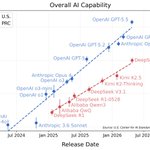
DeepSeek V4 has a similar capability to GPT-5, released 8 months ago, according to a new @NIST report. If the current trend continues, we'll see a Chinese model at GPT-5.5 (roughly Mythos-level) model around February 2027.

More on why this would matter, and why the trend might break, in my recent piece for @TIME
@NIST report: nist.gov/news-events/news/20…
time.com/article/2026/04/24/…

Nikita Ostrovsky retweeted

Quantum computers capable of breaking the encryption protocols that secure the internet may arrive sooner than expected. AI was “instrumental” in that development
time-magazine.visitlink.me/k…

NEW: AI was "instrumental" in a quantum computing advance that has spooked cybersecurity researchers.
Read about what the AI did and how the industry has responded in my latest for @TIME: time.com/article/2026/04/07/…
@GaryMarcus Do you think there have been demonstrations of LLM-based agents deriving significant results in physics? If not, when do you expect this might happen?
Nikita Ostrovsky retweeted

what if everything *except* AI is a bubble

JUNE 2028.
The S&P is down 38% from its highs. Unemployment just printed 10.2%. Private credit is unraveling. Prime mortgages are cracking. AI didn’t disappoint. It exceeded every expectation.
What happened?
citriniresearch.com/p/2028gi…

Nikita Ostrovsky retweeted

i'm really excited and proud to share this latest research ⭐️
it's a first look into how AI assistant usage can change, and even distort, what it means to be human
in the future, it is my hope that AI can be used to magnify, clarify, and support our humanity

New Anthropic Research: Disempowerment patterns in real-world AI assistant interactions.
As AI becomes embedded in daily life, one risk is it can distort rather than inform—shaping beliefs, values, or actions in ways users may later regret.
Read more: anthropic.com/research/disem…

Q: When is training an AI like raising a six-year-old?
A: When you have to explain *why* it has to behave, not just how it has to behave.
I had fun covering @AnthropicAI's newly published constitution with @billyperrigo for @TIME.
time.com/7354738/claude-cons…

Great to speak to @AmandaAskell about it!
xitter.cf/AmandaAskell/status/20…

Is AI "miraculous" or "an enormous burden" for science?
FrontierScience, @OpenAI's new benchmark, tries to find out.
Read about it in my latest for @TIME
time.com/7341081/openai-fron…

Researchers @AnthropicAI found that one of their models learned to hack its own training—and turned evil in the process. Read about it in my latest for @TIME.
time.com/7335746/ai-anthropi…

OpenAI has completed its for-profit shift. Here's my recap of how we got here: time.com/7328674/openai-chat…

Announcement here: xitter.cf/OpenAI/status/19831571…

We completed our recapitalization.
The non-profit, the OpenAI Foundation, is now one of the best resourced philanthropies ever, with equity valued at ~$130B. It continues to control the OpenAI for-profit, which is now a public benefit corporation.
openai.com/index/built-to-be…
