









Pinned Tweet
Kimberly Powell. The Nvidia VP the NYT just named in Jensen Huang's second reported affair.
I looked her up on @autumn_ai_inc. Here's her whole career:
She's 48 and based in Santa Clara. She studied electrical engineering at Northeastern, with a concentration in computer engineering. She is also married (won't share name).
Her career started with an internship at a medical imaging company, working next to radiologists. That turned into engineering and product management on diagnostic displays at Planar Systems.
Then she contacted Nvidia about using its GPUs. Their answer, in her words: "We have early evidence that healthcare is going to be a great user of this technology, but we don't know how. Would you like to join the company and help us figure that out?"
She joined in 2008, when Nvidia was still a graphics card company. Her job was to get GPUs inside medical imaging machines.
After that she ran Nvidia's higher education and research business, NVIDIA AI Labs, and Inception, its startup program with 4,000+ AI startups.
Today she's VP of Healthcare and runs the whole thing worldwide: medical imaging, drug discovery, life sciences. BioNeMo is hers. So is a federated drug discovery network across five pharma companies.
In 2026 alone she gave the special address at GTC Berlin, launched Nvidia's Open Agent Safety Platform with 100+ partners, and did the rounds at the JPM Healthcare Conference in January.
She has 1,828 followers on X and posts 2-4 times a month, almost all of it about healthcare AI.
Then today: the NYT, citing five anonymous sources, reported that she and Jensen were caught on video "being affectionate" at a San Jose hotel in March. Both are married. The Times hasn't seen the video itself.
A former employee told CNBC that rumors had gone around for years.
When the NYT called Jensen, he said "It seems you should not be speaking with me directly" and hung up. She hasn't commented, and neither has Nvidia.
Nvidia fell more than 7% after hours, and the WSJ says the board is preparing to oust him.
pinterest: pinterest.com/kgerade/
twitter: @kpowgerade (autumn found the same username pattern)



Darsh retweeted

Guys, mathematicians are officially out of a job if they don't use AI. Read this. Every 3 to 4 days, another unsolved maths problem gets solved, either by AI or by humans working with AI. This time it's a groundbreaking result with serious real-world implications.
A matrix is a grid of numbers. To multiply two of them, you take a row from the first grid and a column from the second, multiply them number by number, and add up the results. That gives you one entry of the answer. For two grids of size n×n, each answer entry needs n multiplications, and there are n² entries. That makes n³ steps in total.
That n³ is the problem. Make the grids twice as big and the work goes up 8 times. Make them 10 times bigger and it goes up 1,000 times. Almost all of modern computing runs on this operation: every AI model, every graphics card, every large simulation. So how fast it can be done really matters.
In 1969, Volker Strassen found a trick. He showed you can multiply two 2×2 grids with 7 multiplications instead of 8. Apply that idea over and over to bigger and bigger blocks, and the cost drops from n³ to about n^2.81. That number in the exponent is called ω, and it measures how the work grows as the problem gets bigger. For 57 years, mathematicians have been racing to push ω lower, and by last year the record was about 2.37.
Everyone agreed it could never go below 2, because just reading the n² numbers in the grids costs that much. The big question was where between 2 and 2.37 the true answer sits. Most researchers believed it was exactly 2, which would mean that in theory multiplying matrices is almost as cheap as reading them.
Answering that question needs two things. An upper bound says "here is an algorithm this fast." A lower bound says "nothing can ever be faster than this." In October, OpenAI's model brought the upper bound down to 2.25, and several independent research groups have since proved that result again themselves. Today's paper delivers the matching lower bound. No algorithm built from arithmetic operations can ever beat 2.25. So the answer is exactly 9/4, and the long-held hope that it was 2 is wrong.
Now the implications.
First, there is now a mathematical ceiling on how much cheaper AI's core maths can get through better algorithms. Nobody is going to find a trick that makes these multiplications nearly free. Future cost drops have to come from hardware, energy, and model designs that do fewer or smaller multiplications. That tells you where the real leverage in AI infrastructure sits.
Second, the result reaches well beyond AI. Inverting a matrix, computing a determinant and solving large systems of linear equations are all known to have the same exponent as multiplication. Those sit underneath weather models, structural engineering, chip design, logistics and risk models in finance. We now know the theoretical best each of them can ever do.
Third, it changes nothing on your machine tomorrow. The algorithms that reach 2.25 only win on matrices vastly larger than anything we actually compute, so GPUs will keep using the methods they use today. The practical race now moves to constants, memory and hardware, not the exponent.
Fourth, proving that something can't be done fast has been the weakest area of computer science for decades. A clean lower bound on a problem this central suggests that wall has started to crack, and that is the territory where questions like P vs NP live.
Mathematicians are officially cooked.

Apparently Strassen was right: the matrix mult exponent is (exactly) 2.25
github.com/openai/math/tree/…
9/4

another incredible result🚨 from oai. matrix multiplication cannot be done in quadratic (n^2) time. it requires n^(9/4) time!!!!!
some background on why the difference between 2 and 2.25 is significant:
the naive algorithm for the matrix multiplication of two nxn matrices takes n^3 time. for each of the n^2 entries in the result, you have to do a dot product over n pairs.
in 1969, strassen found a way to multiply matrices in n^2.807 time (!!), which is asymptotically better than n^3 and a very cool part of the undergrad algos course.
this kicked off a line of research with ever-improving exponents:
- 1969 Strassen: 2.807
- 1978–81 Pan, Bini, Schönhage: ~2.52
- 1990 Coppersmith–Winograd: 2.376
[stall for many years]
- 2012 Virginia Vassilevska Williams: 2.3729 (!!)
- 2026 OpenAI: 2.25 (Oct of this year)
it seemed like we were nearing an exponent of 2, i.e. n^2 or quadratic time. (this is also the bare minimum, since the answer that we need to write has n^2 entries).
the key open question: can we do quadratic time matrix multiplication?
finally we have an answer (!!!!). openai just proved that matrix multiplication requires exactly n^2.25 time by proving a lower bound match Oct's algorithm (upper bound).
this is really cool and really fascinating. why 9/4? the universe is full of mysteries.
repo: github.com/openai/math/tree/…
6
565
guys you don't understand how big this is
for the last 5 years AI has been eating biology, and it went in two steps
first, reading proteins. a protein folds into a 3d shape and that shape is everything. predicting it from the raw sequence was a 50 year old problem until deepmind's alphafold cracked it in 2020. won the nobel last year
then, writing the actual proteins. david baker's lab @UWproteindesign built tools like RFdiffusion that design brand new proteins from scratch, including little "binders" that grab onto a target. that's the core trick behind most drugs. same nobel. in the last year people have designed proteins that hit cancer targets, that act on the receptors behind pain and itch, even ones using chemistry that doesn't exist in nature
every one of those was a specialized model. built for biology and nothing else. deepmind's drug spinout isomorphic is doing the same thing, their newest engine more than doubled alphafold's accuracy at fitting drugs to targets. human trials expected this year
today openai showed GPT-6 can do the second part with none of that. no biology model. it just reasons through it and writes code, same as it would a math problem, and out comes a new protein. they built the proteins in a real lab and a good percentage worked
a decade of work and two nobels went into building specialized machines for this. now the model you text all day walks in and does a chunk of it, having never been built for biology
not solved btw. they still used the specialist tools to filter the designs, and reading a protein's final shape is still very weak. the point is: these generalized models show up and are starting to outperform every other kind of ML model to exist

We’re sharing a new preprint showing wet lab validation of intrinsic protein design capabilities of the GPT-6 family of models.
Our models can design new protein shapes and sequences using reasoning and code, without calling specialized biology models to generate them.
openai.com/index/gpt-6-model…
Darsh retweeted

idk why but i always assumed all YC partners were previously YC founders themselves, but turns out there are some exceptions. biggest surprise for me was Dalton!
Here are all of them: Ali Rowghani (@ROWGHANI), Anu Hariharan (@anuhariharan), Dalton Caldwell (@daltonc), Geoff Ralston (@gralston), Paul Buchheit (@paultoo), Holly Liu (@hollyhliu), Peter Thiel (@peterthiel), Uri Lopatin (@urilopatin), Carolynn Levy (@cjoneslevy), Kat Manalac (@KatManalac), Kirsty Nathoo, Tim Brady and Jon Levy.
also pretty insane that Peter Thiel was a visiting partner at one point, would've never guessed lol
the founders behind this are a penn dropout and a high school dropout
daniel tian (@danieltian) was doing CS + wharton at penn and interned at silver lake. then he exported his iMessage history, trained an AI on it, and let it text his friends as him for a week. not a single one noticed
he open-sourced the iMessage piece, thousands of developers picked it up, and that became photon
ryan zhu (@ryanzhuuuu) dropped out of high school. he used his sister's ID to sneak into university hackathons abroad. after losing one, he decided to run his own
his team was a few classmates and some friends from the internet. once one VC partner agreed to show up, he put the firm's logo on his deck and used it to pull in everyone else. it became one of china's biggest AI hackathons. then he went to MIT media lab as a visiting student
photon: $4.5M seed in october, 40K+ developers, revenue up 10x in 4 months
found all of this with @autumn_ai_inc

Your agent can now call & text you using the same phone number. 📞
Photon 2.0 voice plugs into the stack you already run: ElevenLabs, Twilio, LiveKit, Retell.
No migration, just point your SIP at Photon.
3
392
the 3 xAI cofounders behind epochal.
all of this came from typing them into @autumn_ai_inc
guodong zhang (@Guodzh)
> PhD in machine learning, university of toronto
> google brain intern under geoff hinton
> deepmind research scientist, core contributor to gemini
> xAI cofounder: led all of grok pretraining, including their first 100k GPU training run
> reportedly put $100M of his own money into epochal
zihang dai (@zihang_dai)
> degree from tsinghua, then a CS masters + PhD at CMU
> interned at baidu and mila
> google researcher, worked on XLNet
> xAI cofounder
manuel kroiss (@makro_ai)
> bioinformatics masters at TU munich. his thesis used neural nets to predict stem cell fates
> google, then deepmind 2017–2023: worked on alphastar and alphacode
> senior director of engineering at twitter, ~3 months before xAI launched
> xAI cofounder: led pretraining, reported directly to elon
all 3 left xAI in march, a month after the spacex merger


tom blomfield (@t_blom) has reportedly left anthropic after 4 months
wild career. first startup at ~18, first-class law degree from oxford, then cofounded gocardless and monzo
he left monzo in 2021 because he was burnt out. "i was really struggling." then he trained to give covid vaccines
found all of this with @autumn_ai_inc


28
11,712
Ilhan Omar (@Ilhan). Federal prosecutors just told a judge they believe she committed crimes "over decades — beginning long before she was ever in Congress."
All of this came from typing her name into @autumn_ai_inc.
She was born in Mogadishu around 1982, and she doesn't have a birth certificate. She fled Somalia's civil war at 8 and spent four years in a refugee camp in Kenya.
She came to the US in 1995, moved to Minneapolis in 1997, and became a citizen in 2000.
She got a political science degree from North Dakota State in 2011. Her first jobs were a child nutrition outreach role at Minnesota's Department of Education, then running a city council campaign in 2013. The candidate won, and she became his senior policy aide.
In 2016 she ran for the Minnesota House and beat a Democrat who'd held the seat since 1973. That made her the first Somali-American legislator in the country. Time put her on its cover the next year.
In 2019 she went to Congress, the first African refugee ever elected to it. She's one of the first two Muslim women to serve there, alongside Rashida Tlaib. She's a member of "the Squad" and deputy chair of the Progressive Caucus.
Some moments since:
She led 13 House members filing articles of impeachment against Trump the day after January 6
In 2022 she survived her primary by fewer than 2,500 votes
In 2023 the Republican House removed her from the Foreign Affairs Committee
On Oct 12, Homeland Security agents searched her DC home. They took 17 items, including her phone, computer, passport and old phones she says belonged to her daughter.
Three weeks later she won a fifth term with 76.5% of the vote, the biggest margin of her career.
Last night a judge unsealed 169 pages of the warrant after a lawsuit from news outlets and over the DOJ's objections. It names her as "Ilhan Nur Said Elmi a/k/a Ilhan Abdullahi Omar." Prosecutors call it a "preindictment investigation." The crimes are redacted, but the warrant covers 1980 to the present. Sources told reporters it's about immigration paperwork.
She hasn't been charged. She calls it political retaliation.
This isn't a political statement. It's a factual summary of her public record and what has been reported so far.

Federal prosecutors investigating Representative Ilhan Omar told a judge they believe she committed crimes over a period stretching back decades before she entered Congress, newly released court papers show bloomberg.com/news/articles/…

2
277
people don't realize how crazy this is.
regular EDRs like crowdstrike, sentinelone, or elastic's watch processes, file I/O, network requests, etc and still mostly use traditional ML techniques to flag anything that looks like an attack.
(Ex. an unnatural spike in usage at 4 am)
but EDRs themselves don't fix anything. someone has to get notified and decide whether to kill the process or "isolate" a host (cut the machine off the network)
so if that machine is your prod DB, congrats! production is down.
someone has to comb through logs, figure out what happened, wipe and rebuild the box, and bring every little thing up one by one. meanwhile the bug is still out there.
BUT what if you had an agent that runs inside the linux kernel (eBBF) and blocks only the exact, specific input that triggers the bug? effectively the bug doesn't exist anymore.
no isolation, no restart, nothing went down, users don't feel a thing.
in their demo, a shield codex wrote stopped an exploit on a live elastic server while it kept running
Log4Shell. Equifax. Heartbleed. all of these would've never happened if something like this existed.
We’re introducing Shirudo, an open-source Linux runtime allowing agents to defend systems without downtime. It lets agents write dynamic eBPF controls to shield systems from exploits, giving defenders more time to test and roll out patches. Built by @cisco together with OpenAI.
Shirudo is a first step toward self-defending infrastructure that can adapt to new threats while keeping services running. Our goal is for defenders to work with AI agents to find affected systems, test and share shields, and deploy them without disrupting workloads.
openai.com/index/introducing…

Darsh retweeted

insane news: Claude just proved VP ≠ VNP 🚨. not quite P ≠ NP but this is a *really* big step towards the result. here's a short breakdown.
first, P vs NP eli5. P is the set of problems you can solve quickly. NP is the set of problems where you can quickly check a proposed answer, like checking that a sudoku or jigsaw puzzle is correctly solved.
P vs NP just asks: is every problem that's easy with a computer to check also easy to solve with a computer?
proving "this problem is hard" is very difficult. You have to rule out every possible algorithm, including clever ones nobody has thought of yet.
in 1979 Leslie Valiant (who is an incredible figure in the world of theoretical CS) proposed a restricted setting: algebraic circuits.
instead of the solver and checker being full computers, what if they were weaker machines called algebraic circuits? then, the question becomes, is every problem that's easy to check with a *weak computer* also easy to solve with a *weak computer*?
this setting has its own version of P and NP called VP and VNP. so, VP ≠ VNP is the algebraic version of P ≠ NP.
again!! this result does NOT imply that P ≠ NP.
more details on why it doesn't carry over: algebraic circuits ("weak computers") can only add and multiply. ordinary computers can also compare bits, branch, and use other operations that aren't algebraic.
per the repo, an internal research Claude model discovered the result, and AI models wrote both the paper and the Lean proof (still hasn't been checked by human experts yet).
repo: github.com/anthropics/formal…

An internal Claude model claims to have found a proof of Valiant’s conjecture that VP ≠ VNP over every field.
This is a massive result in theoretical computer science.
Both a written and Lean proof is given.
github.com/anthropics/formal…


Stupid things I did:
1. 250,000+ pages was a joke guys!, I find big number extremely hilarious. I tried to make it clear by the level of pedantry of the reals total ordered statement in the main theorem, but people ran with it unfortunately and I didn’t feel like talking on social media in the days after the announcement, though I did have a good time with the memes. Sorry!!! (Similarly with our YM4 existence I found it extremely funny that we were slowly working through 60,000 pages of slop, though the committee asking for Lean made me feel dumb about wasting our time with that. But 60,000 funny.) Tao advises to not joke in papers, see also the Big Lebowski reference I shoehorned, I now understand why… I didn’t feel comfortable having any slop writeup attached to this problem, and I figured I can’t produce anything readable anyway, so I went off the Lean to lengthmaxx.
2. The Lean is full of garbage obviously, but compiles, but all criticism of such garbage is totally reasonable and accepted, I should have cleaned it up but it was randomly difficult to for various strange reasons. Mea culpa…
3. @scottnarmstrong clocked me, indeed even as a student there were theorems that took me the better part of a decade to write up, but with this one I should hopefully be more responsible. (I really was yoloing a lot in there, I bet most is unnecessary in the end, admittedly the lazy thing to do would be to wait because it’ll simplify massively…)
4. I forgot to emphasize what I think is the point. Arguments like these, cool, but they are the raw inputs when interpolating definitions. We don’t have the / an “H^1 object” over number fields, and probably for a layperson the fact that we fight hard for these arguments for the purpose of definitions is not clear a priori (that’s at least my philosophy). Just like I knew I must fight for an utterly simple Weil / Deligne, I feel Riemann should be easy, and any real difficulty is an indication our setup is just dumb at the moment.
1
273
5 days ago elon at dealbook: "it's like kicking michael jordan off your team when you're on a winning streak"
last week nvidia's chairman: "does not intend to reinstate jensen as CEO"
today: vote was unanimous. The WORLD economy is up again
2
1
191
went through everyone who spoke at dealbook with @autumn_ai_inc. elon wasn't the only one who said it. autumn.ai/resources/dealbook…

1
55


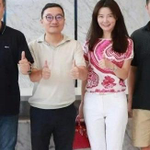
The business partner is Kang Wei. He's also her husband, and he's the one who introduced her to Jensen.
All of this came from typing his name into @autumn_ai_inc:
He's 51, from Shanghai, and went to Shanghai Jiao Tong. At 33 he became the youngest fund company GM in mainland China history. In 2010 he started his own firm, Hexi Capital. Alice joined in 2015.
He'd known Jensen for about 10 years through video games. Per the WSJ, he introduced Jensen to Alice and seemed fine with the relationship for two years. He'd jokingly introduce her as Jensen's "personal assistant."
From 2021 to 2024 he was building state-backed data centers across China, with $9B+ in proposed investment. A Shanghai government body owned 10%. Huawei signed on as a partner in 2022.
In 2023 the couple bought the Singapore arm of a gaming company and renamed it Megaspeed. They told investors Jensen would guarantee their chip supply. Megaspeed then bought $4B+ of NVIDIA chips, and the US is investigating whether some of them ended up in China.
Last week the NYT also reported that the MSS has spent at least two years running a secret campaign to get restricted US AI chips into Chinese companies.
Nobody has been charged. China calls it "groundless." Shanghai police reportedly detained Kang earlier this year over suspected stock manipulation.


NEW: Alice Huang was in touch with an officer of China’s Ministry of State Security from the spring of 2025 until the fall of this year, people with knowledge of U.S. intelligence reports describing the encounters said. @jonathanvswan @julianbarnes me nytimes.com/2026/11/22/us/po…

1
5
453