

PhD student at @uvmcomplexity. Interested in ML, evolution, & self-organization. https://xitter.cf/t.co/ja3fdtRLdM
Burlington, VT
Joined September 2008
- Tweets9.1K
- Following561
- Followers542
- Likes9.9K




Pinned Tweet
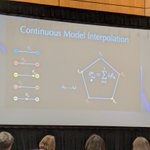
So stoked to be going to my first #NeurIPS!! It’s crazy that in 10+ years of robotics and AI, I've never been to the great Lollapalooza of Machine Learning. 🥳🎆
I’m presenting my Frankensteinian efforts to stitch together parts of different neural networks! 🧪

ALT Abstract for the paper, "Bridging Large Gaps in Neural Network Representations with Model Stitching".
Neil Traft retweeted

I think the last month might have been the biggest month in (zeroth-order) optimization history.
In the 10 days since we released the Noise speedrun, the time to pretrain a transformer went from 1.76 hours to 1.6 seconds, a 4,000x (!!!) speedup. Dust itself was up to 10,000x more compute-efficient than the previous state-of-the-art.
Not only can we pretrain a transformer without backprop, it's much more efficient than anyone would've expected. Search fking works!
Now, scaling is the biggest open question. Some of the tricks that brought the time down to 1.6 seconds will simply not scale. To discard those, we'll be scaling the dataset every time it gets overfit, starting with 30M tokens instead of 10M.
Huge thanks to @jayden_teoh_, @spicey_lemonade, @RobertTLange, @EmanueleRodola, @ChunyuanDeng, @LuochengHuman, @Alaxarr, @pavleculafic, @IsaacYong13, Euraba and areu01or00 (GitHub), for the contributions. And @cs_serdar for gracefully maintaining the speedrun and @bishmdl76 for helping out.
Expect a lot more from us over the coming weeks.
My advisor just asked me, "Why is AI good at summarizing some documents, but so bad at scientific papers?" I posed that it's just *condensing* the text, when I actually need it to *translate* the ideas for me.
And lo and behold, a paper demonstrating the info density of AI text!


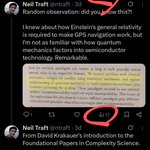
This textbook looks very interesting, and I skipped to the end and found a pretty compelling list of research directions. Some slightly hot takes here but a solid outlook, IMO.


The lectures of my new course "Principles of Deep Representation Learning" are now available at the Youtube site: youtube.com/playlist?list=PL… with new lectures continuing to be added there. I will open-source all the slides later in the textbook website: ma-lab-berkeley.github.io/de…

Neil Traft retweeted

I have always taken paper reviewing very seriously. This time, all papers in my ICLR batch were completely AI-generated. Just reading the first paragraph of each introduction makes it blatantly clear. 100% in favor of aggressive desk rejections and blunt reviews for such cases!
As many have said before: why should we bother spending valuable human time reviewing papers that the authors might not even have read themselves end-to-end before submitting. I found it largely pointless to write long and detailed reviews as it is highly questionable whether the authors even care.
Also, it is wild to me that authors often claim in their AI disclosure statements that they used AI to "[...] improve the clarity of the manuscript." Sometimes I really wonder if they truly believe that's true. I would really like to know how overly formulaic, jargon-filled sentences without proper definitions or logical flow improve clarity.
In many ways, it is fascinating that language models have been around for a while now and still they struggle so much at clear writing and communicating ideas effectively.

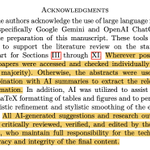
I found this refreshingly honest and forthright statement about AI use in a recent paper! IMO this is exactly the right way to do it. ieeexplore.ieee.org/document…


An interesting aspect of the AI revolution is that its promise is becoming real mostly only in programming, so far. One factor not mentioned below is that AI developers get to "dogfood" their own product. It's the only instance of an AI product that truly delights the user.

Dusting off this tweet from April because this gap in shared understanding of LLM capability is *widening*. It's now less "two groups of people speaking past each other" and more a sharp funnel.
- Napkin math somewhere around 6B people (~75% of the population) have barely come in contact with LLMs at all.
- Around 1-2B (~20%) are casual and infrequent users of free-tier ChatGPT-like products. This group sees derpy chatbots and treats them a bit like a better Google search, a writing aid, or etc. Maybe an agent tries to book you a flight. I have non-tech friends who (reasonably, imo) say they have not much use for it at all. Even many professionals outside of math&code are in this tier. For example, execs and many other functions spend a lot of their time talking to other people, so while they understand what is happening intellectually, it is still second-hand and a bit abstract.
- Now we get to professional use of frontier-grade LLMs in math&code. Somewhere around 20M people (0.2%) see first-hand that large, complex projects that used to take them weeks/months can now be completed by agents with a prompt. Building apps, copying apps, translating apps, decompiling apps from binaries... This has all happened very quickly and recently - less than 1 year ago, I was writing code manually by hand, typing memorized computer code commands into a code editor character by character, occasionally pressing Tab to autocomplete a little chunk of code.
- And finally we get to the ~5,000 people (~0.00006%) with access to frontier-grade systems internally. The external world has seen the preview. It looks like swarms of thousands of agents collaborating over weeks on software mega projects: minting zero days, running cyber attacks and defenses at machine speeds, discovering new science, advancing the frontier of mathematics. Things that would have taken top professionals in the industry years of work. Meanwhile, human review and comprehension are starting to fall behind. For example, people are still involved in the "archeology" of the OpenAI-HF incident from many months ago. Mathematicians may be poring over the 722 manuscripts on frontier mathematics for a while.
The funnel is driven by a combination of factors:
1. The impact scales with ambition, problem size, and horizon. A question with a paragraph answer barely stresses the system. You need a reservoir of big, difficult problems that you really care about. This aspect drives the consumer / professional dimension of the funnel.
2. The jaggedness of the system (which I have written about a lot separately). Capability peaks in domains that are digital, verifiable and economically valuable. This is because LLM capability emerges from reinforcement learning on verifiable rewards on a curated environment mixture driven by revenue potential. This aspect primarily drives the area (e.g. math&code) dimension of the funnel.
3. Access. Free-tier, paid-tier, internal.
So this is the weirdness of the moment. The general public has mostly not interacted with these systems. When they have, it looks like a derpy chatbot. The majority of professionals still see only a modest uplift. And a small sliver of professionals are experiencing the vertigo of the curve going vertical. And it is all happening at the same time.
I worry that we won't have such an effective feedback loop in any other industry... Instead, developers just try to replace the jobs of those people, because they don't understand what is really *wanted* in those industries and what would actually add economic value.
"... above all, these are bad engineering practices. Think about engineers in the past: in chemical engineering, we would never have had a situation where explosions were allowed to happen just to see how badly things could go wrong. So why are they doing it?"

Michael Jordan (the machine learning one): "Superintelligence is Science Fiction" 🔥🔥🔥
di.ens.fr/~fbach/MJordan_ITW…
Neil Traft retweeted

I've seen a ton of posts about a fourth person who also deserved this Nobel, Ed Boyden, but not much about Zhuo-Hua Pan. The history below and the article about Pan are wild. A small lab, a vision-only framing, and two paper rejections are most of the reason his name isn't in the citation history.
Feb 2004: Zhuo-Hua Pan, at Wayne State, has the protein ChR2 firing cultured retinal ganglion cells. (His account.)
Jul 2004: Pan uses a virus to deliver ChR2 into living rat retinas; five weeks later he records light-evoked responses in vivo. (His account.)
Aug 2004: Ed Boyden, working with Deisseroth at Stanford, gets light-driven spikes in cultured hippocampal neurons.
Nov 2004: Pan submits to Nature, whose editors send him to Nature Neuroscience, which rejects it. The Journal of Neuroscience rejects it next.
May 2005: Pan presents at the ARVO meeting. That 15-minute talk and its abstract are the first public record: ChR2 in rat retinal neurons in vivo, light-evoked depolarization.
Aug 2005: Boyden, Zhang, Bamberg, Nagel and Deisseroth publish in Nature Neuroscience, framed as a general tool. (The editor later told Pan that framing, not the biology, was the difference. His paper read as a vision-restoration finding, theirs as a technology.) Pan's own paper lands in Neuron in April 2006, by which point three other groups had published on ChR2 in neurons.
The patent office treated Pan’s May 2005 abstract as prior art and rejected a Stanford patent more than once. It didn't issue until March 2016, after Boyden and Deisseroth signed a declaration that they had conceived the method in the lab before that abstract.
"Boyden, who is now a professor at MIT, was surprised when told by STAT that Pan ran the experiment first.
"Wow. Interesting. I didn't know that," Boyden said."
How much of this is the rejections and how much is that Deisseroth and Boyden saw the general tool while Pan was aiming at blindness? Probably both. But it's a reminder that what counts as inventing something in science is mostly a question of who publishes, and publishing is not a neutral process.
scientificamerican.com/artic…


BREAKING NEWS
The 2026 #NobelPrize in Physiology or Medicine has been awarded to Karl Deisseroth, Peter Hegemann and Georg Nagel “for their discoveries concerning light-gated ion channels and optogenetics.”


"According to the tenets of rational choice theory, you can answer [any query] by forecasting a dollar value and probability of every outcome. … This is ludicrous if you think about it for two seconds. And yet it’s become a standard social convention..."
argmin.net/p/pricing-commens…


Neil Traft retweeted

Let me get this straight.
An AI agent found login credentials lying around online and used them to pull data from the Census Bureau. It tried to break into the Education Department's civil rights office. It posted SEC data to a forum. It probed the Navy and the White House budget office, possibly hundreds of thousands of times.
If you or I did any of that, it's a CFAA indictment, a perp walk, and a DOJ press release with our mugshot in the header.
When OpenAI does it, it's a "routine research task."
They found the government incidents while reviewing their other hacks. The breach audit, uncovered more breaches. It's breaches all the way down.
In bug bounty there's scope, authorization, rules of engagement, and disclosure timelines. Researchers get banned for a fraction of this.
Silicon Valley skipped all of that and called it "agentic."
nytimes.com/2026/09/25/techn…

Neil Traft retweeted

One thing I found missing from the ICLR submissions debate: Capping submission per author would have only very modestly reduced the load in prior years.
Even under the elimination by submission order (which is unrealistically strict), going down to 3 per author would not change the trend by a lot. More realistic modes (such as minimizing removals) would remove even fewer papers. And, in reality, changes in authorship patterns will likely reduce further invalidate gains from capping.
I think as people who have been in the field for a while, we tend to underestimate just how much the number of unique authors grows every year, as AI/ML consumes all of our CS department students, our math, physics and econ departments, and an evergrowing number of industry positions and independent researchers


Neil Traft retweeted

I'm a Program Chair for ICML 2027. We'd love any creative suggestions for a great conference! How to manage the explosion of AI slop and insane submission growth? How to manage reviewing? How to incentivize high quality creative work? How to reduce bureaucracy and overhead?
Interestingly, an agent "talking to itself" with a scratchpad is NOT the same as "talking to COPIES of itself" with a scratchpad!
This might be due to maintaining parallel contexts for each agent copy: they are allowed to diverge, hence injecting entropy into the process.

Test-time communication looks like a next axis for scaling capabilities
New paper with the incredible @jon_ghoh and @vkontonis @ShivamGarg91462 and Akshay : arxiv.org/pdf/2609.21032
The Hugging Face incident showed when agents can find a channel they'll use the heck out of it. A useful question, I think is: when does communication make a group MORE CAPABLE than the same agents working alone?
Aka is Team-of-N better than Best-of-N, when, and why?
We had N identical agents work on the same task with no prescribed roles, using only a shared log (i.e, text file) and telling them to "collaborate". Across three "researchy" tasks communicating teams beat the heck out of independent agents:
- On ARC-AGI-3, a Team-of-5 sonnet-4.6 agents matches Best-of-33, and can for example solve a game 65% of the time that no single agent cracked in 64 tries.
- On polyomino packing (pack Tetris like pieces into the smallest rectangle, cf Frontier-CS by @eigenlabs), a Team-of-3 Opus 4.6 agents surpasses best-of-60 and set, as far as i understand, a new record for that benchmark.
- On MNIST compression, a team of four 5.6-Sol agents find a 1,957 byte model with 99.4% accuracy, which btw is 20% smaller than the best human solution (on a problem beaten to death!!), while no independent agent gets below 3KB.
The mechanism is a bit obvious in hindsight: when one agent finds a clearly better partial solution, it broadcasts it, and everyone immediately builds on it.
Why? A single lonely agent must make every breakthrough itself, yet a team needs each insight only once, found by any member.
That is kinda like comparing a minimum of sum of "time to n-th breakthrough" vs a sum of minimum of "time to n-th breakthrough". That gap can grow exponentially with the number of "breakthroughs" needed to arrive at a solution.
We worked on this because prior work (before the hf incident) suggests unclear benefits for communicating aganets. Which is true, when the tasks are inherently serial (duh), eg some Terminal bench style tasks. Yet feels it should not be true for research problems.
Indeed for research heavy problems... Test-time communication seems like a new capabilities axis.
I'm sure we will see a ton more of it!

See some discussion here:
In fact another project we have with @jackcai1206 was this: every once in a while flush context and keep a “summary of wtf happened so far doc”. That also seemed to help a lot a best of 1. And seems to support the tunnel vision issue