

Founder at https://teapawt.net/t.co/6I9CloAYls — triage and root-cause analysis for Selenium and Playwright tests. Software engineer, teacher, entrepreneur.
Uzhhorod, Ukraine
Joined April 2009
- Tweets5.9K
- Following306
- Followers294
- Likes3.4K




Pinned Tweet
Meet my startup — testinel.dev
I've been working in test automation for many years. I started my professional career as a software tester (hello, Marek Nowak!), and later, as the head of an IT company, I introduced automated testing to make our software more reliable.
Test automation still has many unresolved challenges. One of the biggest is that it's an underserved market. A typical backend developer can choose from hundreds of excellent tools, while test automation engineers have surprisingly few purpose-built solutions.
That's what motivated me to build Testinel.
Its goal is simple: reduce the time engineers spend diagnosing and fixing failures in automated tests, while lowering the barrier to entry for people getting started with test automation.
I describe the problem in more detail—and explain the approach behind Testinel—in my DEV.TO article:
dev.to/obrizan/how-i-improve…
There’s a role on a team: tester, test engineer, software quality assurance — a person who tests an application professionally.
But it would be cool to have a “professional user” role: someone who isn’t a professional tester, but a professional user. For example, if a company is building an ecommerce platform, the team has someone who sells products on that marketplace and someone who buys things there. They could work part-time or come in for individual sessions. They don’t need to write test plans. They just need to use the product. Their responsibility: give feedback and report user experience problems.
It’s somewhat like beta testing, but the way I see it: a) beta testers get invited too late; b) they usually aren’t employees or contractors of the company building the product, so they have no obligation to report anything at all.
This kind of staff user role could be pretty well protected from the threat of AI and agents. Because while people in the industry are already saying, “We don’t need testers, an agent will replace them,” only a businessperson who’s lost their mind would say, “We don’t need users.”
Do your organizations have a “professional user” role? Have you heard of anything like this?
1
124
A New Large Language Model Isn't Always Better Than an Old One
Sometimes it seems (or at least that's what marketers want us to believe) that anything new must be better than what came before.
I'm migrating a translation service that uses language models. The old version uses gpt-4.1, while the new one uses gpt-6-luna. Users started complaining that the new version was translating more slowly.
My first thought was: how is that even possible? The new model is supposed to be better than the old one!
But then I remembered an old joke: "In one village, they asked people; in another, they actually measured." So I ran a small benchmark to see whether the new model really was slower.
And indeed, gpt-6-luna is, on average, 1.3 times slower than gpt-4.1 when translating texts of various lengths.
This benchmark doesn't account for translation quality or cost, both of which can also be important.
Unfortunately, gpt-4.1 was officially deprecated on October 14, 2026, and will be permanently shut down on January 14, 2027.

77

The key mistake in AI adoption is a failure to understand the principles of delegation.
For example, what I need is a configured, tested, reliable SaaS application. I don’t need ChatGPT for that. I need someone who will take responsibility for the outcome. Whether they use AI or not is secondary.
Delegation means hiring a person or a company — an accountable party — to take responsibility for the final result. When I delegate, my working time decreases and my free time increases. The responsibility for achieving the goal lies with someone else.
The “I’ll just do it myself with AI” approach means installing, building, testing, deploying — damn, I’ve hit the usage limits; oh, now something’s crashing — and dealing with all the other joys of software development. Those who know, know. My working time increases, my free time decreases, and on top of that, all the responsibility is still on me.
That’s anti-delegation!
Here’s an example for non-programmers. I want a clean home. I could grab a vacuum cleaner, a broom, and a mop and clean it myself in my free time. But I don’t want to! I want to go to the movies and delegate the cleaning to someone else, so that when I come home, everything is sparkling clean.

With AI, the need for knowledge doesn’t disappear — it changes.
I’ve noticed an interesting paradox.
On the one hand, when I suggest using my own product, testinel.dev, people tell me: “Pfft, why do we need that? We just give the logs to AI and it fixes everything.”
On the other hand, engineers complain that AI is expensive, that they need to save tokens, that sessions run out too quickly, and ask: “What are we supposed to do for five hours without AI?”
Meanwhile, testinel.dev is being built specifically to optimize AI costs.
What I hear is basically: “We’re delegating the work to AI that we can’t afford.”
There’s a conflict between the marketing slogan “AI will replace all of us” and the actual engineering reality: limited budgets, operator expertise, and time.
Does AI replace engineers when it comes to diagnosing problems? In many ways, yes.
Do you still need to know how to configure and optimize all of this? Of course you do.
And how do you learn to optimize the cost and speed of using AI?
You dig into it and learn. 🙂

Meet my startup — testinel.dev
I've been working in test automation for many years. I started my professional career as a software tester (hello, Marek Nowak!), and later, as the head of an IT company, I introduced automated testing to make our software more reliable.
Test automation still has many unresolved challenges. One of the biggest is that it's an underserved market. A typical backend developer can choose from hundreds of excellent tools, while test automation engineers have surprisingly few purpose-built solutions.
That's what motivated me to build Testinel.
Its goal is simple: reduce the time engineers spend diagnosing and fixing failures in automated tests, while lowering the barrier to entry for people getting started with test automation.
I describe the problem in more detail—and explain the approach behind Testinel—in my DEV.TO article:
dev.to/obrizan/how-i-improve…
2
88


Volodymyr Obrizan 🇺🇦 retweeted

This is #2835 breach for the last few years, and we keep reminding the world that it should be zk, without storing, sharing personal data. But we forget the next day. It’s not the tech problem anymore but a global compliance reg coordination problem.
Reminder: @Rarimo_protocol is the only solution that does both document and biometric verification without sharing your face anywhere for matching. Just scanning a passport means validating a document, not a person. In 5 years this will be a norm. Thank you for this matter.


I trained my own LLM for code reviews.
I called it LGTM-5.6.
It has only one token: LGTM.
No matter what the input is, it responds with:
LGTM
According to code-review quality benchmarks, it performs no worse than 80% of senior developers. :)
4
123
I've wrote a simple but useful library for Python Selenium: automatic waiting for basic browser interactions.
Anyone who has written Selenium tests has encountered the same frustrating problem: the test tries to interact with an element a fraction of a second before the page is ready.
My main motivation was to reduce the amount of synchronization code required in everyday Selenium tests without falling back to fixed delays.
The details in the post below: testinel.dev/blog/selenium-a…

3
67
Volodymyr Obrizan 🇺🇦 retweeted

Doesn’t matter if you are at $1K MRR, $10K MRR, $100K MRR, or more, every founder experiences valleys of slow growth, plateaus, or even declining revenue.
There is a book that might help you get out of such situations and keep growing your business.
Most entrepreneurs fail to extract the correct and reusable lessons from their journey. More often, they misinterpret them and end up writing fairy tales about themselves.
Jason Cohen is different. He built unicorns, but he has a skill for extracting lessons from his experience and writing about them in a way that is useful to others.
His book, Hidden Multipliers, is a must-read for every software entrepreneur who wants to grow their business.
Giving away 5 copies:
Share what you are building and what stage you are at (no customers/idea/new product, first customers, growing, or stagnating).
And 5 random people will get a free copy of the book.

After more than a year of labor, my book 𝘏𝘪𝘥𝘥𝘦𝘯 𝘔𝘶𝘭𝘵𝘪𝘱𝘭𝘪𝘦𝘳𝘴 has launched!
It's all my best ideas -- and best writing -- on how to grow your company with your existing budget and team.
And yes, I read the audiobook myself. :-)
𝗕𝘂𝘆 𝗱𝗶𝗿𝗲𝗰𝘁: You can buy cheaper bundles directly from me -- Kindle and Audiobook, or those plus the physical book -- from hiddenmultipliers.com
𝗕𝘂𝘆 𝗼𝗻 𝗔𝗺𝗮𝘇𝗼𝗻: It is available in paperback, Kindle, and Audible: tinyurl.com/hiddenmultiplier…
𝗙𝗿𝗲𝗲 𝗔𝗜 𝘀𝗸𝗶𝗹𝗹𝘀: Skills that implement the ideas in the book as well as articles, more added all the time, at skills.asmartbear.com/
I'm so proud of this and grateful to the many people who helped along the way, reading early drafts, challenging my ideas, and encouraging me to do it, and the 750 people who preordered the book, trusting that it would be worth it.
All your feedback and ideas are welcome, as usual!
(P.S. You know this already, but 𝗹𝗲𝗮𝘃𝗶𝗻𝗴 𝗿𝗲𝘃𝗶𝗲𝘄𝘀 and 𝘁𝗲𝗹𝗹𝗶𝗻𝗴 𝘆𝗼𝘂𝗿 𝗳𝗿𝗶𝗲𝗻𝗱𝘀 is extremely appreciated!)
Empirical Proof That AI Doesn’t Increase Productivity
To save you time, I’ll start with one important definition. Productivity is how much money you earn per unit of time spent.
If, without AI, you earn $1,000 in 160 hours, let’s call that the baseline productivity: 1X.
If, with AI, you earn $5,000 in 160 hours, your productivity has increased to 5X.
If, with AI, you earn $1,000 in 80 hours, your productivity has increased to 2X.
But if, with AI, you still earn $1,000 in 160 hours while producing 10 times as many “tasks,” “lines of code,” “pull requests,” “posts,” or whatever it is you do, then you haven’t become 10 times more productive. Your code has simply become 10 times cheaper.
And why do I call this empirical proof? Because I constantly see programmers trying to save tokens, waiting for their session limits to reset, and juggling multiple accounts. Why don’t they just dump $10,000 into tokens if AI really increases their productivity — that is, their earnings — so dramatically?
If I put $100 into something and make $1,000, then putting in $200 should make me $2,000. It’s basically a money-printing machine.
But for these programmers, no matter how many tokens they throw at it, they can’t make any more money. So their productivity hasn’t increased. The cost of producing the output has simply collapsed.
1
5
118
I read docs this week. And last week. And I'll read docs next week.
I like read docs.
Why do I need to spend time typing to AI, waiting for "thinking longer for the better answer"™, when I can google some doc, open it and just enjoy slow reading from top to bottom.
Be careful: AI can not reproduce copyrighted material word-by-word, it needs to rephrase it. So why read rephrased by AI, when I can read the true source and original?

1
2
120
Volodymyr Obrizan 🇺🇦 retweeted

You can help shape the future of #Python typing with the power of having an opinion!
Fill out the annual Python Type System and Tooling Survey:
surveymonkey.com/r/python_ty…
Volodymyr Obrizan 🇺🇦 retweeted

I’m looking for my next role.
I’m a software engineer and product designer with deep experience in databases, sync engines, frontend systems, performance, and UI/UX.
Open to full-time or contract work, remotely or in Berlin.
Details in reply ↓
RT for reach 🙏
With AI, You’re Smarter Than Me
Today, for the first time, I told a colleague, “With ChatGPT, you’re smarter than me!”
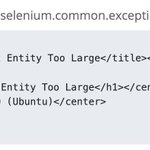
Here’s the context: our automated test for file uploads to a marketplace failed because the proxy server rejected requests larger than 10 MB.
My colleague looked at the detailed report on testinel.dev and said, “Vova, I can’t upload a file larger than 10 MB. I’m getting a 413 Request Entity Too Large error. ChatGPT says we need to set client_max_body_size to 20m in the nginx configuration and restart the server.”
I thought that allowing 20 MB was excessive for a test that uploads a 10 MB file, so I set the limit to 12 MB.
But it didn’t work. My colleague reported the error again and said, “Vova, ChatGPT says 12 MB isn’t enough because Selenium encodes files using Base64, so a 10 MB file becomes a 15 MB Base64 request. We need to set client_max_body_size to 20m.”
So I increased the limit to 20 MB, and the test passed.
First, we spent half a day going back and forth in chats because we work asynchronously. In an automated setup, AI could have analyzed the problem, applied the fix, and restarted the server in a minute.
Second, I’m glad that AI helps developers dig deeper into the root causes of problems and communicate them more clearly to their colleagues. I clearly remember how, just a few years ago, test automation engineers would come to me and say, “Vova, something’s broken—please help!” Now, with AI, they can immediately say, “Set client_max_body_size to 20m.”
The big goal of testinel.dev is precisely this: to reduce the cost of fixing automated test failures to zero—not only through AI, although it can do a great deal, but also through good old-fashioned algorithms.

Meet my startup — testinel.dev
I've been working in test automation for many years. I started my professional career as a software tester (hello, Marek Nowak!), and later, as the head of an IT company, I introduced automated testing to make our software more reliable.
Test automation still has many unresolved challenges. One of the biggest is that it's an underserved market. A typical backend developer can choose from hundreds of excellent tools, while test automation engineers have surprisingly few purpose-built solutions.
That's what motivated me to build Testinel.
Its goal is simple: reduce the time engineers spend diagnosing and fixing failures in automated tests, while lowering the barrier to entry for people getting started with test automation.
I describe the problem in more detail—and explain the approach behind Testinel—in my DEV.TO article:
dev.to/obrizan/how-i-improve…
Anthropic draws victories on charts, like russia's ministry of defense does. :)

lol did nobody at Anthropic stop for a second and wonder why the numbers looked this absurd before posting the “victory”-tweet?
openai.com/index/how-two-set…

2
166
I can't get it. @OpenAI has billions of dollars, best of the best engineers, top AI model, and still VS Code Codex diff doesn't work. And such similar issues are following me for weeks: sometimes Codex chat hangs without any response.
I know the motto "go fast, break things" — but the chat interface or diff interface — is not on the edge of AI innovation, just a basic dev tool component.


1
3
107