
Avid walker. Web3 Learner.
Joined August 2022
- Tweets41
- Following173
- Followers6
- Likes76



oddquills retweeted

1/ It’s 2024 and we are still seeing far too many teams getting SIM swapped or phished on a regular basis resulting in millions stolen.
So here are some tips EVERY team should follow to secure their X (Twitter) account and what to prioritize if an account becomes compromised.


Over the past four months $13.3M+ has been stolen as a result of 54 SIM swaps targeting people in the crypto space.
When an account is compromised scammers attempt to create a sense of urgency with a fake claim to drain your assets.
Never use SMS 2FA and instead use an authenticator app or security key to secure accounts.


Hello, this might be for you!

📢𝗢𝗣𝗘𝗡𝗖𝗔𝗟𝗟📢
NFT Asia is teaming up with MET AMS to showcase the works of 5 artists in their gallery space from Nov 1-3!
To join:
- Post a VERTICAL art piece (image/video)👇
- Follow @NFTAsiaOfficial & @met_ams✨
- Tag friends to inform them💕
Deadline: Sept 19, 2pm SGT.

Wow

JUST IN: Google announces a new browser-based code environment.
It will bring the entire full-stack and app development workflow to the cloud.
It also includes Generative AI features based on PALM 2:
▸ Code generation
▸ Code completion
▸ Translating code between languages
▸ Code Explanation
You can join the waitlist today.
6
oddquills retweeted

#BangkokPost: Julius Baer, a renowned Swiss private bank, presents a virtual exhibition featuring winning artworks from the second edition of the "Julius Baer Next Generation Art Prize", from now until Aug 21. #lifestyle #art
bangkokpost.com/life/social-…

Wahhh!

Bhutan is the FIRST country in the world to adopt a decentralized National Digital Identity mandate to promote equity and inclusion through technology across the Kingdom 🇧🇹💯
“The Gyalsey” Crown Prince Jigme Namgyel Wangchuck at 7 years young is the Kingdom’s 1st digital citizen 👑
👏🏻 thebhutanese.bt/what-adoptio…
wionews.com/world/bhutan-pri…
@smoblerstudios is excited to be part of this landmark journey .
Watch this space ! 👀❤️👏🏻 @ysiu @viewfromhk @borgetsebastien
5
👀👀👀👀

You'll soon see lots of "Llama just dethroned ChatGPT" or "OpenAI is so done" posts on Twitter. Before your timeline gets flooded, I'll share my notes:
▸ Llama-2 likely costs $20M+ to train. Meta has done an incredible service to the community by releasing the model with a commercially-friendly license. AI researchers from big companies were wary of Llama-1 due to licensing issues, but now I think many of them will jump on the ship and contribute their firepower.
▸ Meta's team did a human study on 4K prompts to evaluate Llama-2's helpfulness. They use "win rate" as a metric to compare models, in similar spirit as the Vicuna benchmark. 70B model roughly ties with GPT-3.5-0301, and performs noticeably stronger than Falcon, MPT, and Vicuna.
I trust these real human ratings more than academic benchmarks, because they typically capture the "in-the-wild vibe" better.
▸ Llama-2 is NOT yet at GPT-3.5 level, mainly because of its weak coding abilities. On "HumanEval" (standard coding benchmark), it isn't nearly as good as StarCoder or many other models specifically designed for coding. That being said, I have little doubt that Llama-2 will improve significantly thanks to its open weights.
▸ Meta's team goes above and beyond on AI safety issues. In fact, almost half of the paper is talking about safety guardrails, red-teaming, and evaluations. A round of applause for such responsible efforts!
In prior works, there's a thorny tradeoff between helpfulness and safety. Meta mitigates this by training 2 separate reward models. They aren't open-source yet, but would be extremely valuable to the community.
▸ I think Llama-2 will dramatically boost multimodal AI and robotics research. These fields need more than just blackbox access to an API.
So far, we have to convert the complex sensory signals (video, audio, 3D perception) to text description and then feed to an LLM, which is awkward and leads to huge information loss. It'd be much more effective to graft sensory modules directly on a strong LLM backbone.
▸ The whitepaper itself is a masterpiece. Unlike GPT-4's paper that shared very little info, Llama-2 spelled out the entire recipe, including model details, training stages, hardware, data pipeline, and annotation process. For example, there's a systematic analysis on the effect of RLHF with nice visualizations.
Quote sec 5.1: "We posit that the superior writing abilities of LLMs, as manifested in surpassing human annotators in certain tasks, are fundamentally driven by RLHF."
Congrats to the team again 🥂! Today is another delightful day in OSS AI.

1
Patterned learnings.

In 2007, I was 1 of 2 designers on Google Maps.
The app was growing like wildfire.
But it was becoming a cluttered mess — new features were being shoved into every pixel.
Here’s the 4-step process we used to redesign Google Maps into one of the most loved apps in the world: 🧵
–––
But first, it’s important to understand it is normal to build a product based on the underlying technical structure.
In 2005, Google Maps queried one of three databases for any search:
• Maps data
• Local business data
• Directions data
Not surprisingly, the first version of the website had three tabs, one for each of these databases: Maps, Local Search, Directions.
–––
By 2007, Google Maps still wasn’t the dominant mapping application.
But it had hit PMF, its user base was growing quickly, and we were rapidly adding new content and features like:
• Satellite and Terrain views
• Streetview, 3D buildings, Traffic
• Editable map data, Reviews, Photos
• Transit Data
We were wedging new features into any space we could find in the UI.
It became clear the user experience was suffering and the product was growing increasingly complicated.
At that time, our VP, Marissa Mayer likened Google Maps to a Christmas tree that we kept adding more and more ornaments to until it started to fall over…
We tried many different ways to rearrange the UI to accommodate new features.
Eventually we had to step back and rethink Google Maps based on what we knew was working, what brought people to the product, and what we believed the future might look like.
–––
These were the 4 key steps we took to simplify the design of Google Maps to be the intuitive, durable, much-loved product that 1B people still use today:
1. Deconstruct
We wrote down all of the product’s current and upcoming content, features, and functionality and loosely grouped them into categories:
• Core features — The most common tasks people came to do (search, get directions, find businesses)
• Aspirational use cases — Tasks we wanted people to start doing (adding their own content, correcting inaccurate information, using Maps to explore new places, etc.)
• Global actions — Actions that impacted the entire page (print, share, save, etc.)
• Use case specific actions — Actions that were relevant only within a specific use case (eg while getting directions, being able to drag a route or add a destination)
• Related features — Things that weren’t a part of Google Maps at the time, but existed and were closely related. (eg transit information, business searches on Google.com)
–––
2. Reframe
We leveraged a combination of user research, business goals, and our own intuition to make the product better, simpler, and scalable over time. We focused on understanding:
• What brought people to the product
• How they navigated through the product
• What was working well
• What flows were confusing
• What things were missing
• What information was valuable when
• What functionality was redundant
We emerged with several key points:
• “Searching” was the most pivotal task in Maps
• Searching addresses, businesses, parks, mountains, cities, etc could all be thought of as searching for “places”
• Getting directions was important, but rarely happened between two specific addresses. Directions searches usually had a known start or end point, like home or work. It was also more intuitive to be able to search for directions by a place name e.g., Carmel Library rather than having to look up the address first.
• It was strategically important for people to be able to contribute content to Google Maps and to be able to explore the world around them.
–––
3. Reconstruct
Based on what we learned, we then explored ways to reshape the product.
We held these general usability principles in mind:
• Entry points to core use cases should be prominent
• Flows within core use cases should be intuitive
• Common actions, interactions, and views should be consistent
• Contextual actions should be accessible when relevant
This is one exploration of clustering tasks and connecting relevant content:
Our explorations of how to reconstruct the site around people’s needs and flows led to several key design changes:
• There would be only one search box for everything
• Directions would live as a secondary feature
• Other features would appear in context (eg, transit became a mode within directions)
–––
4. Scale for the future
This was 2007. We knew the product would continue to evolve, the information set would grow exponentially, and the feature set would continue to expand.
But by focusing on key use cases and folding information in to the UI where it was relevant, we created a framework to support future growth.
16 years later, Google Maps has continued to evolve, yet is still a simple, intuitive, much-loved product that 1B people use around the globe.
For more on design, follow @elizlaraki


8
oddquills retweeted

Bullish on:
• Actually being kind to people
• Replying for the sake of building relationships, not engagement
• Creating unique, authentic content. Not meaningless platitudes
• Building a business based on giving value, not ponzinomics
• Radical transparency
Bearish on:
• Gatekeeping
• Toxicity
• Lazy engagement farming
• Announcements of announcements
• Building a business based on hype generation
Working on the first list. Who’s with me?
oddquills retweeted

Mira Murati is the most powerful CTO in the world.
As CTO of OpenAI, she has led the work on ChatGPT, DALL-E, the OpenAI API, GPT-4, and much more...
And she only graduated college in 2012 🤯
Here's Mira's amazing story:
1/10

ALT Source: Fast Company Middle East


Haaaaa. Hard truths.

You assholes ruined NFTs.
Yes, you.
You dumb mother fuckers. You sit on your phones trying to guess which animal picture is going to go up.
Instead of just shopping around for a couple you like and holding onto them, like a normal fucking person, you try “trading” and “profiting”. That’s called gambling. You’re just gambling on pictures with a “value” that’s pegged to a completely arbitrary “floor price” that is set by any one of 10,000 bozos. Do you not realize how fucking asinine that is?!
This is all so god damn stupid. You’re all just degenerate gamblers enabling eachother.
You have all been rugged countless times, yet you’re still fucking here. Even talking to the same fucking people. It’s truly insane
You’re not even making money. Don’t lie to yourself. You’re not. It’s been 3 years and you’re in the same place as before. If you did manage to make some money, let’s be honest, you probably did it unethically or illegally. “I bought an ape. I made $100,000”. Congratufuckinglations, you won a small lottery of one year’s salary.
You keep suckingling at the tweets of these wannabe influencer losers with fucking Twitter accounts.
Hey bozos, “Twitter Influencer” DOESN’T EXIST. You have to do something in the real fucking world and then your words will have meaning. You’re listening to jerkoff grifters as if they’re Zuckerberg.
Wake the fuck up.
Time for the hardest truth. Not sure you’re ready for this one.
“Web3”
Are you fucking kidding me with this shit? You’re on fucking Twitter. This is web2 dumbass. You spend 0 time in the “metaverse” and all of your time on twitter. You’re not in web3. You own a jpeg and a shitcoin. That doesn’t mean you’re part of web3. That’s like the janitor of Yankee Stadium saying he plays baseball.
You’re all just here on Twitter wasting time, slowly spending more and more money and making less and less of it back. You’re all such shameless degenerate gamblers, you buy up absolutely ludicrous shitcoins just “hoping it goes up”. You use NFTs as a crutch because it sounds better than just gambling. Come on people. What the fuck are you doing? Please god stop this. Give your money to kids fighting cancer. Or to families without food. Honestly, if you’re such a gambler, give your money to a bookie or casino. At least they’re running an honest business. Stop giving all of your attention and money to grifters and scam artists. Those are the only people dropping these coins and collections. All of them are garbage and worthless and stupid and you know it. But you do it anyway because you are weak. You are malleable to the wills of those around you.
Slowly but surely all the floor prices will go to their true valuations (hint, it’s zero)
What will you do then? You do have a nice community of people with nothing to do 24/7 and varying disposable incomes. If you just spend half the energy and capital into charity as you do these bullshit “projects” (fancy word for scams), you and the world would be a much better place
Cheers 🍻
31
Mates in SG - #giffest III at National Design Centre is mad fun. Till 26 Aug.

It doesn’t matter if you say GIF or jif. Your pronunciation doesn’t need to be perfect at GIFFEST III: IMPERFECT. https://teapawt.net/t.co/X8x5QbocCG
3

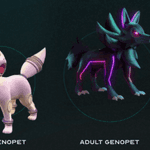
How you can earn: Trade your Genopet NFT on Marketplace and sell it to other players in #Genoverse.
IRL: I chose the organic free-to-play journey for an authentic experience. NOT.
It takes forever. There are 12 stages and 78 levels of growth 😱
🧵6/7
1
1
38