

K-beauty expert | 15+ yrs in beauty marketing. Industry news, regulations & history. Featured in Vogue, BBC & Le Monde.
Republic of Korea
Joined July 2019
- Tweets2.6K
- Following181
- Followers4.3K
- Likes40.4K




Pinned Tweet
A few weeks ago, I spoke with Vogue's @katicy_ about the future of the Korean beauty industry, including the growing role of biotechnology in skincare and why K-beauty brands don't actually come and go as quickly as people seem to think.
The article is now online [link in the first comment]
#kbeauty

Discover the best-selling beauty products of 2026 at Olive Young, Korea's largest health and beauty retailer.
The results of the 2026 Olive Young Awards are now live on The Monodist:
themonodist.com/olive-young-…
#kbeauty

4
260
Il Post has published a really interesting piece on the Italian cosmetics industry and something that many people, even Italian themselves, know very little about. (Link below, it's in Italian but you can easily use a translator to get the gist of it)
In recent years we Italians have developed such a deeply rooted sense of oikophobia that we're quick to romanticise anything foreign (beauty products in this case), without quite realising that many of those fancy cosmetics we see on social media have actually been developed and manufactured in Italy for decades.
Did you know that 10 years ago, Korean brand Missha was actually bragging about its eyeshadows being made in Italy?
And yet, here I am, having to keep a straight face whenever young Italian women tell me they buy all their make-up from Korea because they think it's so much better.
As I've always tried to explain on my channels, a brand's country of origin is no guarantee of quality or innovation. Most consumers have no idea where a product was actually developed or manufactured (nor should they be expected to tbh), so claiming that cosmetics from country X are inherently better than those from country Y is really just pointless tribalism I want nothing to do with.
A product should be judged on its own merits, not on the nationality of the brand behind it.
Link:
ilpost.it/2026/10/09/distret…

Are we approaching peak K-beauty?
I recently spoke to Lynsey Barber at Cosmetics Business about the growing saturation of the Korean beauty market.
You can read the article here: cosmeticsbusiness.com/k-beau…

At this point I'm increasingly convinced there's an AI-powered K-beauty product generator that just combines whatever skincare keywords are trending that week.

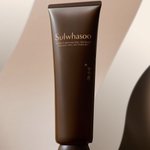
Amorepacific is holding a series of educational events across South Korea to celebrate the 60th anniversary of @SulwhasooKR
At the pop-ups, you'll find lots of special promotions, competitions and free samples. Staff also told me that explanations are available in English and Mandarin.
#kbeauty


1
8
731
South Korean customs authorities seized over 280,000 counterfeit products between August and September, including nearly 5,600 fake cosmetics of Korean beauty brands like Sulwhasoo, d'Alba, AHC and Beauty of Joseon.
Authorities reminded consumers to be careful when purchasing Korean beauty products online because counterfeit cosmetics are produced by unauthorised manufacturers with no regulatory oversight and often don't comply with the strict safety standards of South Korea's Ministry of Food and Drug Safety (MFDS).
#kbeauty

Korean beauty brand Sulwhasoo has relaunched its bestselling Clarifying Mask with a new, improved formula.
The new edition, re-named "Pore Purifying Peel-off Mask", has been shown to be more effective in reducing impurities and excess sebum compared to the previous version, while being gentle on the skin at the same time thanks to an improved formula enriched with soothing and skin barrier-fortifying ingredients.
The formula has also been enriched with Sulwhasoo's signature ingredient Jaum Activator™ (also known as Jaumdan™) to re-balance skin after peeling off the mask.
Sulwhasoo's Clarifying Mask is one of the brand's biggest bestsellers and has sold over 11.3 million units over the past 19 years.
#kbeauty


The products that got me through another hot and humid Korean summer. Some old favourites I’ve been using for years, alongside a few more recent additions to my routine.
Translated product details, including ingredients lists, certifications and product claims are available on my website (link in bio).
Most of these products are available on YesStyle and Olive Young Global.
YesStyle: use code ODILE123
Olive Young Global: use code ODILEMONOD1
#kbeauty
🧵


A quick note:
It goes without saying that beauty brands making illegal drug claims is something that should be taken seriously. However, I've been reporting on this type of administrative sanctions for years.
Korean authorities announce these sanctions every couple of weeks. They are not rare occurrences, and the reports usually involve 20+ brands or products at a time.
At no point have I ever claimed that "XYZ brand has been CANCELLED in Korea", or tried to present one of these sanctions as some catastrophic event, as happened with a certain brand a few months ago.
A couple of influencers looking for a quick shot at internet fame blew that story wildly out of proportion, leading people to believe that the brand was somehow being "cancelled" in Korea and the sanctions represented a much bigger deal than they actually did.
Consumer groups and the MFDS do a very good job of monitoring the domestic market. That is precisely why these reports are published so regularly and made available to consumers.
These sanctions are simply the sign the market is being regulated and monitored as it should be. There is no conspiracy, no national outrage and no "cancellation" happening.
This kind of violation happens all the time. It shouldn't, but it does. It also tends to happen more often with Korean SMEs, because they don't always have a dedicated regulatory team in-house and often hire freelance consultants when they need them.

Abib was fined by the Korean Ministry of Food and Drug Safety (MFDS) for making misleading drug claims to promote its
• Glow Collagen Mask Glutathione Film
• Heartleaf Essence Pad
The company was ordered to suspended all promotional activities related to these products for 2 and 3 months, respectively.
#kbeauty
A little reality check on the “organic” growth of some K-beauty brands.
Anua made over ₩700bn in sales last year, 67.8% more than the year before. However, The Founders (Anua's parent company) also revealed that the company's advertising and promotional expenses went from ₩45.2bn to a staggering ₩118bn in a single year.
That’s an absurd amount of money being invested into making one brand "viral". To finance these expenses the company borrowed ₩80bn short-term, which made its debt ratio go from 37% to 84%.
Let this be an important reminder when discussing the seemingly overnight success of certain K-beauty brands in the West. Vsibility is not necessarily the same thing as organic consumer demand and oftentimes social media "virality" is just the result of an enormous marketing budget.
Visuals: dailybeauty.drop
#kbeauty


South Korean authorities really looked at the recent Choice / Sunscreen Gate and said:
"You know what? This is just the perfect time to relax laws around sunscreen testing."
🤷♀️
South Korea is preparing to make a major change to the way sunscreens are tested in the country.
Under a new proposal announced by the Ministry of Food and Drug Safety (MFDS), sunscreen efficacy would no longer need to be tested exclusively on human skin, and for the first time, cosmetic manufacturers would be allowed to substantiate SPF and PA claims using two internationally recognised in vitro testing methods (ISO 23675, 24443)
The agency explains that these changes are meant to reduce the operational and financial burden of carrying out in vivo tests for Korean companies, allowing them to launch new products more rapidly in response to the increasing demand for Korean cosmetics abroad.
Secondly, the South Korean MFDS has proposed an amendment to Article 10 of the Enforcement Rule of the Cosmetics Act, which sets out the conditions under which functional cosmetics can be exempted from pre-market review.
You might remember this particular law from the Korean sunscreen controversy of 2021. It's the law that establishes that sunscreens and other functional cosmetics can bypass required pre-market tests when the formula is very similar to a product that was already tested and approved by the MFDS.
After the controversy, the MFDS decided to tighten the conditions under which companies could use this particular exemption and now, in 2026, the agency is proposing to narrow them even further.
Under the new proposal, the exemption would only apply when the new product is nearly identical to the formula that was already reviewed by the MFDS. Most ingredients (even non-active ingredients) would need to be the same and used in the same amounts, with only limited exceptions for fragrance, preservatives and colourants used below 1%.
The proposal is currently open for public consultation until September 18, after which the MFDS will review the feedback received before finalising the amendments.
#kbeauty

1
13
1,202
South Korea is preparing to make a major change to the way sunscreens are tested in the country.
Under a new proposal announced by the Ministry of Food and Drug Safety (MFDS), sunscreen efficacy would no longer need to be tested exclusively on human skin, and for the first time, cosmetic manufacturers would be allowed to substantiate SPF and PA claims using two internationally recognised in vitro testing methods (ISO 23675, 24443)
The agency explains that these changes are meant to reduce the operational and financial burden of carrying out in vivo tests for Korean companies, allowing them to launch new products more rapidly in response to the increasing demand for Korean cosmetics abroad.
Secondly, the South Korean MFDS has proposed an amendment to Article 10 of the Enforcement Rule of the Cosmetics Act, which sets out the conditions under which functional cosmetics can be exempted from pre-market review.
You might remember this particular law from the Korean sunscreen controversy of 2021. It's the law that establishes that sunscreens and other functional cosmetics can bypass required pre-market tests when the formula is very similar to a product that was already tested and approved by the MFDS.
After the controversy, the MFDS decided to tighten the conditions under which companies could use this particular exemption and now, in 2026, the agency is proposing to narrow them even further.
Under the new proposal, the exemption would only apply when the new product is nearly identical to the formula that was already reviewed by the MFDS. Most ingredients (even non-active ingredients) would need to be the same and used in the same amounts, with only limited exceptions for fragrance, preservatives and colourants used below 1%.
The proposal is currently open for public consultation until September 18, after which the MFDS will review the feedback received before finalising the amendments.
#kbeauty
Frankly, it was about time.
You probably don't realise how widespread this has become in Korea. Walk into any Daiso and you'll find countless products clearly designed to resemble injectables, it's ridiculous. If anything, I'm surprised it took the authorities this long to act.
(Below: an actual product sold in Daiso)

The South Korean Ministry of Food and Drug Safety (MFDS) has announced plans to introduce new rules banning cosmetics from being packaged in ways that resemble pharmaceutical products.
In recent years, demand for skincare products inspired by dermatology and aesthetic medicine (e.g. topical PDRN products, at-home booster treatments, etc.) has grown exponentially in Korea. To appeal to local consumers, many Korean beauty brands have launched skincare products with packaging inspired by clinical treatments, from serums packaged in syringe-like containers to treatments sold in containers resembling artificial tears.
This marks the second time the MFDS has stepped in to regulate cosmetic packaging that could lead consumers to mistake a cosmetic for a different type of product, after banning cosmetics designed to resemble food in 2021.
#kbeauty
Goodai Global (the parent company of Beauty of Joseon) has acquired a minority stake in Torriden.
The company previously acquired other Korean indie beauty brands such as Skin 1004, Tirtir, Round Lab, and Skinfood.
#kbeauty

Olive Young Korea is currently recruiting new developers. In the past, the hiring process included a live coding interview, but from this year the company has dropped the coding test altogether and replaced it with an AI-based assessment, where candidates are evaluated on how effectively they use AI, write prompts and validate AI-generated code.
This is yet another example of how normalised (and incentivised) Al is becoming in Korea, and in #kbeauty especially.

6
472
Update: Estée Lauder has decided to keep Dr.Jart.
Via @BoF

The Korea Economic Daily, South Korea's largest business newspaper, reports that The Founders, the parent company of K-beauty brand Anua, is in talks to acquire Dr.Jart+.
Once a #kbeauty powerhouse, Dr.Jart+ was sold to Estée Lauder in 2019 for approximately $1.1 billion. Since then, the brand's performance has declined both domestically and internationally, prompting Estée Lauder to seek a new owner
In the graph below you can see the decline in sale revenue (blue bar) and operating profit (red bar).
