

Art educator, printmaker, collage enthusiast and passionate believer in the value of the Arts.
- Tweets1.3K
- Following278
- Followers173
- Likes5.3K


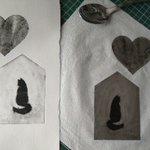




ALT The devaluation of the creative arts in schools since 2010 is stark and deeply concerning.Andrew Ellis, Chief Executive of Art UK

ALT Types of boundaries Physical - protect my personal space Emotional - protect my feelings Verbal - protect how we speak Time - protect how I spend time Work - protect my limits Financial - protect my finances Sexual - protect safety and preferences


ALT Infographic: Your voting rights at the General Election. 1. Having a mental illness does not mean you lose the right to vote. 2. You need to register by 23:59 on 18 June to be able to vote in the General Election. 3. Everyone now needs to bring photo ID with them to vote at a polling station. 4. You have the option of a postal vote or a proxy vote, if you can’t or don’t want to vote in person. If you work with people with mental health difficulties, you can help them exercise their voting rights by: Supporting people to register and get voter ID; Sharing information about postal or proxy voting options; Finding practical ways to ease anxieties and overcome other barriers to voting. Find more information on exercising your voting rights: www.centreformentalhealth.org.uk/your-voting-rights/


ALT The image displays a blue background with a list of important deadlines in bright yellow text, outlining specific dates and times for deadlines related to the general election. Register to vote - Tuesday 18 June at 11:59pm Apply for a postal vote - Wednesday 19 June at 5pm Apply for a proxy vote - Wednesday 26 June at 5pm Apply for a voter authority certificate - 26 June at 5pm


ALT Screenshot of a news article. It reads: record 3.1 million food bank parcels handed out in a year, says charity. The number of people of pension age picking up parcels also increased by 27% to 179,000 according to the Trust with older people who rent said to be particularly likely to need help.

ALT Mental health must be at the top of the political agenda this year.


ALT The title says: Body image and mental health. There are two thought bubbles. The first has the text: "Body image is how we think and feel about our bodies". The second has the text: "It can be complex, and closely related to mental health. Body image issues can affect all of us."

ALT On the left hand side, there is the text: "Body image is closely linked to mental health problems, such as body dysmorphic disorder (BDD) and eating disorders, like anorexia and bulimia." followed by icons that illustrate 34% and the text: "34% of adults felt down or low about their body image*". Small print underneath this says: "*Body Image - how we think and feel about our bodies - 2019 report - Mental Health Foundation". On the left, there is the text: "Body image can be affected by: relationships with our family and friends; how our family and peers feel and speak about bodies; exposure to images of idealised or unrealistic bodies through media; pressure to look a certain way or to match an ‘ideal’ body type.
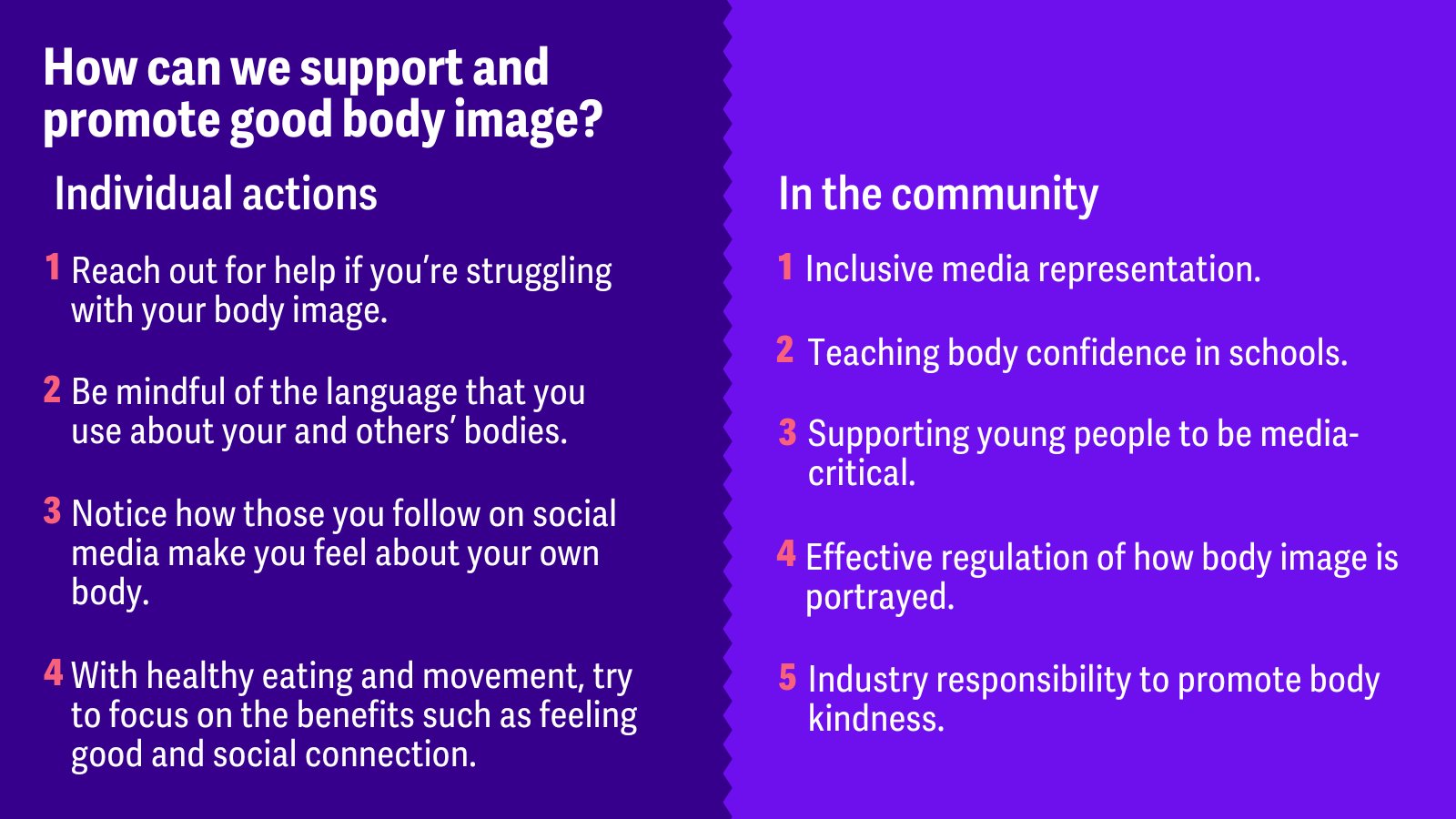
ALT On the left side, the title reads: "How can we support and promote good body image?" followed by a subtitle: "Individual actions", and a list: "1. Reach out for help if you’re struggling with your body image. 2. Be mindful of the language that you use about your and others’ bodies. 3. Notice how those you follow on social media make you feel about your own body. 4. With healthy eating and movement, try to focus on the benefits such as feeling good and social connection." On the right side there is the subtitle: "In the community" followed by a list of text: "1. Inclusive media representation. 2. Teaching body confidence in schools. 3. Supporting young people to be media-critical. 4. Effective regulation of how body image is portrayed. 5. Industry responsibility to promote body kindness."

ALT Text says: "Everyone has the right to feel comfortable and confident in their body.". There is then a M shaped graphic with a sketched heart-shape.


ALT On a pink background, there are two speech bubbles in white with a blue outline. Above the first speech bubble it says: 'What we say' in blue bold print. Underneath is a bubble saying "I'm fine." Below that in blue bold print it says 'What we mean'. Underneath is a speech bubble containing the following words in various sizes "overwhelmed, anxious, stressed, fed up, struggling, scared, tired, nervous, embarrassed."


ALT The image is an iceberg diagram visually representing the "Social causes of mental illness." Above the waterline, it displays the ways in which the mental health system is in crisis. There are 3 examples of this: "understaffed NHS", limited response to mental health emergencies and under-resourced mental health social care. Below the water, several hidden factors are listed as social causes of mental illness on the submerged part of the iceberg. These include "Lack of employment opportunities," "Racism," "Social isolation," "Poor housing," "Stigma & discrimination," "Cost of living crisis," and "Delayed access to early intervention services." The text "Mental health system in crisis" is prominently displayed at the top. The background is a dark blue water-theme emphasizing the depth and complexity of the issue.


