

#International #Financial Services Executive, #Entrepreneur and Adviser. #Fintech, #startup and #Crypto (#bitcoin, #blockchain) Fan. Founder of #AtrevaFintech.
Joined February 2010
- Tweets20.8K
- Following867
- Followers1.1K
- Likes607





Claudio Migliore retweeted

I spend most of my time on how to improve privacy, and avoid KYC, and I don't understand why you claim I don't. I think "merchant adoption" is sometimes a red herring, but to some degree I'm interested in that as well. I don't care for stocks. I think "Crypto" is a cancer, one of the main obstacles to the growth and efficacy of Bitcoin.
Maxim is trying to annoy me as some sort of revenge, because he thinks I didn't help him enough in his several conflicts and money/power game (while I think I did it way too much). Since he knows I hate shitcoiners, he thinks calling me one will get under my skin so much that I'll go back trying to actively protect him from his self-inflicted ostracism from donors, investors, developers. But my self control improved over the years.
Fuck the government, fuck shitcoiners. Piece&love.
yesigiveafig.com/p/part-1-my…
@profplum99
Nice 1st order view. Now take out subsidies and their overhead. Drop in demand curve +drop in waste +drop in taxes. Childcare plummets. Health too. Axe regulation and transport tanks. Nanny state is the problem. Even halfway would do good.

1
96

Claudio Migliore retweeted

One reason money is so complex is that the actions of every person across all time influence the purchasing power of everyone else’s money across all time. For instance, if you consume an apple right now, then the purchasing power of everyone’s money decreases by one apple, all else being equal. To use a metaphor from quantum mechanics, money is global macrohistorical entanglement: through this medium, everyone’s actions instantly impact the livelihoods of everyone else, in both the present and in the future. Like math, money is a universal language. It is the economic water in which we are all immersed, and of which none of us can ever break the surface. Money is the lingua franca of praxis: the encoded consequences of every human action, ever.


So with Android 15, My preferred languages got wiped and Android thinks Blackfoot or Ojibwee are reasonable suggestions for my keyboards. Don't get me wrong, I am sure legit languages, but why suggesting them? Chinese would be equally alien to me, but maybe a little more useful?

2
82

The free market only works with reasonably rational actors. In a rational world, actors would not accept tyrannical products (Apple?) and demand real value, not status and nice icons.

There is a lot to fix in America.
One thing is the conveyor belt system I have observed close up that builds MBAs from ivory league universities to form cronyism based on”capital optimization” by gutting beloved brands of their value.
The current system is designed for cronyism
3
69
Claudio Migliore retweeted

There is a lot to fix in America.
One thing is the conveyor belt system I have observed close up that builds MBAs from ivory league universities to form cronyism based on”capital optimization” by gutting beloved brands of their value.
The current system is designed for cronyism

fortune.com/2024/10/05/white…
Per Forbes, it seems you can be called “economist” having studied Fine Arts at the Manhattan School of Music and Social Welfare at Columbia. You do not even lose points fumbling on camera when asked about bond market basics.

1
45
Wrong conclusion, from a bad extrapolation, out of cherry picked info, out of dubious raw data. And, finally, an arrogant mandate, like from the Pope: "build."
Perfect synthesis of collectivism.

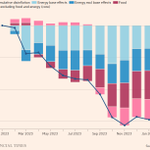
Shelter inflation over the past year: 5.2%
"Everything else" inflation over the past year: 1.1%
Housing is the problem. Build more of it.
1
35
But of course, you cannot make the distinction without external cues. Ask an economist if s/he thinks s/he is being scientific and s/he will always say "yes." Like ask a a possible liar if s/he is lying; s/he will always say "no."

Is high-impact climate science really just “science”?
Greg Mankiw’s, Principles of Macroeconomics textbook makes an interesting distinction between the different roles that economists play:
“When economists are trying to explain the world, they are scientists. When they are trying to help improve it, they are policy advisers.”
He alludes to Hume’s is-ought distinction, saying scientists make descriptive claims about how the world is, not prescriptive claims about how the world ought to be.
Critically, he says, “Deciding what is good or bad policy is not just a matter of science. It also involves our views on ethics, religion, and political philosophy.”
This is a very interesting distinction in the context of high-impact “scientific” publishing on climate change because in order for "science" to be “high-impact” (of sufficient interest to a general readership), it is often incredibly helpful for it to be framed as having important prescriptive implications for contemporary policy debates.
The journal Nature, for example, recommends that the end of the abstract/intro paragraph give a “broader perspective” on the findings, which in practice often means “state why these findings are of sufficient interest and palatability to our readership.”
In the climate science landscape, this recommendation often manifests as studies focused on the physical and biological world but concluding with a prescriptive claim about how the world ought to be (a claim that does not actually follow from the study itself because the study is way too narrow to make said claim).
These types of abstracts very much blur the lines between Mankiw’s definition of a “scientist” and a “policy advisor." What’s particularly insidious is that having a strong prescriptive implication on e.g., reducing greenhouse gas emissions acts as a selection mechanism for what studies get published and amplified as the most important "science".
This muddying of the waters between researchers acting as scientists or policy advisors wouldn't be such a problem except that the public perceives that a journal like Nature is a scientific journal, and thus, it produces more-or-less authoritative truths, not claims that rely on ethical, philosophical, and moral assumptions. This can be partially remedied if the public understands that the prescriptive statements emanating from these journals are subjective and do not deserve the perceived authority typically bestowed upon the idealized concept of "Science."
I have written about these issues previously:
What The Science Can’t Say About Climate Change: thebreakthrough.org/journal/…
The Social Feedback Loops That Constrain Climate Science: thebreakthrough.org/journal/…
The fact illusion: Objective truth is elusive in (climate) science: patricktbrown.org/2017/07/28…


46
Close to 100%, actually. There is no lineage not mingled at some point with both slave and slave-owner blood. Romans by Etruscans, Brits by Romans, Chinese by mongols, Indians by Indians, Jews by Egyptians, non-Jews by Jews, Mayas by Aztecs, round and round in the circle game.

If you were to give reparations to everyone whose ancestors had been slaves, I suspect that you would have to give reparations to more than half the entire population of the globe. Slavery was not confined to one set of races.
52

Yep. You could argue, though, that DC is a net negative tax since everyone lives off the teat of the state...

30
The fact they got help from an American 3letter agency does not mean they were not commies. Maybe conniving enterprising commies.

🍀
Actually, the Red Brigades weren't real commies.
They were part of a CIA plot to keep commies out of the government in Italy by making them look bad.
Aldo Moro was actually sympathetic to the PCI (Italian Communist Party) and was pushing for forming a coalition with them.
✅
19