






Travis retweeted

Seeing a weird thing with AI rn where people are doing random stuff to feel productive
Add a lil dashboard here and there
Instead of actually just doing the work???
Like ‘oh I’ve made this thing that makes me more productive but I’m behind on deadlines’
The rot has begun
Travis retweeted

Where did brands spend their money in Q1?
What was the iROAS of every channel and tactic?
What about the median MER and contribution margin?
Let me show you:

Ok @Shopify needs to do 2 things right now.
1) clear fee per order tracking. Why can't I know how much I paid on order fees each month via accural by order?
2) A way to get label + labor cost from 3PL software like @weareshiphero, why can't I know what an order cost to ship?
2
10
470
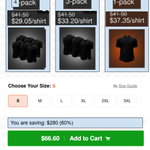
We have officially sold over $10m of stuff with AI hero product images.
In an industry like window coverings, this is a great use of AI!
1
10
559
If you sell physical products you need to get as close to manufacturing as possible.
I’m launching 3 new categories in the next 12 months. We can take entire working businesses and integrate their offer into our store, but I can NOT setup manufacturing.
4
191
Travis retweeted

The White House has instructed CBP to stop collecting IEEPA tariffs so make sure your broker is removing those line items effective immediately.
If you use automatic discounts on shopify that sync with sales channels, shopify just deleted this feature. Check merchant center, shop app, etc. You can’t turn it on anymore.
And I loved getting the AI slop support from shopify telling me this feature never existed.
3
257

Travis retweeted
This is so exactly right.
It’s not about the cost savings. (Exclusively)
It’s about the latency and clarity of information.
Every time knowledge moves from one person to another there is some degradation in the accuracy and understanding.
Additional there is often a reduction in skill as info flows down an organization.
So you get less clear information excited less effectively the more people are involved.
The reason you want to enable one high level person to execute is to maximize cost AND QUALITY.

80%+ of our revenue this year came from new or improved SKUs. And we grew existing customer revenue by 60% YoY.
I solo operate a 7-figure ecom brand and have spoken 1-on-1 over email with over 1,000 customers already this year.
"That's not scalable!"
This is only like 3-4 emails a day on average... I can do way, way more.
I market and design all of our products, and I want every customer to speak directly with me and tell me what they love and hate, everything from ad angles to product photos, PDPs, colors, UX, etc.
I have 6 ways to automate starting these conversations to make it easier for people to talk.
We won't even do $10M this year, so I don't think there’s any excuse not to build these 1-on-1 relationships with customers. They’re spending $200–$400 per order, even as a solo operator, it’s worth it to let anyone speak with me at any time.
Operating a business I didn't start makes it harder for me to resonate with the products I’m making (I don’t even use curtains). How could I improve reviews for products I can't use?
I’m a 26 year old dude living in a condo with blinds, not a mom buying curtains for her nursery.
So I let our customers flow through me. I make what will put us in a larger TAM, with better margins and higher AOV or what will increase out LTV. (shoutout @seanfrank)
In the future, you need to be able to translate concrete words customers are saying into abstract, high-level business strategy. You need to be able to bounce between chatting with Eliza about your next release and demand forecasting Q1 inventory. Its what CTC's profit engineer role is about, being in the weeds and high level at the same time. (shoutout @TaylorHoliday)
It builds intuition about your customers, your business, and your product development, and that’s key.
Send a founder plaintext email and tell people you read and respond to every message, you literally can try to talk to every customer. This is a moat, your brand can own.
No one does this, customers can’t believe they can talk to the guy running the joint, making the products, and building the website.
Build intuition. You can do way more labor than you think.

Is there a way for me to pay money and have access to a bunch of creator micro accounts for partnership ads in my niche?
I made one page and the partnership ads on a brand new page are just so much better than from our brand account. Lmk if anyone wants to try it!
1
1
237
Travis retweeted

Your marketing teams job is to say things that are uniquely true about your products.
Your product teams job is to give them unique things to say.
Travis retweeted

I thought this too. Had lunch with Cindy Allen this week after meeting through @aaronrubin
She could be a fun person to interview.
China shipping appears to continue to be viable.
They’re shipping DDP and claiming the goods at wholesale by structuring the transaction as B2B2C.
In some cases they’ve got a US entity which is the second party in the B2B, but many times it’s just a synthetic entity.
It appears packages have to touch a warehouse in the US instead of going straight through postal methods, so we’re seeing domestic postage labels slapped on top of international ones at a forwarder.
While it seems against the spirit of the law when compared to 321, CBP doesn’t seem to care because they’re collecting what could be considered a comparable amount of duties if the goods were imported in bulk.
So where most companies structured a B2C transaction, they really only did so because of the crazy high deminimis and ease of entry. Technically they could have always done it this way, which I assume applies to 321 goods now too.
In this case, 321 remains disadvantaged from the need to hold a secondary warehouse, but advantaged in time in transit — for many goods that hasn’t mattered enough, and the gross volume of shipments direct from China has reduced air freight costs somewhat.
Notably the USPS duties and tax assessments aren’t subject to the same international tariff imposition because they’re governed by international treaty instead of federal law. This gives them some latitude to assess duties differently, where other carriers are subject to (stricter?) different entry guidelines.
I certainly thought we’d see a flood of leads looking to get stateside, and we did at first, but as @RomanEcom said, they found a quick workaround in a nominal (probably undervalued) duty rate on the wholesale cost of the goods.
Here are the DTC benchmarks you should be aiming for:
20% Ebitda
15% OPEX/G&A
This means you want a 35% contribution margin. The remaining costs will be 65% of Revenue, made up of the following items:
Returns
Cogs
Fulfilment
Transactions fees
Ad Spend
The goal of these costs are to spend as much as possible on ads.
*If you make a bulk of the contribution on repeat orders, you need to breakout new and existing customers and forecast future orders.
Travis retweeted
As July books close, you're gonna start to hear more about the tariff pain showing up for eCom brands.
Why now?
The median cash conversion cycle for an 8-figure eCommerce brand is 92.63 days (source: @FinaloopTeam). That means that brands generally have about 3 months of inventory on hand at any given moment.
As a result, July likely represents the first time most brands are selling inventory subject to increased duties.
And the reality is that brands are absorbing the bulk of these costs:
@GoldmanSachs latest estimates suggest:
-Foreign exporters absorbed 14% of US tariffs
-US companies ate 64%
-US consumers ate 22%
And the pain is just beginning...
Don't be surprised if the next few months the topic surges back into focus as the ire of angry store owners is reignited.

Travis retweeted
UNPOPULAR OPINION:
Gross margin IS NOT product costs.
Gross margin must include:
- product costs
- freight cost from factory to warehouse
- payment processing rates
- returns and exchanges
- sales channel fees (wholesale AND Amazon)
- fulfillment to customer
This is the GAAP definition of gross margin.
Cost to get the goods in the hands of the customer.
ecom friends, I need to hire a few partners/ agencies
2-3 video creative agencies, ongoing.
1 branding agency for a full rebrand
1 solution for product seeding
1 packing pro
1 organic social
$0-$10m in the last 2 years in home goods, with 20% ebitda. We have ex-DTC darling leadership, DM me
Also if anyone has any good non paid group chats with 7-8 figure brands, please invite me ♥️
This is the most important Meta metric not easily accessible. Every time we massively beat our monthly projections, it was because we found a way to reach a bunch of new people very cheaply. And the inverse is true.

Here's a metric you should be monitoring every week if you're spending more than $400k/month:
Net New Reach
Most brands track "total reach" - a meaningless number that counts the same customer 47 times.
Smart operators track incremental audience growth.
If your net new reach % is consistently below 10%, you're not growing your audience. You're just burning budget on the same people over and over.
The brutal truth:
Your Facebook ads might show 10M "reach" but if 9.5M of those are people who've seen your ads {X}+ times, you're not scaling.
You're stuck in an expensive echo chamber.
What to do:
Audit your current campaigns for net new reach %
If it's below 10%, you have a targeting problem, focus on broad audiences through:
- Broad targeting
- New offers
- Creative diversity
- New campaign optimisations to open up your account to new audiences
If your cost per 1K net new is above $200, you have an efficiency problem.


1
6
489