

High Growth US Consumer Tech. Previously at 3 midcap public tech cos. Voting and weighing stocks. raw thoughts. dms open.
San Francisco, CA
Joined October 2020
- Tweets8.9K
- Following754
- Followers2.8K
- Likes10.9K








ConsumerTechBets retweeted

Dusting off this tweet from April because this gap in shared understanding of LLM capability is *widening*. It's now less "two groups of people speaking past each other" and more a sharp funnel.
- Napkin math somewhere around 6B people (~75% of the population) have barely come in contact with LLMs at all.
- Around 1-2B (~20%) are casual and infrequent users of free-tier ChatGPT-like products. This group sees derpy chatbots and treats them a bit like a better Google search, a writing aid, or etc. Maybe an agent tries to book you a flight. I have non-tech friends who (reasonably, imo) say they have not much use for it at all. Even many professionals outside of math&code are in this tier. For example, execs and many other functions spend a lot of their time talking to other people, so while they understand what is happening intellectually, it is still second-hand and a bit abstract.
- Now we get to professional use of frontier-grade LLMs in math&code. Somewhere around 20M people (0.2%) see first-hand that large, complex projects that used to take them weeks/months can now be completed by agents with a prompt. Building apps, copying apps, translating apps, decompiling apps from binaries... This has all happened very quickly and recently - less than 1 year ago, I was writing code manually by hand, typing memorized computer code commands into a code editor character by character, occasionally pressing Tab to autocomplete a little chunk of code.
- And finally we get to the ~5,000 people (~0.00006%) with access to frontier-grade systems internally. The external world has seen the preview. It looks like swarms of thousands of agents collaborating over weeks on software mega projects: minting zero days, running cyber attacks and defenses at machine speeds, discovering new science, advancing the frontier of mathematics. Things that would have taken top professionals in the industry years of work. Meanwhile, human review and comprehension are starting to fall behind. For example, people are still involved in the "archeology" of the OpenAI-HF incident from many months ago. Mathematicians may be poring over the 722 manuscripts on frontier mathematics for a while.
The funnel is driven by a combination of factors:
1. The impact scales with ambition, problem size, and horizon. A question with a paragraph answer barely stresses the system. You need a reservoir of big, difficult problems that you really care about. This aspect drives the consumer / professional dimension of the funnel.
2. The jaggedness of the system (which I have written about a lot separately). Capability peaks in domains that are digital, verifiable and economically valuable. This is because LLM capability emerges from reinforcement learning on verifiable rewards on a curated environment mixture driven by revenue potential. This aspect primarily drives the area (e.g. math&code) dimension of the funnel.
3. Access. Free-tier, paid-tier, internal.
So this is the weirdness of the moment. The general public has mostly not interacted with these systems. When they have, it looks like a derpy chatbot. The majority of professionals still see only a modest uplift. And a small sliver of professionals are experiencing the vertigo of the curve going vertical. And it is all happening at the same time.

Judging by my tl there is a growing gap in understanding of AI capability.
The first issue I think is around recency and tier of use. I think a lot of people tried the free tier of ChatGPT somewhere last year and allowed it to inform their views on AI a little too much. This is a group of reactions laughing at various quirks of the models, hallucinations, etc. Yes I also saw the viral videos of OpenAI's Advanced Voice mode fumbling simple queries like "should I drive or walk to the carwash". The thing is that these free and old/deprecated models don't reflect the capability in the latest round of state of the art agentic models of this year, especially OpenAI Codex and Claude Code.
But that brings me to the second issue. Even if people paid $200/month to use the state of the art models, a lot of the capabilities are relatively "peaky" in highly technical areas. Typical queries around search, writing, advice, etc. are *not* the domain that has made the most noticeable and dramatic strides in capability. Partly, this is due to the technical details of reinforcement learning and its use of verifiable rewards. But partly, it's also because these use cases are not sufficiently prioritized by the companies in their hillclimbing because they don't lead to as much $$$ value. The goldmines are elsewhere, and the focus comes along.
So that brings me to the second group of people, who *both* 1) pay for and use the state of the art frontier agentic models (OpenAI Codex / Claude Code) and 2) do so professionally in technical domains like programming, math and research. This group of people is subject to the highest amount of "AI Psychosis" because the recent improvements in these domains as of this year have been nothing short of staggering. When you hand a computer terminal to one of these models, you can now watch them melt programming problems that you'd normally expect to take days/weeks of work. It's this second group of people that assigns a much greater gravity to the capabilities, their slope, and various cyber-related repercussions.
TLDR the people in these two groups are speaking past each other. It really is simultaneously the case that OpenAI's free and I think slightly orphaned (?) "Advanced Voice Mode" will fumble the dumbest questions in your Instagram's reels and *at the same time*, OpenAI's highest-tier and paid Codex model will go off for 1 hour to coherently restructure an entire code base, or find and exploit vulnerabilities in computer systems. This part really works and has made dramatic strides because 2 properties: 1) these domains offer explicit reward functions that are verifiable meaning they are easily amenable to reinforcement learning training (e.g. unit tests passed yes or no, in contrast to writing, which is much harder to explicitly judge), but also 2) they are a lot more valuable in b2b settings, meaning that the biggest fraction of the team is focused on improving them. So here we are.
ConsumerTechBets retweeted

This guy re-created all the adobe apps with opus-5.5, ported them to rust, and opensourced them
something really cool is happening

Readers added context they thought people might want to know
These projects are partial open-source Rust reimplementations of Adobe apps (built rapidly with AI agents), not complete recreations; their READMEs and roadmaps document many missing features and features still in development.
github.com/storytold/phot…
github.com/storytold/vect…
github.com/storytold/vect…
github.com/storytold/film…
github.com/storytold/film…
github.com/storytold/ligh…
getartcraft.com


ConsumerTechBets retweeted

Excited to share what we’ve been building at Meta Superintelligence Labs! We just released Muse Spark, our first AI model. It's a natively multimodal reasoning model and the first step on our path to personal superintelligence. We've overhauled our entire stack to support scaling, and this is just the beginning.
ai.meta.com/blog/introducing…

ConsumerTechBets retweeted

Seedance 2.0
Prompt: Sum up the AI discourse in a meme - make sure it’s retarded and gets 50 likes.
ConsumerTechBets retweeted

$HOOD looks like prediction markets will not be included in the "Other" transaction-based revenue in Q4 and will have their own "segment" on this slide.
Prediction markets will likely generate $86 million in revenue for Robinhood (per my estimates), which is higher than Q3's "Other" revenue and likely surpassing Q4 equity transaction-based revenues.
Who knows, maybe in a few quarters, prediction markets transaction-based revenue will be closer to crypto revenue than to equities.
For a product that brought little to no revenue a year ago, that's not bad.

ConsumerTechBets retweeted

The bigger point is that theres no advantage in being public unless like space x you want immediate access to large pools of capital. In a hot market a company like space x can do large scale convertible notes that generate very low effective costs of capital by selling out of the money call options. Any founder that doesnt need capital is making up stories to convince themself theres some benefit but really theres none. And today its esp painful since pvts get a huge premium to public which has been the case for the past 15 yrs other than one bubble in 2021.
ConsumerTechBets retweeted

Capstone $CGEH up ~150% since our research note in August with still plenty of potential upside:

ConsumerTechBets retweeted

Adobe to Acquire Semrush
"Today, Adobe (Nasdaq: $ADBE) and Semrush Holdings, Inc. (NYSE: $SEMR) announced that they have entered into a definitive agreement under which Adobe will acquire Semrush, a leading brand visibility platform, in an all-cash transaction for $12.00 per share, representing a total equity value of approximately $1.9 billion. Semrush is a powerful partner for marketers looking to manage brand visibility and audience reach through its data-driven generative engine optimization (GEO) and search engine optimization (SEO) solutions.
Adobe is leading customer experience orchestration in the agentic AI era with comprehensive solutions spanning content supply chain, customer engagement and brand visibility. Adobe enables 99% of the Fortune 100, including The Coca-Cola Company, General Motors and IBM, to use AI to transform the way they work.
Brand visibility is top of mind for Chief Marketing Officers as consumers increasingly turn to LLMs, such as ChatGPT and Google’s Gemini, for information, recommendations and purchase decisions. As generative AI platforms become a new interface between customers and brands, organizations that invest in GEO alongside their SEO capabilities are poised to keep their brands represented, discovered and trusted across owned and earned channels."
research.alpha-sense.com?doc…

ConsumerTechBets retweeted

BREAKING: DoorDash has announced that they are launching an autonomous delivery robot. The company will use the bot in an attempt to replace delivery workers.

ALT Little red doordash delivery robot.
ConsumerTechBets retweeted

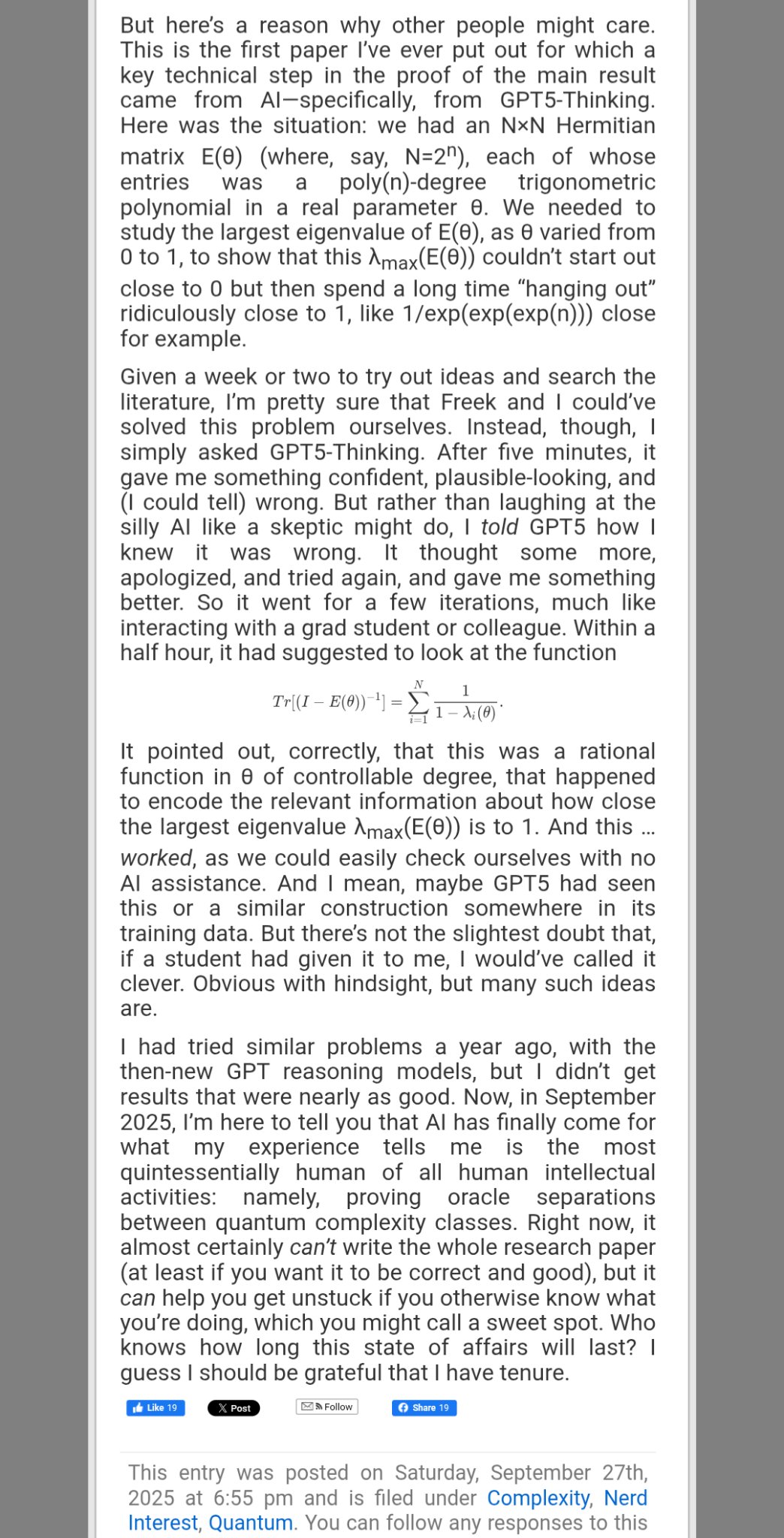
Yet more evidence that a pretty major shift is happening, this time by Scott Aaronson
scottaaronson.blog/?p=9183&f…
ConsumerTechBets retweeted

No one does. But currently Street seems to be happy to lean into “more capex” while completely discounting signal being sent from those who have asymmetric info re where models will be in two years. If Street was paying attention IGV would be trading materially lower. I’m not saying Dario/Ilya are right. I’m saying putting a sub 20% prob on them being right requires a ludicrous degree of hubris.
ConsumerTechBets retweeted

but they told me there’s no way openai was gonna have the money to pay orcl
ConsumerTechBets retweeted

From the beginning, we had clear goals for Chrome: simplicity, speed, and security.
And now with AI, we have a chance to make the browser even safer, more intelligent and helpful.
Our next Chrome era is just beginning…
ConsumerTechBets retweeted

PayPal is teaming up with @Google to bring smarter shopping to billions—think agentic commerce and PayPal checkout everywhere. Global scale, redefined. Excited for this new chapter in our partnership @sundarpichai 🚀
ConsumerTechBets retweeted

We’re teaming up with @lyft to bring Waymo magic to the Music City! We’ll pair our world-leading technology with Lyft’s proven track record of fleet management through its Flexdrive subsidiary. Nashville riders will be able to hail on the Waymo app starting next year. waymo.com/blog/2025/09/waymo…

ConsumerTechBets retweeted

“My Boyfriend is AI” (MIT study on 27k members from r/MyBoyfriendIsAI)
• Most AI romances start by accident (10% from productivity use → love)
• 25% report life benefits (loneliness ↓, mental health ↑), but some face dependency & dissociation (1/2)

ConsumerTechBets retweeted

Start with the RFR like you said, then add an average equity risk premium for that region's broader stock market. So if the RFR is 14% but that region's stock market returns 20% per year before accounting for inflation, the ERP is around 6%. Technically this makes the discount rate around 20%. You can adjust by betas or default spreads if you want. This is useful because you are weighing the position against the next best thing, which is holding the broader market or holding a government bond.
Aswath Damodaran at NYU calculates ERPs for every country pretty often, and he keeps it posted for everyone. It's a nice 'easy button' for knowing a region's ERP quickly. Hope that helps!
pages.stern.nyu.edu/~adamoda…
ConsumerTechBets retweeted

Copy what the best firms did. Their biggest hacks for reducing drawdowns:
1. Add more uncorrelated strategies.
2. Bet small enough on a strategy or correlated basket of strategies so it won't lose you more than a few percent of NAV when you're wrong.
ConsumerTechBets retweeted

Primera publicidad de @Mercadolibre 100% generada por IA. Costó, aprendimos y quedó buena. Primer paso, vamos!! 🚀