

What you hear about, next to what you already know. The whole picture, in other words.
Joined September 2025
- Tweets127
- Following169
- Followers28
- Likes2



Think making the NCAA means going pro? Barely. Share of NCAA athletes drafted: football 1.4%, men's basketball 1.0%, baseball 4.9%, men's hockey 7.5%. Source: NCAA Research, Probability of Competing Beyond High School (2024-25)

1
34
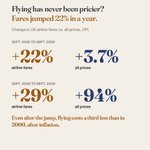
US airline fares rose 22% from September 2025 to September 2026, six times the 3.7% rise in overall prices. Over the longer run it's the other way around: since 2000 fares are up 29% while prices overall nearly doubled, so flying is about a third cheaper after inflation. Source: BLS, Consumer Price Index

38
A dozen grade A eggs averaged $2.27 in September 2026, down 64% from the $6.23 peak in March 2025. Ground beef went the other way: $6.79 a pound, up 7% in a year, after a record $6.92 in August, the highest since BLS began tracking it in 1984. Source: BLS, CPI Average Price Data

1
1
30
In 2019, 27.5% of US high school students had vaped in the past month, about 4.1 million teens. In 2025 it was 7.1%, about 1.1 million. Only 1.4% of middle and high schoolers smoked cigarettes. The survey method changed after 2019, so the years aren't perfectly comparable. Source: FDA/CDC, National Youth Tobacco Survey

17
Americans 65 and older spend about 4.8 hours a day on TV, games and leisure computer use as a main activity, versus 3.1 for ages 15 to 24. TV alone: 4.3 hours vs 1.8. Older adults also read the most, about 32 minutes a day vs 10. Phone use alongside other activities isn't counted. Source: BLS, American Time Use Survey 2025

1
17
Regular gas averaged $4.48 a gallon in September 2026, up 34% in a year. In today's dollars, though, July 2008 ($6.27) and June 2022 ($5.75) were both higher, and July 2008 remains the inflation-adjusted record in data going back to 1976. Source: BLS, CPI Average Price Data

21
About 1.03 million US high schoolers played football in 2024-25. Roughly 81 in every 1,000 go on to play in the NCAA, and only about one is drafted: the 2025 NFL draft had 257 picks. In men's basketball, 3.6% play in college and 1% of those reach the NBA draft. Source: NCAA Research (Sept. 2026)

96
Picture a midterm voter and you probably picture a line at the polls on Tuesday. In 2022 that was only about half of voters: 49.0% voted in person on Election Day, 31.9% by mail and 22.2% in person early. In the 2018 midterm, 58.2% voted on Election Day and about a quarter by mail. Source: U.S. Election Assistance Commission, 2022 Election Administration and Voting Survey (June 2023)

1
53
"Nobody votes in midterms" is a 2014 fact. That year 41.9% of voting-age citizens said they voted. In 2018 it jumped to 53.4%, the highest midterm since at least 2000, and 2022 held at 52.2%, with registration at a midterm high of 69.1%. Official counts run a bit lower (46.8% in 2022) because surveys overstate voting. Source: U.S. Census Bureau, Current Population Survey Voting Supplement (2022); EAC EAVS 2022

34
The average light vehicle on US roads is 12.8 years old, up two months for the second year in a row. Passenger cars average 14.5 years, SUVs, pickups and vans 11.9, across 289 million vehicles. Source: S&P Global Mobility, vehicles in operation analysis (May 2025)

27
In 17 states, people 65 and older now outnumber children under 18, up from 5 states in 2020. Nationwide, kids' lead shrank from 17.7 million to 7.4 million as the 65+ group grew 15%. Source: US Census Bureau, Vintage 2025 Population Estimates (June 2026), state counts computed from Census files

36
US workers aged 25 to 34 had been with their employer a median 3.0 years in January 2026, the same as in 1983. Across all workers the median is 4.1 years, up from 3.5 in 1983 (BLS notes the series isn't strictly comparable). Source: Bureau of Labor Statistics, Employee Tenure releases (2026, 1997)

23
"Social Security will be gone" is what 41% of US adults expect within 10 years. The 2026 Trustees Report says something different: the combined trust funds run out in 2034, but payroll taxes keep coming in and would still cover 83% of scheduled benefits (65% by 2100). Without a fix, benefits would be cut, not gone. Sources: West Health-Gallup (2025); 2026 Social Security Trustees Report

27
Americans spent $1.41 trillion on food away from home in 2025 and $1.10 trillion on groceries and other food at home. All food took 9.7% of disposable income, down from 10.4% in 1997. Source: USDA Economic Research Service, Food Expenditure Series (2025 data, updated June 2026)

34
The typical first-time US home buyer is now 40, the oldest on record. First-timers were just 21% of buyers, a record low and about half their 2007 share. Repeat buyers' median age: 62. Source: National Association of Realtors, 2025 Profile of Home Buyers and Sellers (Nov 2025)

25
US life expectancy hit 79.0 years in 2024, the highest ever recorded. It was 78.8 in 2019 and fell to 76.4 in 2021. The overdose death rate dropped 26% in 2024, the largest decline on record. Source: CDC National Center for Health Statistics (final 2024 data)

2
39
The US cancer death rate (age-adjusted) fell 34% from its 1991 peak through 2023: about 4.8 million fewer cancer deaths. Five-year survival for all cancers is now 70%, up from 49% for people diagnosed in the mid-1970s. Source: American Cancer Society, Cancer Statistics 2026

32
The average worker now pays $7,471 a year for employer family health coverage, up 9% from 2025. The full premium is $28,303, up 5%, and employers pay the other $20,832. Wages rose 3.7%. Source: KFF 2026 Employer Health Benefits Survey

1
32
In 2020, 53% of Native Hawaiians in the US lived outside Hawaiʻi: 362,945, vs 317,497 in the islands. That share was 40% in 2000 and 45% in 2010. 2020 was the first census to count more off the islands than on them. Sources: Census Bureau; Hawaiʻi DBEDT

31
