

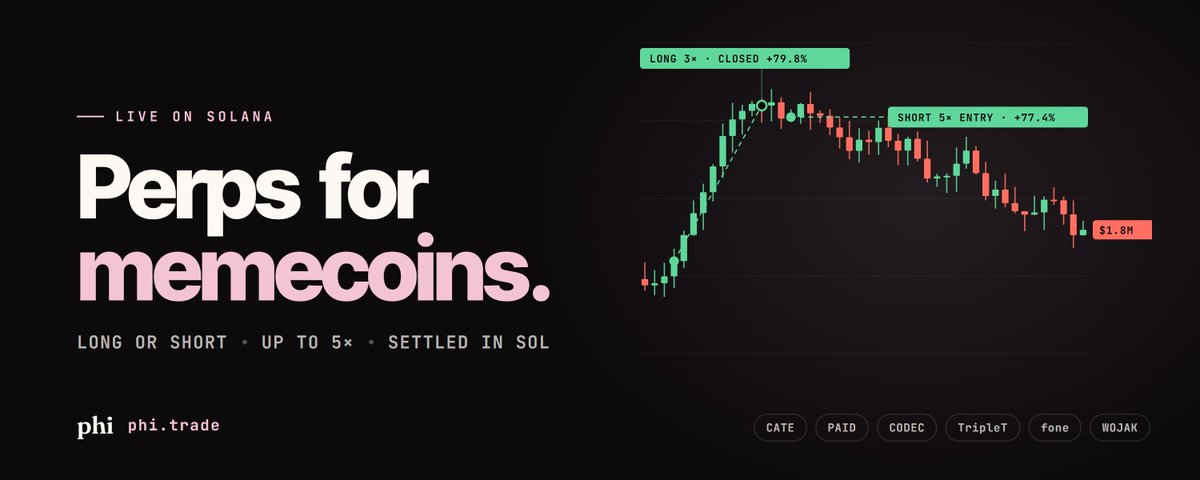
the first perpetual futures exchange for memecoins. up to 5x leverage, long or short
Joined September 2026
- Tweets28
- Following2
- Followers405
- Likes6



phi, 12 hours in.
$2.1M in $PHI volume across 34,000+ trades.
142 SOL in $PHI creator fees, every lamport paid into the vault.
The vault: 4.94 → 136.7 SOL.
The largest trade it backs: 0.99 → 27.3 SOL.
29 positions opened on phi by 15 traders, 65 SOL of volume, longs and shorts across six memecoins. Zero liquidations.
15.5 SOL bought back and burned: 10.5M $PHI gone for good.
The more $PHI trades, the deeper phi gets.
phi.trade
$PHI buybacks are live.
Every hour, 97% of phi's realised profit against traders buys $PHI on the open market and burns it. Burned for good, and $PHI's supply drops on-chain every time.
To start it off, we bought and burned 15 SOL of $PHI straight from the vault.
10.5M $PHI burned so far, 1.05% of supply.
Every buyback and every burn, with its transaction: phi.trade/buybacks
this is the phi program. every trade, payout and fee on phi runs through it.
solscan.io/account/phiA9JsBf…
no server holds your funds and no oracle sets your price. this thread walks through what it does.

phi's leaderboard is live: phi.trade/leaderboard
Every trader, ranked live. Closed trades and open positions, marked to each coin's pool, every one verifiable on-chain.
Longs and shorts across $CATE, $PAID and $TripleT.
Up to 5x.
The top spot is open. Come take it.
Every trade on phi has two sides: the trader, and the vault.
When a trader wins, the vault pays them. When they lose, the vault keeps their stake.
From today, 97% of the vault's profit buys $PHI on the open market and burns it.
Every buyback, on-chain: solscan.io/account/DNRfuJXY5…

Someone just opened a 5x short on $PAID.
1.94 SOL stake. 9.7 SOL of exposure. On a two-week-old memecoin.
The moment it opened, phi's vault set aside 1.94 SOL to pay its best case. If $PAID falls 20%, the trader doubles their SOL, paid out by the program. If it rises 20%, they're liquidated.
It's right at the limit: one trade can use up to 20% of the vault. That vault doubled in ten minutes from $PHI creator fees.
And like every position on Hyperliquid, it's public. Verify it yourself:
solscan.io/account/HkgPPR2oe…
A statement on @TryLeveragePad.
We are not the same.
phi is Solana's perpetual futures exchange for memecoins: an on-chain program, not a website in front of a wallet.
Where your money lives
Leverage Pad takes deposits into a single wallet and tracks balances on its server. That wallet holds 0.003 SOL right now. It held 3.7 SOL this morning.
On phi there is no deposit wallet. Every position is its own account on Solana, every payout is made by the program, and your maximum win is reserved in the vault before the trade can open. If the vault can't pay it, the trade doesn't open.
Where the money comes from
Leverage Pad's coin earned ~170 SOL in creator fees. It went to a team wallet.
100% of $PHI creator fees are locked to phi's vault on-chain, forever. In the first ten minutes of $PHI, they took the vault from 4.94 to 9.76 SOL. Every open (0.30%), every hour of funding (0.05%), and every losing stake flows there too.
Why it can't be gamed
Thin pools are easy to push. A venue that pays out on a pushed price gets drained by it. phi is built so that never pays:
• No oracle. Every price is read straight from the coin's own pool.
• Every open, close and liquidation settles at the worse of the live price and the price a few slots earlier. Push and cash out in the same moment, and you get nothing.
• Each side of each market is capped by the depth of its pool, so pushing the price costs more in swap fees than the positions could ever win.
• Every position is held for ten minutes. A push has to survive the whole market.
• No single position can use more than 20% of the vault, and everything owed is reserved up front. The vault can never owe more than it holds.
Hyperliquid showed what an exchange can be when it runs on-chain and is backed by its own vault. phi is that, for memecoins.
phi.trade
$PHI did $106K in volume in its first 10 minutes.
Every trade paid a creator fee. 100% of it just landed in the phi vault, on-chain:
4.94 SOL → 9.76 SOL
The vault backs every position, so the limits grow with it. A single $PAID trade can now be 1.95 SOL, up from 0.99 at launch.
The more $PHI trades, the deeper phi's orderbook gets.