

One 5-minute lesson a day on how the world actually works. Economics, history, civics, science. Free. Better than a doomscroll. 🐙🎓
United States
Joined April 2026
- Tweets59
- Following8
- Followers3
- Likes0







Pinned Tweet
Most of what scrolls past you is outrage about outcomes. Almost none of it explains the machinery that produces them.
Polymath is one 5-minute lesson a day on how the world actually works. Free. Daily lessons start tomorrow.

1
1
83
Yesterday's answer: Cyrus. Making compliance cheap lowers the incentive to rebel. The Persian Empire lasted over 200 years in part because that lighter touch cost less to run than forcing total submission.

Cyrus the Great let conquered peoples keep their religion, customs, and local rulers, as long as they paid tribute. A rival king called that weakness.
Who was right, and why?
0%Rival: demand total
0%Rival: they'll rebel
0%Cyrus: lighter lasts
0%Cyrus: too weak to force
0 votes • Final results 1
Your bank account can read -$200. A thermometer can read -10°F. A friend says negative numbers are a trick, because nothing in the real world is actually negative.
What's the most accurate pushback?
0%Just a shorthand
0%Direction, not quantity
0%Only for subtraction
0%Only money and temp
0 votes • 11 hours 1
8

Yesterday's answer: Mountains wring the moisture out. Air rises, cools, and rains on the windward slope. By the time it descends the far side, it's dry. That's why the Great Basin sits east of the Sierra and Cascades.
Look at a map: a tall mountain range, winds blowing west to east, and a huge desert sitting just east of the peaks.
What's the most likely explanation?
0%Rain shadow
0%Too far from ocean
0%Higher, too cold
0%Deserts prefer east
0 votes • Final results 5
Cyrus the Great let conquered peoples keep their religion, customs, and local rulers, as long as they paid tribute. A rival king called that weakness.
Who was right, and why?
0%Rival: demand total
0%Rival: they'll rebel
0%Cyrus: lighter lasts
0%Cyrus: too weak to force
0 votes • Final results
Look at a map: a tall mountain range, winds blowing west to east, and a huge desert sitting just east of the peaks.
What's the most likely explanation?
0%Rain shadow
0%Too far from ocean
0%Higher, too cold
0%Deserts prefer east
0 votes • Final results
Yesterday's answer: Answer: authoritarian, dressed up with elections. A democracy's defining test isn't whether votes happen. It's whether power can actually change hands through a fair vote. Remove the real challengers and the election is theater.
Every government answers one question: who gets to decide?
A country holds elections every 4 years, but the leader jails the two most popular opposition candidates before the vote. What is it?
0%Full democracy
0%Theocracy
0%Oligarchy
0%Authoritarian, w/ votes
0 votes • Final results 2
Polymath, week 2:
• Too much money chasing too few goods
• Why London is mild and Calgary is frozen
• Writing started as accounting
• The number Rome never had
• Energy never disappears
• Elections ≠ democracy
How many did you get right? Catch up on any you missed → polymath-daily.com

7
Yesterday's answer: Answer: it becomes heat. Resistance in the circuitry turns the "wasted" share into thermal energy, which is why chargers feel warm. Nothing is destroyed. It just ends up in a form that doesn't do the job you wanted.
Energy can't be created or destroyed. It only changes form. So where does the "lost" part go?
A phone charger is about 90% efficient. What happens to the other ~10% of the energy?
100%Becomes heat
0%Destroyed
0%Stored in the charger
0%Sent back to the outlet
1 votes • Final results 5
Every government answers one question: who gets to decide?
A country holds elections every 4 years, but the leader jails the two most popular opposition candidates before the vote. What is it?
0%Full democracy
0%Theocracy
0%Oligarchy
0%Authoritarian, w/ votes
0 votes • Final results
Yesterday's answer: Answer: Roman numerals have no place value and no zero, so you can't line up digits and carry. Romans calculated on an abacus or counting board and only wrote down the results. Zero as a true number, with rules for arithmetic, comes from India: Brahmagupta, 628 CE.
The Romans built aqueducts that still stand. But try multiplying MMXXV by MMV.
Why was big multiplication so hard for the Romans?
100%No place value or zero
0%Didn't value math
0%Had zero, other name
0%Engineering-only math
1 votes • Final results 6
Energy can't be created or destroyed. It only changes form. So where does the "lost" part go?
A phone charger is about 90% efficient. What happens to the other ~10% of the energy?
100%Becomes heat
0%Destroyed
0%Stored in the charger
0%Sent back to the outlet
1 votes • Final results
Yesterday's answer: Answer: accounting. The earliest tablets from Uruk (c. 3300–3200 BCE) mostly record grain, livestock, rations and labor. Surplus created more transactions than anyone could remember, so writing began as bookkeeping. Literature came centuries later.
Mesopotamia, Egypt, the Indus Valley: every early civilization grew up on a river floodplain. Rivers meant food surplus, and surplus created a new problem.
The world's first writing, in Sumer over 5,000 years ago, was mostly used for what?
0%Religious hymns
100%Grain & trade accounts
0%Royal laws
0%Letters between cities
1 votes • Final results 5
The Romans built aqueducts that still stand. But try multiplying MMXXV by MMV.
Why was big multiplication so hard for the Romans?
100%No place value or zero
0%Didn't value math
0%Had zero, other name
0%Engineering-only math
1 votes • Final results
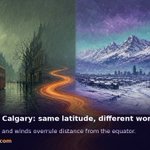
Yesterday's answer: Answer: the coastal city. Water stores summer heat and releases it slowly, and warm currents like the Gulf Stream / North Atlantic Drift carry it to the coast. Westerly winds then bring that mild ocean air onto land. That's why London stays mild while Calgary freezes.
London and Calgary sit at almost the same latitude. London barely sees snow. Calgary gets buried.
Two cities at the same latitude in January: one on a coast with a warm ocean current, one far inland. Which is warmer?
0%Coastal: ocean heat
0%Same: latitude rules
0%Coastal: more sunlight
100%Inland: away from sea
1 votes • Final results 5