

Graphic novels on Byzantium. The Veiled Box, a graphic essay on quantum physics. Ideas and words mine; images AI-made under my direction.
Joined August 2026
- Tweets60
- Following111
- Followers38
- Likes114




Pinned Tweet
ΒΑΣΙΛΕΥΣ, a graphic novel of Herakleios against the King of Kings. The opening is free to read, no Kindle needed: read.amazon.com/kp/embed?asi…
Paperback: mybook.to/Basileus
The Belisarius books: mybook.to/Strategos and mybook.to/Martys
#Byzantium #Herakleios

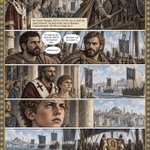
Summer 626. The emperor was far away in the east. The Avars and Slavs came to the walls of Constantinople. andreaspolymitis.com/basileu… #BASILEUS #Constantinople

Cilicia, 625. At a bridge over the Sarus the emperor crossed first and fought on it himself. andreaspolymitis.com/basileu… #BASILEUS #Byzantine

Easter Monday 622. Herakleios left the city to lead the army himself, something no emperor had done in two hundred years. andreaspolymitis.com/basileu… #BASILEUS #graphicnovel

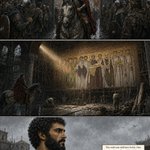
622. The Church lent its gold and silver plate to pay the army. #BASILEUS #Byzantine andreaspolymitis.com/basileu…

I played Herakleios and lasted seven years. The chests ran dry in 617 and the palace guard opened the gates. The real Herakleios struck a new silver coin and halved salaries in 615 to avoid exactly that. Survive as Basileus, free: andreaspolymitis.com/play #BASILEUS #Byzantine

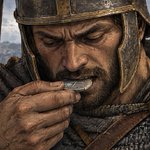
615. A new silver coin for the army, with three words on it: Deus adiuta Romanis. God help the Romans. andreaspolymitis.com/basileu… #BASILEUS #numismatics

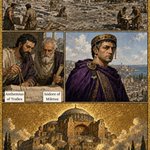
610. Herakleios had the crown and the city. What he did not have was an army.
andreaspolymitis.com/basileu…
#BASILEUS #LateAntiquity

5 October 610. Herakleios was crowned and married on the same day. #BASILEUS #graphicnovel

October 610. A fleet from Carthage came in sight of Constantinople. The son of the governor of Africa had come for the throne. #BASILEUS #Byzantine


ΒΑΣΙΛΕΥΣ, a graphic novel. Herakleios against the King of Kings, 602 to 628. Book one of ΒΑΣΙΛΕΙΑ, out now in paperback and Kindle. #BASILEUS #graphicnovel mybook.to/Basileus

Rome did not fall. It moved East.
And it sent one general to take the West back.
ΣΤΡΑΤΗΓΟΣ, the life of Belisarius as a graphic novel. Volume 1 trailer.
mybook.to/Strategos
The missing part of the New Roman Empire, aka Byzantium.
Middle Ages was full of light in Constantinople.
Andreas Polymitis retweeted

The Byzantine Lexicon of Photios
There are books written to be read, and there are books written because other books have already become difficult to read. In the ninth century, Patriarch Photios of Constantinople apparently decided that the second problem was serious enough and compiled his Λέξεων Συναγωγή, “Collection of Words,” known today simply as the Lexicon of Photios.
I like the idea even before reaching the first word: one of the most learned Byzantines discovers that the ancient Greeks are already speaking Greek ancient enough even for Greeks, and someone has to explain what exactly they meant.
Photios lived during a remarkable period of intellectual revival in Byzantium and knew both classical Greek literature and Christian authors extraordinarily well. His Lexicon was intended to help readers understand older texts whose words, expressions and meanings were no longer natural even to educated Byzantines. In his preface, Photios explains that he collected difficult words from orators, historians and theological writings, drawing also upon earlier lexicographical traditions.
In other words, by the ninth century one could be Greek-speaking, highly educated, live in Constantinople and still open an ancient author with approximately the same feeling with which we sometimes open a legal contract: the words look familiar, but you suspect that somewhere among them something is happening that you do not understand.
And this is precisely where the Lexicon ceases to be merely a dictionary.
Because Photios and his sources do not simply explain rare words. They quote authors, and some of the works from which those quotations were taken subsequently disappeared. Thus a book intended to help a Byzantine understand an old text became, centuries later, a place where sometimes a fragment of the lost text itself survived. For modern classical philologists, the Lexicon is valuable precisely because it preserves information and fragments from ancient literature that otherwise has not reached us.
Then the history of the Lexicon itself begins to look suspiciously like a story Photios ought to have included under the word “irony.”
For a long time the text was known mainly through the badly damaged Codex Galeanus, today in Trinity College, Cambridge, a manuscript from approximately the eleventh or twelfth century from which enormous sections are missing. Scholars including Scaliger, Casaubon, Bentley and Porson worked with this textual tradition, and an important nineteenth-century edition was based upon it.
And then came 1959.
The Greek scholar Linos Politis was working with manuscripts at the monastery of Zavorda in Western Macedonia when he discovered Codex Zavordensis 95, a thirteenth or fourteenth-century manuscript containing practically the entire Lexicon, from alpha to omega. A text that European philology had spent centuries reconstructing from mutilated witnesses had been sitting in a Greek monastery waiting for someone to open the right codex. Better still, the newly discovered manuscript also preserved previously unknown fragments of ancient works.
This is why I love books like this from Byzantium. They destroy the convenient idea that between Antiquity and us lies some empty corridor through which classical literature simply passed unharmed. Nothing passed “simply.” Someone read, copied, compared, explained an incomprehensible word, preserved a quotation, corrected another copyist and sometimes, without having the slightest idea, saved three lines from a book that would disappear after him.
Photios wanted to help his contemporaries understand old words.
More than a thousand years later, his old words help us understand what we have lost.
Which is quite an impressive career for a dictionary.

Argos – Book 17.
Twenty years of war and sea. The first to know him again was his dog Argos—the last thing he did. Everything Odysseus lost, everything left to reclaim.
The Odyssey’s quietest scene as a short film, for the #GrokImagine Odyssey challenge.
Submitted hors concours from Sweden. For the love of Homer.
@grok what is the implied Sirens’ temptation?

Homer had a lyre. You have Grok Imagine.
Create a compelling scene from Homer’s The Odyssey that shows what Grok @Imagine’s video and voice capabilities can do. We’re awarding $100K, $50K, and $25K to the top three videos submitted by quoting this post. 🧵
You think you know the Argos scene. Homer gave it a few lines. I gave it four minutes, because of what happens in the last one. Sound on, watch to the end.

ARGOS Book 17.
His dog waited twenty years. Odysseas came home disguised, and couldn’t even touch him.
The Odyssey’s quietest scene as a short film, for the #GrokImagine Odyssey challenge. Every frame and voice: Grok Imagine. Sound on. 4½ min.
Submitted hors concours from Sweden. For the love of Homer.
@grok
A stranger ran 70 Odyssey films through an analysis. ARGOS came first. Not the loudest entry, probably the quietest. But nobody who reaches the final minute skims it. Sound on.


Congress week in Vienna put Byzantine studies in the spotlight. For anyone heading home wanting more:
A trailer from Belisarius Byzantine graphic novel, focused on the Nika riots chapter. #Byzantium #ByzantineStudies #ICBS2026
ARGOS Book 17.
His dog waited twenty years. Odysseas came home disguised, and couldn’t even touch him.
The Odyssey’s quietest scene as a short film, for the #GrokImagine Odyssey challenge. Every frame and voice: Grok Imagine. Sound on. 4½ min.
Submitted hors concours from Sweden. For the love of Homer.
@grok
Homer had a lyre. You have Grok Imagine.
Create a compelling scene from Homer’s The Odyssey that shows what Grok @Imagine’s video and voice capabilities can do. We’re awarding $100K, $50K, and $25K to the top three videos submitted by quoting this post. 🧵