

Tech, Data Science, Blockchain, Graham-and-Doddsville, Laphroaig Connoisseur | Co-founded @tribalcredit @aingelai
New York, NY
Joined March 2009
- Tweets1.2K
- Following869
- Followers1.2K
- Likes6.6K




15/n Their own validity rule: donors must avoid 'an obvious large shock' in the window. They apply it to China in the GDP pool. The governance donors get no scrutiny: Malaysia (1MDB, first-ever transfer of power), Sri Lanka (state collapse), Argentina (Milei), Peru (six presidents).
22/n Same blade, both directions. Within their own 14 donors, sign-flips are rare and small: robust conditional on their pool, decided by the choice of it. And the viral pro-Modi thread claiming a 0.76% miss for its basket? On the real data it misses by 24%. I check allies too.
1/n A Texas Tech paper reports that under Modi, Indian income ended about 10 per cent below its estimated counterfactual, and democracy collapsed: 'the first counterfactual-based causal evidence'. It circulates as settled fact. I rebuilt it from its own data. The receipts follow.
13/n For the record, every 2024 gap keeps its sign, and two grew. The effects do not vanish. The point is sharper: a flagship magnitude that halves when a dozen coders revise their view of Buenos Aires is not a stable measurement of anything that happened in India.
12/n Their gaps reproduce from v16 to three decimals: same data vintage. v16 contains 2024; their weights are pre-2014 by construction. Extend one year: the religion gap shrinks 44% while India's estimate sits unchanged at -0.14. The entire move is Argentina's re-rating under Milei.

11/n The 'especially damning' corruption result, gap +0.27, decomposes as: India worsened 0.10; the counterfactual improved 0.16. The synthetic is 54.5% Malaysia, and over half the gap comes from that counterfactual improving across Malaysia's 1MDB rupture and Najib's fall.

10/n And a -168.7% change is not substantively interpretable on an interval scale with no natural zero. India's own series crosses zero in 2015, so the ratio can blow up as the base shrinks. The paper's table note concedes the scale, then prints the percentage anyway.
9/n The paper's most-quoted number: religious freedom, gap -1.4, reported as -168.7% of India's 2013 level. Behind it: 54% Argentina, scored near the ceiling and rising, plus 46% Malaysia, whose own score is negative and rests on four contemporary coders. Four.
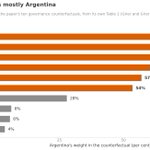
8/n Now the counterfactual. What is 'India without Modi'? By the paper's own weight table: 61% Argentina for democracy, 74% for expression, 54% for religion. On the headline outcomes, synthetic India inherits whatever V-Dem's panels come to believe about Argentina.

7/n 'But polyarchy is a broad index.' Its two institutional components did not move: suffrage is 1.000 in 2013 and 1.000 in 2023; elected officials, 0.996 and 0.996. The entire decline flows through the expert-coded components. The breadth is nominal; the evidence is the panel.
6/n The authors pre-empt bias with a strawman: it 'would have to be a pretty well-organized campaign' across 10 measures. No campaign is needed. The ten outcomes are dependent because they share coders and components. V-Dem models coder-specific bias for precisely this reason.
5/n How thin is the base? In 2023 the India panels behind the religion, judiciary, public-discussion, and rule-of-law indicators each count exactly nine coders. The ten outcomes are far from ten independent measurements: they share indicators and, evidently, the same small panel.
4/n The paper has two halves. The governance half rests on ten V-Dem outcomes: expert-coded estimates of latent concepts, not observed institutions. Synthetic control on such data estimates an effect conditional on the measurement being valid and stable. That condition is the fight.