

The coding agent built for long-horizon tasks
Joined August 2023
- Tweets1.1K
- Following173
- Followers1.9K
- Likes317






pre.dev retweeted

Imagine if Chat GPT or Claude could build full apps in any stack with 0 setup, downloads, or oauth, and you had any model you want and that’s @predotdev
pre.dev retweeted
See my latest article on how we post trained Qwen with dense continuous reward RL tasks that allow it to climb the ladder and show gradient in fewer rollouts and allowing for some interesting training optimizations. We had to customize GSPO and some techniques to account for the dense reward - but we found that you can actually milk every RL task to the fullest (given the continuous reward forms a true capability ladder and harder tests also pass the easier ones).

TLDR; post-training can escape the pre-training ceiling if you have a dense reward system.
a reward of either 1 or 0 is quite bad, and a reward that is continuous from 0 to 1 is more ideal.
best quote: "When training these models utilizing a standard sparse reward, we indeed find that the base model’s probability of producing the desired behavior has a strong effect on the success of RL post-training"

pre.dev retweeted
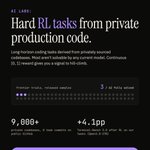
The biggest lesson from our coding RL run wasn't about the model. It was about what's actually scarce.
Everyone's hunting for more prompts, more repos, more verifiers. But none of those are the bottleneck.
The scarce artifact is a long-horizon environment where you've already proven there's learning signal: known provenance, demonstrated solvability, a reward that resolves coherently, and a difficulty ladder validated before a single GPU step.
We found most of the cost savings (5 to 7x) not on the GPU fleet, but by killing bad tasks early in the data pipeline. An all-zero task teaches nothing, and you want to know that before you're paying to sample it 64 times.
Which raises the question: if you audited your RL corpus today, how many of your tasks have demonstrated signal vs. how many you just assume are teachable because they look hard?
Hard != teachable.


As part of predev Labs, we build frontier-difficulty, long-horizon reinforcement learning environments to push our coding agent to its limits.
But do these complex RL tasks actually move the needle?
To prove it, we trained Qwen3.8-27B on ~100 long-horizon coding tasks, moving its Terminal-Bench 3.0 score from 1.4% to 5.4%.
Here’s the full break down of how we did it, by Adam Elkassas (@adampredev).
RT @adampredev: curl -fsSL pre.dev/install | bash
Start locally, reverse engineer your codebase, delegate agent tasks with Kanban…
This quoted post is unavailable.
pre.dev retweeted

The best predictor of success for tech companies, at every stage from during the YC batch to public company with billions in revenue, is the rate of shipping new stuff.
pre.dev retweeted
Everyone’s talking about loops, but no one is talking about how much token waste most loops cause out of the box
pre.dev retweeted
Predicting ahead the consequences of the agents actions is what is missing in every harness but @predotdev
pre.dev retweeted
We are web sandboxed by default, but soon you will be able to drive @predotdev on your local filesystem and sync seamlessly with the cloud with the release of our new predev CLI

pre.dev retweeted
I as a human expert dev with 15+ years of experience coding, still can drive Opus 4.8 on Claude Code in a manual Ralph loop for a full day on a single feature without success. This is what non-coders don't understand right now.
There are many days where you can code a full day without moving the needle even with perfect prompting and human assistance
This is a mismatch in expectations that vibe coders will have to learn the hard way, because the truth is to get one decent feature working perfectly in prod you need to be iterating heavily, scratching and rewriting, rethinking multiple times over.
pre.dev retweeted
It’s wild that token maxxing means using the most tokens possible
It should mean using the least tokens possible to get the job done
pre.dev retweeted
We’ve been saying it for years at @predotdev: the key to AI coding agents scaling to big systems is the architect layer
Every coding agent with baseline native architectural understanding means you never have to struggle onboarding new agents
pre.dev retweeted
If your harness does worse on the bench than Terminus for a given model, you need to re-evaluate your life
pre.dev retweeted
Terminus Kira is one of the most elegant lightweight harness implementations. Love what the guys at @Krafton_AI are doing. Harness engineering is a weird gray area right now. I've found that through running a slimmed down version of pre.dev on Terminal Bench 2.0, that the harness does make a difference, but the toolset/memory/prompting are not always obvious because they do heavily rely on the underlying model's RL post training habits.
For instance, RLM is an interesting concept but I've found that on Terminal Bench, pure RLM doesn't perform better because the problems aren't that deep and the models aren't trained natively to use this paradigm. Granted we've gained huge alpha over the baseline models over harnesses such as Claude Code and Codex (more on this coming soon) with where our implementation landed. I think @Kangwook_Lee is on the right path because ultimately the scope of the work and problem demand a different optimal harness solution, and it's highly dependent on the frontier labs aligning the models to being good at adapting to different toolsets / scopes of work.


pre.dev retweeted

Upgrades to vibecomposer.studio
- Live Billing (pay for credits and auto recharge them)
- Choose Models (try out different models and how they compose software).
- Example Prompts (Try out a bunch of different styles).

