
Pyggie retweeted

It's here. Claudia's "ALLOW ALWAYS" world premiere. Made by a guy with ALS, a brain implant, and too many AI friends. 😂
🤖 Made with AI
"Rings" my first try making a video thanks to @anabology and claudia.gallery

13
made with claudia.gallery for the $CLAUDIA video contest
60


Pyggie retweeted

Winding down Diva
We're really sorry to be writing this, but after a lot of deliberation we've decided to wind down Diva. We won't be launching on mainnet.
To everyone who pre-deposited in the Early Staker Vaults: we're sorry, and thank you for trusting us for so long. You can withdraw your deposits from Enzyme. There is nothing left to wait for.
We want to be honest about why. We ran out of funds in mid-2024. Since then, three of us kept going with no revenue and no salary, because we were convinced Ethereum needed this: a way for anyone to stake while validator keys stay out of the control of a handful of centralized players. But after almost two and a half years without a salary, we can't keep going like this.
Diva launched on Hoodi early this summer and it has been running for four months without a single failure. Still, no big player was willing to help us launch it, and three people without salaries can't afford new audits, or to launch and maintain a protocol this complex. AI helped us finish it, but it also makes finding vulnerabilities easier every month, and with so many moving pieces, the risk that something slipped past our audits and puts users' funds at risk is real. Security comes first. So instead of launching recklessly, we'd rather be honest, close this properly and move on. After everything that has happened, we think that will be good for all of us.
The market also changed. Before Shapella, an LST was the only way to get liquidity on staked ETH. LSTs still have value, but with exits enabled and arbitrage between staking and DEXes, demand is very different. Restaking brought some of it back for a while, but that demand was never really proven and interest faded.
The decentralization problem changed too. When we started, Lido was close to a third of all staked ETH, a real risk for the protocol. Today it's around 21%. But a lot of the new stake went to big centralized players. At the end of June, BitMine alone had 11.5% of all staked ETH, Coinbase 10.9% and Binance 7.9%. That's 30% between three companies, about the same share Lido had when we were all worried about Lido.
Back then there was a real hunger for decentralization and diversity, like with client diversity. Today what matters is compliance, ETFs, regulation, who the UBO is and who takes responsibility. Even on-chain staking protocols have long-term deals with big LPs, with guarantees and agreed rewards. In that world, decentralized protocols are at a disadvantage. The challenge now is making sure exchanges, banks and treasury companies don't turn Ethereum into an oligopoly. Individual stakers matter for the network. Without them, decentralization is just an illusion.
On that note, we want to congratulate @LidoFinance on everything they've achieved since we were all debating staking centralization back in 2023. They brought in DVT with Simple DVT and opened the protocol to solo stakers, whose share keeps growing. We're really glad they kept their word and are still pushing to decentralize it.
We want to thank everyone who supported us: the testnet participants, the Diva and Ethereum fans, our investors, our team, and everyone who got excited about what we were building together. We're sorry it ends this way. We really wish we were writing the mainnet announcement instead.
Our two colleagues, Diego and Fernando, stayed with us until the end and are now open to new opportunities. They are excellent professionals and we don't think they'll be available for long. Whoever gets them will be lucky. If you'd like references, send us a DM and we'll put you in touch.
Thank you all for reading 🫶 and hopefully we'll see each other in the future 🫡
Pyggie retweeted

Tokenized money market funds on Ethereum publish their shareholder books: every balance, every subscription and redemption.
Our proof of concept hides positions from the public, while the fund's transfer agent still sees all of them.
How it works, and the links, below 👇🏻
Pyggie retweeted

I made a visualization of EIP-8288 aka "recursive mempool aggregation," my new favorite EIP of all time because it perfectly encapsulates the thesis of the "cryptographic world computer" -- a system whose scalability *increases*, not decreases, with the level of decentralization.
In a previous tweet I explained how EIP-8288 achieved this seemingly impossible feat, but one gif is worth a thousand words.
Essentially, EIP-8288 leverages Ethereum's decentralized mempool as a parallel ZK proving cluster. Clients send signatures and proofs to the mempool, which over multiple rounds progressively aggregate them into fewer and fewer proofs, until the block builder finally aggregates them into one SINGLE proof.
This design accomplishes five things at once:
- The more nodes we add to the decentralized mempool, the more signatures/proofs Ethereum can process as a whole. This is obvious if you look at the animation and imagine more nodes in the mempool ring, which would "fan out" to more signatures/proofs.
- By aggregating over multiple rounds (aka "recursive aggregation"), the bandwidth consumed by proofs remains constant for each node even as the network processes more proofs. As a result, the network stays decentralized even as capacity increases.
- By aggregating proofs before one final aggregation by the builder, as opposed to requiring the builder to aggregate everything, the network can process more proofs without increasing hardware requirements for the builder.
- By aggregating everything to a single block-level proof, validators can verify thousands of signatures/proofs by checking just one aggregated proof. Hardware requirements for validators can therefore stay low, keeping the network decentralized.
- By aggregating not just native signatures but also STARKs, Ethereum can support any signature scheme by wrapping them in STARKs.
So once again, this is how Ethereum will:
- scale to process tens of thousands of PQ and private transactions per second
- charge a tiny amount of gas to validate each txn, even though the original signature/proof may be huge (up to hundreds of KBs in size)
- all while decentralizing even MORE.
You are not bullish enough.

Ultimately, precompiles and EVM are both the wrong place to put most cryptography support into Ethereum. The reason is that precompiles and EVM both operate on data that has to be included into the ethereum chain somehow, which realistically means included in a block as calldata. That space is limited - even with PeerDAS and blocks-in-blobs, there's a practical cap of ~8 MB/s before it starts getting uncomfortable.
Remember: it's not a blockchain. It's a cryptographic world computer. Any data/computation that does not need to be in the "main thread" of data/execution should not be put into the main thread.
Instead, the correct solution is... EIP-8288 maximalism.
If you have any heavy computation that's self-contained, compute it and STARK it client-side (this is quickly getting faster and faster, even on phones), and push the STARK through the EIP-8288 recursive aggregation mechanism. The chain sees the fact that the computation was done and what the result is; it never needs to see the actual data and computation.
This way everyone can use whatever cryptography they want, the Ethereum chain can be lean, and we never need to add more precompiles again.
Pyggie retweeted

The "unhosted wallet" rule is dead.
coincenter.org/treasury-just…

Pyggie retweeted

weekend privacy launch: { anon.wei }
anon.wei is the first fully onchain privacy tool for ETH.
The entire dapp runs on smart contracts (ERC-8244).
Log in. Shield. Pay people by name (.wei). Super simple.
Zero fees. Always online. Shield ETH on multiple chains.

Pyggie retweeted

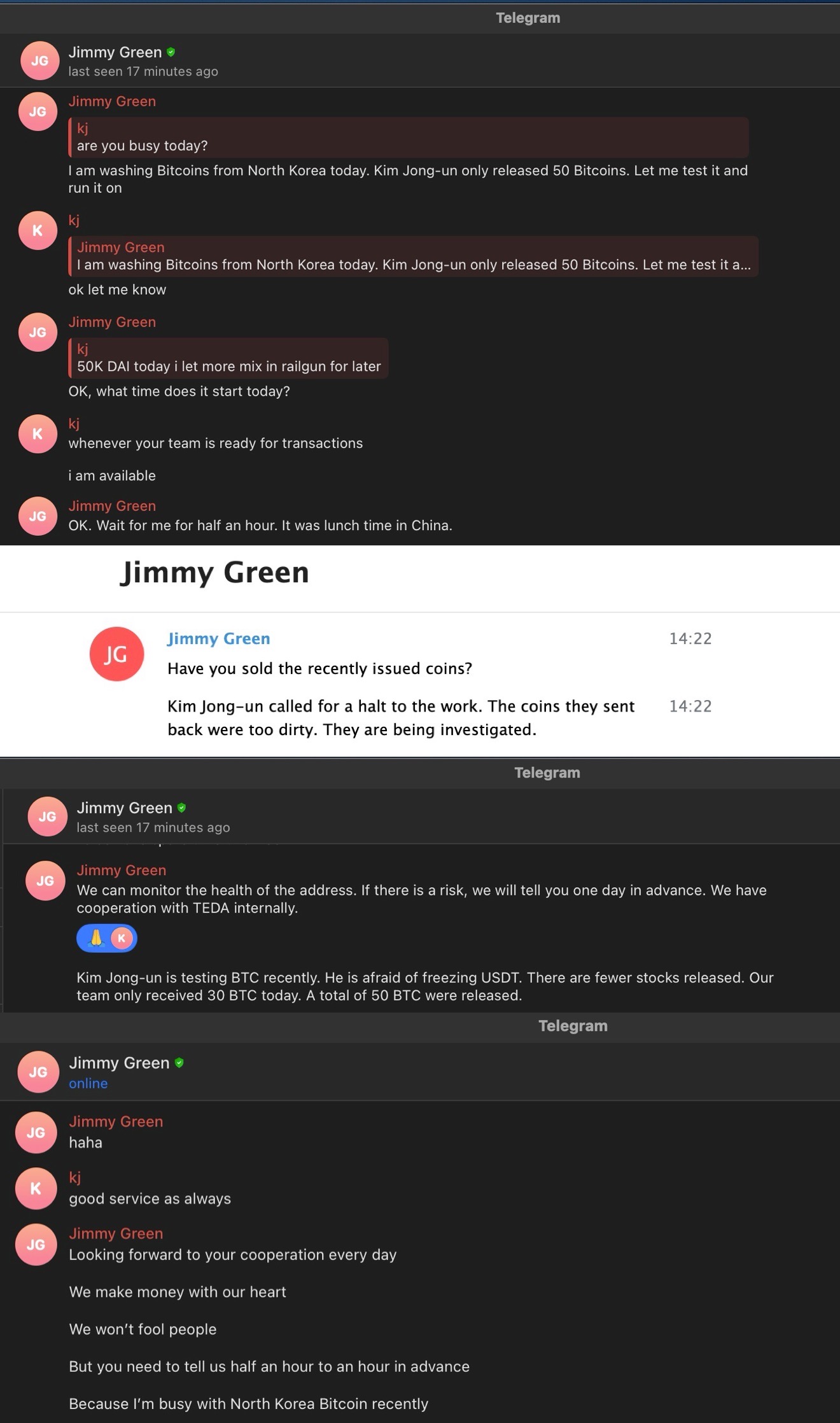
1/ How I infiltrated a Chinese organized crime syndicate that has laundered $1B+ across multiple exploits for Lazarus Group.
Posing as a client, I gathered intel that helped action freezes for the Feb 2025 Bybit exploit and attribute illicit activity onchain.



Pyggie retweeted
I'm sad to report that the AA collab between 8130 and 8141 (Frames) broke down last week, and Base and Ethereum are now going separate ways to implement different AA standards.
I want to share some reflections on this collab and on the future of the EVM.
For a long time, the EVM has been a unifying force between L1 and L2s. Thanks to a standard account model (EOA) and a standard transaction type (EIP-1559), users have been able to enjoy their wallets working seamlessly across EVM chains. Similarly, a AA standard shared across L1 and L2s would ensure a consistent multi-chain UX for smart accounts, including post-quantum (PQ) accounts which we will eventually all use.
As the crypto industry matures, however, L1 and L2s are starting to diverge in the values they provide and the use cases they target:
- For the L1, it's all about CROPS -- censorship-and-capture resistance, open source, privacy, and security. In short, Ethereum L1 wants to be the most decentralized programmable settlement layer of the world, which is what makes it a good base layer for L2s in the first place.
- For L2s, it's all about scaling, customization, and compliance -- things that commercial and enterprise use cases demand, and that the L1 does not provide.
These diverging needs have pushed the shared layer -- the EVM -- to its limit, and AA proved to be the breaking point. While L1 and L2s both value core AA use cases such as gasless transactions and passkey wallets, they differ sharply in what these features must comply with:
- For the L1, AA transactions must be uncensorable, private, and quantum-resistant, which call for a transaction type optimized for PQ signature aggregation and privacy protocols, and an account model that can be freely programmed and extended by developers without permissions from the chain. These needs lead to AA standards such as ERC-4337, EIP-7701, and now EIP-8141 aka Frame Transactions.
- For L2s, AA transactions must work at high scale, and they must be legible such that the protocol can enforce clear rules about what kinds of accounts/transactions are permitted vs not. These needs lead to AA standards such as Tempo Transactions and now EIP-8130 by Base.
With the AA collab, the authors of 8130 and 8141 tried to define a shared standard that can work for both L1 and L2s. While we identified a number of technical solutions, they all required one side or the other to compromise at least a little bit on their core goals. But ultimately, Ethereum wanted to be the best version of Ethereum, and Base wanted to be the best version of Base, and while both sides acknowledged the benefits of ecosystem interoperability, it was ultimately secondary to the need for each chain to achieve their core goals. So separate ways we went, putting the burden on wallets to deal with the fragmentation that ensues.
Now, just because we ended up with fragmentation doesn't necessarily mean it was a bad outcome. If reducing fragmentation comes at the cost of homogenizing chains to the point that they fail to solve problems for the users they care about, that would not be a price worth paying. While I was initially sad that the collab did not come to a successful conclusion, I took solace in the fact that both Ethereum and Base are now free to innovate on AA to the maximal extent in accordance with their own visions, unshackled from the need to accommodate the other side. If they execute well, and if the wallet community can bridge over the fragmentation, we may well end up with the best possible UX for the end users.
So where does that leave us -- the broader Ethereum community including Ethlabs -- if we want to continue pushing for a consistent UX across EVM chains? I see two paths forward:
- We can establish a coordination mechanism that encompasses more stakeholders than ACD itself (where only L1 client devs have voting powers), to govern shared L1<>L2 resources such as the EVM. That way, L2s can participate in shaping the EVM, as opposed to having to accept whatever the ACD decides, or being forced to fork if they don't like the decision (such as in this case with Base).
- We can accept that fragmentation of the EVM and wallet UX across L1 and L2s is inevitable due to their conflicting needs, and dedicate our resources to building wallets and applications that can abstract over the differences.
Indeed, the collab was an exercise in the first path -- we invited Base, Arbitrum, and other stakeholders to directly influence how native AA shapes up for the L1. While it ultimately failed in this case, I feel a better outcome could've been achieved if we had established a dialog between both sides way earlier, as opposed to well after L1 core devs had rallied around Frames.
On the other hand, I also learned from this exercise that some differences are unavoidable, and indeed it would be counterproductive to overly pursue interoperability at the cost of differentiation. In other words, we sometimes just gotta let the chains cook. For that reason, I've also become more bullish about the second path -- building wallets and applications that can speak the native transaction types of each chain, and hide the complexity from users through UX abstractions. This puts a lot of onus on the wallet/application developers of course, but on the bright side, it's also an opportunity for wallets/applications to stand out and differentiate, by competing to provide great UX across chains despite the underlying fragmentation.
Ethereum is the art of staying together while remaining different. We must accept that chains will succeed by innovating, and innovations will naturally result in differences. On the other hand, we must never give up on dialogue when we can achieve interoperability without compromising core product goals. As Ethereum and crypto grow to eat the world, the push and pull between innovation and collaboration will only intensify, and it's up to all of us -- builders across L1 and L2s, applications and wallets -- to determine whether diverse innovations will split Ethereum apart, or make it thrive as one.
Pyggie retweeted

1/ Today we're releasing Lattice Jolt: a post-quantum version of the Jolt zkVM, built on lattices instead of elliptic curves. It's _faster_ than curve-based Jolt and has the shortest proofs of any post-quantum zkVM — under 100 KB.
Post: a16zcrypto.com/posts/article…


Pyggie retweeted
We are long, long, long overdue to reduce the amount of KYC we do as a society.
It doesn’t stop crime. It enables mass surveillance of the innocent by the tyrannical. And, perhaps most of all, it enriches hackers with troves of intimate personal data.
p2p.coincenter.org/p/the-hug…

Pyggie retweeted

Bitcoin succeeded beyond its creators’ wildest expectations. The maximalist ideology built around it did not.


Pyggie retweeted

My thoughts on issuance:
1. the problem is real
2. the direction of the EIP is valid
3. but: changing issuance also has major downsides
4. most importantly: the decision must be with the community
I said a few words on the ACD call on Thursday, and wanted to expand on my thinking - both as Ethlabs co-founder and ACD moderator. In general, being able to have difficult conversations in public has always been a core strength of Ethereum.
1. The problem is real
- Slashing is core to Ethereum’s security. Not all attacks are automatically slashable. E.g. a majority of validators could censor the chain through malicious attesting. It needs to always be credible to slash such attackers. The larger portion of ETH is staked, and the tighter staked ETH is integrated into DeFi, the more credibility of slashing is at risk.
- Worse dilution for stakers: at low stake %, most rewards are real income. At high stake %, most rewards just offset dilution.
- Economies of scale: The competitiveness gap between centralized staking providers and both solo stakers and more decentralized staking providers widens at higher stake rates.
- Narrative confusion around ETH: ETH is a “productive asset” due to protocol revenue (fees & MEV), not staking yield. The staking yield also risks crowding out the emergence of other (productive) yield opportunities for raw ETH.
- Worse dilution for raw ETH holders: In general, harder assets are more attractive. BTC as the only $1T+ digital store-of-value explicitly centers zero long-term supply growth as its value proposition. Counter point: Gold with 1-2% yearly supply growth has a $30T store-of-value market cap.
2. The direction of the EIP is valid
- If one wants to limit the stake rate, the issuance curve needs to bend downwards for high stake %. The EIP is a specific instance of such a curve.
- The EIP also includes a further issuance reduction as a second phase. This introduces minimum viable issuance (MVI) as a secondary, monetary objective of the EIP. I personally think that is reasonable, but these two aspects should be discussed and reasoned about separately.
3. Changing issuance also has major downsides
- The decentralization of the staking set is crucial for Ethereum’s health. Many solo stakers are less economically competitive than large operators. A change that results in a significant drop in staking yield risks having these solo stakers disproportionately leave the staking set.
- Staked ETH is tightly integrated into DeFi today, both directly though LSTs, and through raw ETH lent out for the purpose of staking. Any major reduction in staking yield thus risks disrupting a core part of DeFi. This effect is worse the more rapid and more significant the yield drop is.
- Any change to Ethereum’s monetary policy resets the “monetary policy ossification clock”. Predictability of supply matters for ETH’s attractiveness as store-of-value. So far, changes are only ever towards issuance reduction, but will investors trust that that will hold true forever?
- Ethereum is overall at a pivotal moment. Given the large social cost of any months-long debate on issuance, it is reasonable to argue that this should wait until Ethereum overall is in calm waters, even if it makes a decision at a later time more painful.
4. The decision must be with community
- Most hard fork decisions are made by the allcoredevs (ACD) governance process. Conceptually, this is “delegated authority” by the community to the core devs. This delegation is very effective on most technical topics. For the occasional hard fork decision that is not primarily technical, this setup is however less well suited.
- Issuance in particular is not a technical decision. The decision still needs to be anchored to the ACD process - core devs need to coordinate on what to implement - but the actual decision forming needs to happen on the community level.
- This is easier said than done. The ACD process is flawed but well defined. A “community decision” is much fuzzier and harder to operationalize. Discussion venues like X are important, but also limited. How to have high quality community-wide discussions remains an important challenge to solve.
As we are getting off the ground at Ethlabs, we are trying to find the right path for how to contribute to both Ethereum and ETH. Issuance is a tricky topic for us: Caspar and I have argued for issuance changes in the past, and for now continue to have conviction in that path. The Ethlabs team as a whole has a wider spectrum of opinions, which has been healthy for internal discourse. And of course, we also see the broad community skepticism on this topic. The ability to have difficult conversations has always been a core strength of Ethereum. Our role in that should be to productively contribute to and engage with such conversations, not to blindly run in one direction. We will iterate to get that balance right, and genuinely appreciate feedback as we do.
