

Ph.D. (2020). Fulbright Scholar (2016 & 2007). Formalizing the Geometric Structure of Phenomenal Experience. ☸️(-+++)☸️
New Orleans
Joined June 2020
- Tweets2.6K
- Following106
- Followers840
- Likes21.7K




Alexander Yiannopoulos retweeted

Agatheos: European Journal for Philosophy of Religion has a new special issue out on Buddhism and Hinduism. They were kind enough to let me be the guest editor for the issue. The issue features some really interesting essays. I have an article with Gregory Stacey exploring whether the Buddha nature should be understood as in any sense Triune (at least, within the Shentong tradition). I hope you check some of the articles out!
Notably, Buddhist epistemological discourse has many fine-grained terms for "cognition" or "cognitive event"—citta, jñāna, buddhi, and so on—but nothing that maps simply or unproblematically onto "consciousness." The closest I've seen is "cognitively-natured-ness" (jñānarūpatva).


What if consciousness isn't "created" ?

More relevant now than ever... where philosophy meets neuroscience!
What Creates Consciousness? | World Science Festival youtu.be/06-iq-0yJNM?si=x-fH… via @YouTube

67
"Peer review" is predicated on a concept of "peer" that may be falling apart...

Massive. New Harvard study finds that AI-written paper reviews now beat the best human peer reviews on every measure the authors tested.
Peer review is slow and often misses errors. Earlier studies concluded AI should only assist human reviewers, not replace them.
They used 134 reviews from rapidPeer, a Harvard service that pays expert reviewers well. Claude Opus 4.8 reviewed the same 1124 papers, and GPT-5.5 plus 3 former journal editors judged the pairs blind.
GPT-5.5 picked the AI review in all 132 decided pairs, and the editors picked it 87% of the time. Only 5.5% of the AI's claims about the paper were wrong, versus 15.9% for the human reviews.
Teams that depend on expert critique can now let AI do the first full review pass, and keep a human for the final decision.


3
107
Alexander Yiannopoulos retweeted

I think this is where the idiotic "Koans are paradoxes/unanswerable" idea comes from: people who are trying to answer them as "logical questions" bc they lack the faculty to LOOK.
E.g.: "original face before you were born" doesn't make LOGICAL sense but has a PRECISE referent
Koans are often misunderstood in the West as being entirely impenetrable to rational analysis. But, for example, the koan about "the sound of one hand clapping" specifically concerns the Buddhist analysis of causes and effects/"interdependent co-emergence" (pratītyasamutpāda).
A cause is only designated a cause because it produces an effect, but by definition only exists when its purported effect does not yet exist. Similarly, an effect is only designated an effect in relation to some particular cause, but by definition only exists when its purported cause no longer exists.
So here we have a situation where, by itself, neither the cause nor the effect ("one hand") does anything; for there to exist some real result (e.g., "sound") you need both cause and effect ("two hands"), working together. This is only possible because neither that which is designated the cause nor that which is designated the effect has any independent existence, separate from the other: clapping is just what happens when two hands make causal contact.
Many are (rightfully!) critiquing the looseness of this and similar formulations. I think the underlying intuition *can* be made rigorous, but that doing so requires the Buddhist notion of vāsanā—momentary, quantized, latent potentials—or some formal equivalent.

Nobel physicist Anton Zeilinger suggests reality and information are the exact same thing.
Information is the ultimate building block of existence, meaning matter is just a byproduct of data.


2
6
545


In general, Buddhist epistemology disregards scripture as a source of knowledge. Dharmakīrti in particular has many very interesting things to say about error (bhrānti) and its correction.

Popper’s “creative guesses plus error correction” isn’t an alternative to scientific method, it’s a reasonable short description of it
The distinction is precisely that science builds error correction into the process, while other ways of “knowing” often shield themselves from it, e.g. insisting on scripture, tradition, or authority
In the latter half of this very interesting talk, Neil Turok discusses ghost fields, (±) indefinite metrics, and Krein space. Worth a listen!
H/T @PeterMorganQF
youtu.be/VlP-12yc2f8?si=1kMc…
3
263
Physicists and mathematicians working with GPT 5.5-Pro: how/when do you switch from Standard to Extended Thinking (or vice versa), or do you always keep it in one or the other mode?
1
1
161


I think contemporary Anglophone philosophy of mind needs a richer vocabulary. (Dharmakīrtian) Buddhist metaphysical idealism is not identifiably "panpsychist" in the contemporary idiom—for many reasons, including the absence of anything like the combination problem.

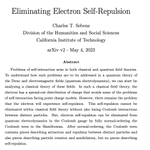
I used to believe in panpsychism, but now I’m not too sure.
Take an electron, for example. It simply doesn’t have enough representational capacity to encode complex feelings (and, frankly, no need).
Where and how would it represent pain, pleasure and all the gamut of emotions and qualia that make up our world? Even if it encodes basic valence somehow, how is the readout happening and is it influencing behaviour.
In retrospect, panpsychism seems significantly handwavy. The binding problem - how simple qualia bits combine to produce our rich experience - is a showstopper.
2
2
280


