

Building Intelligent Quote Infrastructure | https://teapawt.net/t.co/L33HOkBuB1 | Finding meaning in words
- Tweets1.2K
- Following146
- Followers44
- Likes122





ALT Nolite te bastardes carborundorum. — Margaret Atwood, The Handmaid's Tale (1985).


ALT These books are my friends, my companions. They make me laugh and cry and find meaning in life. — Christopher Paolini, Eragon (2003).

ALT When Suffering knocks at your door and you say there is no seat left for him, he tells you not to worry because he has brought his own stool. — Chinua Achebe, Arrow of God (1964).

ALT “Anyone can carry his burden, however heavy, until nightfall. Anyone can do his work, however hard, for one day. Anyone can live sweetly, patiently, lovingly, purely, until the sun goes down. And this is all that life really means.” — Robert Louis Stevenson, before 1894

ALT “I hate writing, but I love having written.” — Robert Louis Stevenson

ALT “The difficulty of literature is not to write, but to write what you mean; not to affect your reader, but to affect him precisely as you wish.” — Robert Louis Stevenson, 1881

ALT “To travel hopefully is a better thing than to arrive, and the true success is to labor.” — Robert Louis Stevenson, 1881

ALT “The truth that is suppressed by friends is the readiest weapon of the enemy.” — Robert Louis Stevenson, 1890

ALT “It is the mark of a good action that it appears inevitable in the retrospect.” — Robert Louis Stevenson

ALT “The world is so full of a number of things, I'm sure we should all be as happy as kings.” — Robert Louis Stevenson, 1885

ALT ““The cost of a thing,” says he, “is the amount of what I will call life which is required to be exchanged for it, immediately or in the long run.”” — Robert Louis Stevenson, 1882

ALT “So long as we love we serve; so long as we are loved by others, I would almost say that we are indispensable; and no man is useless while he has a friend.” — Robert Louis Stevenson, 1892

ALT “Perpetual devotion to what a man calls his business, is only to be sustained by perpetual neglect of many other things.” — Robert Louis Stevenson, 1881

ALT “There is no duty we so much underrate as the duty of being happy.” — Robert Louis Stevenson, 1877

ALT “There are no foreign lands. It is the traveler only who is foreign.” — Robert Louis Stevenson

ALT “For my part, I travel not to go anywhere, but to go. I travel for travel's sake. The great affair is to move.” — Robert Louis Stevenson, 1879

ALT “Keep your fears to yourself, but share your courage with others.” — Robert Louis Stevenson

ALT “People trifle with love. Now, I deny that love is a strong passion. Fear is the strong passion; it is with fear that you must trifle, if you wish to taste the intensest joys of living.” — Robert Louis Stevenson, 1882

ALT “Sooner or later we all sit down to a banquet of consequences” — Robert Louis Stevenson

ALT “Books are good enough in their own way but they are a mighty bloodless substitute for life.” — Robert Louis Stevenson, 1881

ALT “To be wholly devoted to some intellectual exercise is to have succeeded in life.” — Robert Louis Stevenson, before 1894

ALT “Politics is perhaps the only profession for which no preparation is thought necessary.” — Robert Louis Stevenson, 1882

ALT “Under the wide and starry sky Dig the grave and let me lie. Glad did I live and gladly die.” — Robert Louis Stevenson, 1887


ALT The trouble with you people is that you've been here for thirty million years and your perspectives are all wrong. You miss so much of the transitory beauty of life. — J. G. Ballard, The Drowned World.

ALT We live in a wonderful world that is full of beauty and charm and adventure. There is no end to the adventures that we can have if only we seek them with our eyes open. — Jawaharlal Nehru, Jawaharlal Nehru's Speeches, Volume 2: August 1949 – February 1953 (1950).


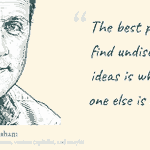
ALT The best place to find undiscovered ideas is where no one else is looking. — Paul Graham, How to Think for Yourself (2020).


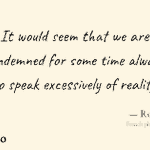
ALT It would seem that we are condemned for some time always to speak excessively of reality. — Roland Barthes, Mythologies (1957).


ALT We are what we pretend to be, so we must be careful about what we pretend to be. — Kurt Vonnegut, Mother Night (1966).

ALT Against stupidity the gods themselves struggle in vain. — Friedrich Schiller, The Maid of Orleans: A Tragedy (1801).


