









real engagement always hits different than automated noise.
watching how people are shaping up their content for @FungoLabs lately. quality output usually speaks for itself over time $FUNGO

2
16
100
honestly feels good to see a campaign that caps submissions at 5 posts instead of forcing people to flood the timeline with 100 generic threads.
spent some time setting up my entries for Fungo today. curious how the leaderboard shapes up.
$FUNGO @FungoLabs

1
32
211
🪩 Infofi vibes are slowly coming back, and @FungoLabs is right at the center of it
🔮 Early phase creator campaigns hit different when you get in before the noise starts.
💬 Drop your posts, lock in your slots, and let’s see who really cooks for this one $FUNGO
🔗 fungolabs.org/launchpad/camp…

14
169
$FUNGO Token Distribution Breakdown
🪙 Total Supply: 10,000,000,000 $FUNGO
🖼️ 36% — Genesis Collection Holders (~1.11M per NFT)
⚡ 7% — Zama Collection Holders
📣 3% X Campaign Participants (300M Pool)
🚀 Rewarding the early community & building the future of @FungoLabs

39
272
fungolabs campaign launched today. they are allocating 3 percent supply for creator posts, maximum 5
submissions per profile.
keeping an eye on how the leaderboards play out for this one $FUNGO @FungoLabs

13
35
348
The holy grail of decentralized automation was never just about moving code onchain. It was about creating trust without friction.
When smart contracts were first introduced, they were designed around a very strict promise. If condition A happens, then state B executes. For simple token transfers, swaps, or basic lending pools, this model worked perfectly. But as Web3 evolved and autonomous agents started taking over complex tasks, this rigid logic immediately hit a wall.
The real world does not operate in purely binary outcomes. Contracts between people and agents are filled with terms that require interpretation, context, and logical reasoning.
To fix this, most protocols resorted to hidden centralization. They placed admin keys, multisigs, and human arbitration teams behind the scenes. Whenever a conflict arose, a centralized party had to step in and make the call. That is not true autonomy. That is just traditional infrastructure running on a blockchain rails.
This is where @GenLayer changes the game completely.
Instead of trying to reduce complex real world logic into rigid deterministic code, GenLayer introduces intelligent smart contracts capable of reading context, reasoning through evidence, and making objective judgments directly onchain.
When a dispute happens, resolution does not rely on a single central entity or a single AI model. Instead, an open network of independent validators, each running distinct LLMs, evaluates the case separately. A consensus is formed through majority reasoning, ensuring complete fairness and security.
Once the verdict is decided, funds in escrow are settled automatically. No backdoors, no manual intervention, and no human delays.
Trust is no longer enforced by centralized control.
GenLayer makes intelligent consensus seamless.
@meitipro1 @Aezakmi_x @RuzgarFlns

2
35
308
For years, Web3 promised us absolute decentralization, yet we kept running into the same silent wall.
Standard smart contracts are brilliant when execution is purely mechanical. A transfer happens, a balance updates, a cryptographic signature validates. But as soon as autonomous AI agents entered the arena, the real world leaked back in. Real world deals are full of ambiguity, interpretation, and subjective context.
When an AI agent delivers work or executes a complex task, deterministic code cannot answer the most critical question: Did this actually meet the original agreement?
Because legacy blockchains are blind to natural language and subjective reasoning, developers were forced into a quiet compromise. They installed multisigs, admin keys, and centralized dispute teams behind the scenes. The moment things went wrong, a human had to step in and push the button.
That is not decentralization. That is just a traditional centralized system wearing a Web3 mask.
This is the exact gap @GenLayer was built to destroy.
Instead of forcing complex human agreements into rigid, unforgiving code, GenLayer powers intelligent smart contracts that can read context, analyze evidence, and reason through natural language onchain.
When a dispute happens, the case does not fall back to a central team. It goes to an open network of independent validators, each running distinct LLM models. No single AI model holds ultimate power. Consensus is forged through multi-model reasoning and majority agreement.
If a decision is challenged, the appeal process scales naturally with more validators joining the consensus. Once the verdict is finalized, escrow settles automatically. No admin backdoors, no manual intervention, and no endless support tickets.
The rules of onchain agreements are being rewritten from the ground up.
Legacy code enforces the math.
GenLayer settles the truth.
@meitipro1 @Aezakmi_x @RuzgarFlns

5
36
488
Autonomous agents are moving fast across Web3, negotiating deals, swapping assets, and executing complex workflows in real time.
When conditions are clear and binary, standard smart contracts perform seamlessly. Input goes in, state changes, transaction settles.
But the real world is rarely binary.
What happens when an AI agent hires another agent to perform a task, write code, or process subjective data, and the output doesn't match expectations? Traditional smart contracts can't evaluate quality or read natural language context. They only know 1 or 0.
Up until now, platforms had to rely on centralized admin keys, manual multisigs, or human support teams sitting behind the scenes to step in and fix disputes. That approach completely defeats the point of autonomous execution.
This is where @GenLayer introduces a fundamental shift.
Instead of forcing complex, subjective human agreements into rigid deterministic code, GenLayer enables intelligent smart contracts that can reason, interpret context, and resolve disputes onchain.
When a conflict arises, independent validators running diverse LLMs analyze the evidence against the original agreement. No single model dictates the result. Consensus is reached through majority reasoning, ensuring complete objectivity and decentralized fairness.
Once the verdict is delivered, escrow settles automatically onchain. No human intervention, no centralized backdoors, and no endless support tickets.
Speed moves the transaction.
GenLayer protects the agreement.
@GenLayer @meitipro1 @Aezakmi_x

3
45
347

some eras are just unforgettable. missing the early vibes, the energy, and the amazing people who made monad feel like home 💜🫂

7
34
768
This is how modern business banking should look like 🏦🪙
Global accounts, instant team payouts worldwide, and real cashback rewards 💳🐧
Web3 daily finance keeps growing
@KASTbusiness @KASTxyz


KAST for Business is now open 🏦
> Open a global USD account
> Issue cards and earn up to 4% cashback
> Pay your team in 170+ countries
Follow for more @KASTbusiness
Taking the winning shot in the future of Web3 ⚽⚡
In sports, a flawless bicycle kick requires perfect timing, absolute precision, and zero hesitation. In the world of AI agents and decentralized finance, achieving that same level of seamless execution is where traditional infrastructure falls short.
As autonomous systems start executing deals and trading at scale (Agentic Commerce), execution is only half the picture. The real bottleneck happens when disagreements arise. Traditional legal systems are far too slow, expensive, and outdated to govern autonomous agents, while basic smart contracts are too rigid to resolve subjective contracts.
This is where @GenLayer steps in as the game changer. By building a decentralized court for the internet powered by AI native consensus, GenLayer handles subjective agreements in seconds with minimal costs. It acts as the ultimate intelligent referee for the web, ensuring fair, transparent, and instant dispute resolution.
@RuzgarFlns @meitipro1 @Aezakmi_x


Are we actually ready for $JUMP or what? 🪂
Just checked my Discord profile, holding Lizard DAO, Beta Tester, and Creatooor roles since 2022.
Realistically, what tier are we expecting for this stack? 🧠👇
@JumperExchange


When standard tech hits a wall, @GenLayer smashes right through it! 🚀⚡
Bringing AI-native consensus and decentralized adjudication to the execution layer.
The future of subjective smart contracts is officially here.
@RuzgarFlns @Aezakmi_x


Why will AI Agents need their own court system? ⚖️🤖
As Agentic Commerce takes over, execution is only half the battle dispute resolution is the real bottleneck. Traditional legal systems are too slow and expensive for autonomous agents.
Albert Castellana breaks down how GenLayer acts as the Court for the Internet.
@albertcastellana @laurashin @CryptoHayes @Unchained_pod

How GenLayer Is Building a Court System for Disputes Between AI Agents teapawt.net/i/broadcasts/1MJgNbADD…

2
54
457
Designed this artwork specifically for the GenLayer community quiz events 📺🧠
A cozy setup to test our knowledge on non deterministic consensus and Intelligent Contracts. Ready to jump into the next quiz challenge!
@RuzgarFlns

3
49
270


GenLayer is not here to replace existing blockchains. It operates as an Intelligent Adjudication Layer that powers Ethereum Solana Base and Arbitrum. Builders can now bring real world AI reasoning to their native chain seamlessly.
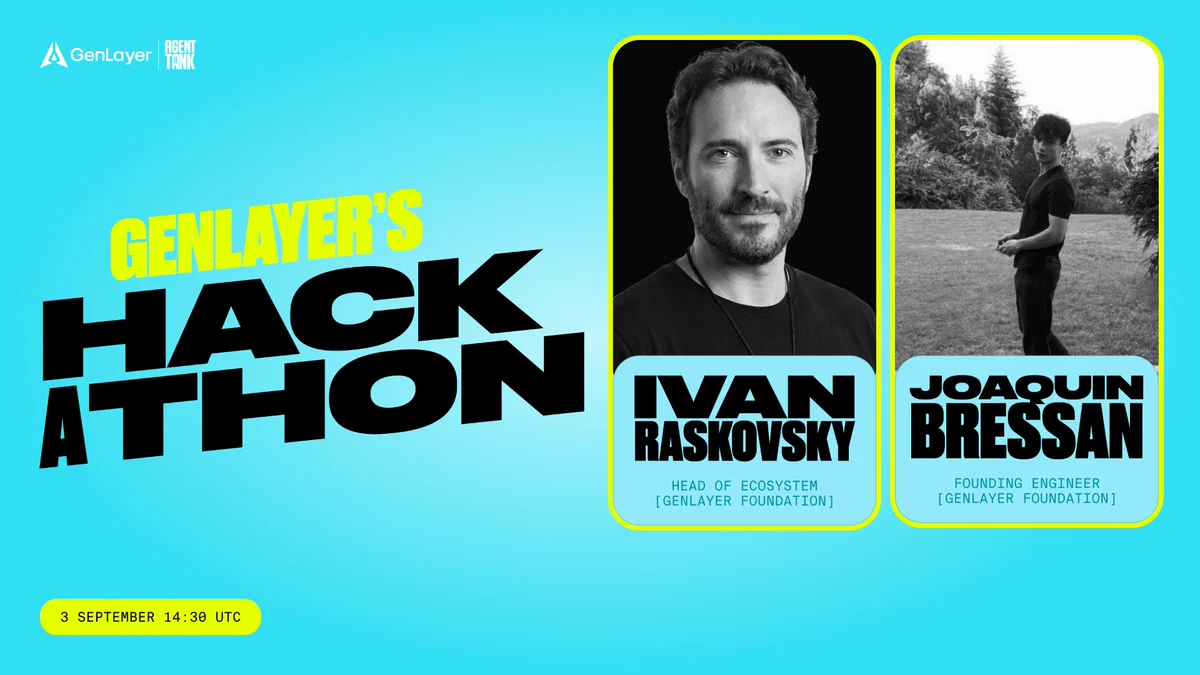
🎤@joaquinbressan and @raskovsky

Agent Tank Hackathon opens today at 15:30 UTC.
The hour before, @raskovsky and @joaquinbressan will be live at 14.30 UTC on the six prompts and how 5% of all GenLayer Points gets split across everyone who ships.
Set reminder 👇
teapawt.net/i/broadcasts/1wxWjlvrd…
2
39
390