

Radio & maker electronics. I design hardware and run ELEKITSORPARTS. Projects, measurements & lessons from my workbench. RadHive newsletter on Substack.
Worldwide
Joined November 2015
- Tweets564
- Following204
- Followers182
- Likes389





An AM transmitter whose active element was a piece of pyrite.
In 2001, Nyle Steiner (K7NS) used a fine wire contact, or cat’s whisker, against a piece of iron pyrite to build an oscillator without a transistor or vacuum tube. At the right contact point and bias voltage, the junction showed negative differential resistance. That let energy from a battery make up for losses in the tuned coil and capacitor, sustaining a radio-frequency signal. One scope trace showed a carrier near 700 kHz.
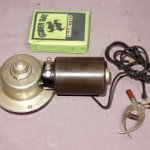
A carbon microphone in the battery circuit varied the carrier’s amplitude with speech. Steiner reported hearing his voice on a nearby AM radio.
The hardest part was keeping the contact steady. A balanced arm inspired by a phonograph tonearm held the whisker in place long enough for the oscillator to run for several minutes.
Steiner’s original build and schematic (archived)
web.archive.org/web/20260115…
The Xtal Set Society Newsletter, July 2001, pp. 5–7
oldradios.co.nz/downloads/Ju…
#HamRadio #RadioHistory #HomebrewRadio #CrystalRadio


36
F4HWN 7.0 brings installable apps to Quansheng’s Fusion firmware
F4HWN v7.0.0 moves the app platform from Labs into Fusion, the everyday firmware for the Quansheng UV-K1 and UV-K5 V3. The catalog grows from 40 to 49 apps, and Fusion can resume an app that was open when you switched off the radio.
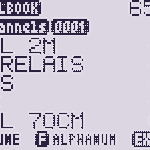
The new ChannelBook app lets you browse saved channels by scan list, a channel-name index, or memory number. CW Trainer adds on-radio Morse practice, and SetFnt offers 12 combinations of text fonts and frequency digits.
The release comes in two editions. Fusion runs the apps, while Service adds tools for radio-to-radio transfers and flash maintenance. UV Studio now installs a matching pack of fonts and menu labels after writing the firmware.
Official release notes
github.com/armel/uv-k1-k5v3-…
#HamRadio #Quansheng #UVK1 #F4HWN


A knob that changes the pattern on a steel plate
CrazyScience built a desktop Chladni plate that turns vibrations into visible patterns. At a resonant frequency, the steel plate vibrates in a standing-wave pattern. Grains bounce away from the parts that move most and gather along lines that barely move. Turn the knob to a different resonance and a new pattern appears.
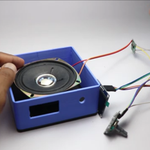
An ESP32-C3 Super Mini generates the tone, and a PAM8403 amplifier drives a small speaker. A 3D-printed coupler connects the speaker cone to the center of the 10 × 10 cm steel plate. The knob adjusts the frequency, the 1.3-inch OLED shows the setting and a pattern preview, and the firmware can save frequencies for later. The builder used semolina to make the patterns visible.
The build guide includes printable STL files, a wiring diagram, and the Arduino sketch.
instructables.com/Make-Sound…
#ESP32 #3DPrinting #Acoustics #DIYElectronics


61
Unofficial firmware brings Morse decoding and SSTV to the Icom IC-705
BI1BIF’s experimental firmware lets the IC-705 decode Morse and send and receive slow-scan TV pictures from the radio itself. The CW screen shows decoded text, estimated words per minute, and a waveform. The SSTV screen detects the incoming mode, displays the picture as it arrives, and can save it to the SD card. It can also transmit pictures stored on the card.
The project lists 23 SSTV modes, including Robot 36 and modes in the Martin, Scottie, and PD families. Operators tested CW and SSTV on a Japanese-market IC-705 running BI1BIF’s earlier v1.1.1 patch, based on Icom’s factory firmware 1.40 for that market (J140). The expanded set of transmit modes passed simulator and full-frame audio tests, with over-the-air checks for the added modes still pending.
BI1BIF credits SQ6EMM’s research into Icom’s firmware format. SQ6EMM’s repository documents the update format used by the IC-705, IC-9700, and IC-905.
SQ6EMM’s firmware research
github.com/sq6emm/ic705-ic97…
BI1BIF’s CW and SSTV project
github.com/BI1BIF/IC-705-Fir…
#HamRadio #IC705 #CW #SSTV


The Newone was a crystal radio built into a single earpiece.
The Japan Radio Museum dates this Japanese receiver to around 1926, about a year after radio broadcasting began in Japan. Its maker, 安良岡ラヂオ研究所, fitted an early fixed crystal detector inside the cylindrical handle. Unscrewing the end cap gave access to the detector.
The Newone needed an external antenna and ground. The received broadcast signal supplied the energy to drive the earpiece, so there was no battery to carry. The museum estimates that the set would only have been practical fairly close to a broadcast station.
Japan Radio Museum collection, item 11A310
japanradiomuseum.com/meseum1…
#CrystalRadio #RadioHistory #VintageRadio


28
Malahit DSP4s brings digital voice and SSTV decoding to a handheld SDR.
The new SDReleven receiver can decode compatible unencrypted DMR, D-STAR, P25, TETRA Direct Mode (DMO), and NXDN. It also decodes CW, FT8, FT4, RTTY, and SSTV directly on the radio. Decoded SSTV images can be saved to microSD as BMP screenshots.
Elecevolve lists a maximum spectrum and waterfall span of 650 kHz, up from 192 kHz on the DSP2. The vendor rates blocking dynamic range at 100 dB or more, versus 82 dB for the DSP2. USB I/Q bandwidth is 162 kHz.
The DSP4s tunes from 100 kHz to 1.62 GHz. The DSP2 reaches lower and higher, covering 10 kHz to 380 MHz and 404 MHz to 2 GHz.
Elecevolve listed the DSP4s at US$390 and showed zero stock on November 18.
Elecevolve product page
elecevolve.com/products/mala…
#SDR #Malahit #HamRadio #Shortwave #SSTV


83
Icom announced the IC-7110 on November 17 and plans to launch the 100 W model in Japan in late November. Its global announcement gives a winter launch window.
The IC-7100 successor delivers up to 100 W on HF and 50 MHz and up to 50 W on 144 and 430/440 MHz. The European version adds 70 MHz at up to 50 W.
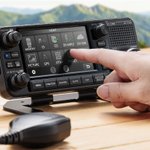
The radio uses direct RF sampling below 74.8 MHz and has a detachable 4.3-inch color touchscreen with a live spectrum scope and waterfall. Dual receive lets you listen on HF or 50 MHz while monitoring a 144 or 430/440 MHz repeater.
The IC-7110 includes a CW decoder, an FT8 setup preset, D-STAR repeater monitoring, built-in GPS, Bluetooth, and firmware updates over Wi-Fi. Japan also gets the IC-7110M (50 W) and IC-7110S (10 W on HF and 20 W on 50/144/430 MHz).
On November 18, Japanese dealer CQ Ohm listed the 100 W model for preorder at the equivalent of about US$1,443 including tax. The listed reference price was about US$1,712.
Icom Japan launch announcement
icom.co.jp/news/9103/
Icom global announcement
icomjapan.com/news/4765/
#HamRadio #Icom #IC7110 #DSTAR


66
QMX Panadapter v2.0 adds RTTY to the M5Stack Tab5.
Steffen Lav (OZ1LAV)’s open-source project pairs the 5-inch touchscreen with a QRP Labs QMX/QMX+ over USB, providing a spectrum, waterfall and digital-mode operation without a PC.
Released on November 15, v2.0 brings a dedicated RTTY page alongside FT8, FT4, JS8, WSPR and CW. It receives and transmits directly on the Tab5, with matching controls in the browser.
RTTY features include automatic speed, shift and polarity detection, AFC, CQ/Answer/Exch/73 messages, and live keyboard sending. Supported speeds are 45.45, 50, 75 and 100 baud, with shifts from 170 to 850 Hz. The developer reports on-air validation of Auto against 75-baud stations; live 50/100-baud and contest pile-up testing remain outstanding.
The release also enlarges the receive-audio buffer and gives audio processing priority over the web server to address gaps and pitch drift under load. A v2.0.1 follow-up fixes the SD-card log-archive prompt when Wi-Fi is enabled.
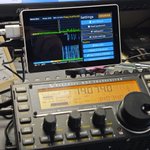
The photos show a local Elecraft KX3 adaptation; the upstream project targets the QMX/QMX+.
GitHub — source code and firmware:
github.com/SteffenLav/qmx-pa…
v2.0 release:
github.com/SteffenLav/qmx-pa…
User guide:
tab5.lav.dk/
#HamRadio #QMX #KX3 #M5Stack #RTTY #ESP32 #OpenSource


1
78
VardeFM is a new open-source FM data modem from Norwegian amateur LB1DK, announced on November 9.
It provides a VARA-style TCP interface for applications such as Winlink Express and Pat, using command/data ports 8300 and 8301.
Both stations must run VardeFM. Its independently designed waveform cannot communicate with stations running VARA FM, including existing gateways using that modem.
Written in Rust and licensed under GPL-3.0, VardeFM runs on Windows, Linux, macOS and Raspberry Pi. Its waveform and protocol are openly documented. It uses OFDM, LDPC error correction and retransmission of missing data, with seven adaptive speed levels per mode.
• Narrow: microphone/speaker connections, 0.7–7.4 kbit/s.
• Wide: a 9600-baud data port with flat audio, 1.9–18.7 kbit/s.
These are documented modem net rates before link-layer overhead.
LB1DK reports successful initial tests with real radios, alongside a built-in two-modem simulator. Broader testing across radios, audio interfaces and operating conditions is still needed.
GitHub — code, protocol and downloads:
github.com/notepid/vardeFM
Original announcement:
lb1dk.no/blog/vardefm
#HamRadio #VardeFM #Winlink #OpenSource #DigitalRadio


2
89
The European PSK Club’s EPC QSO Party returns on November 21–22, 2026, with updated rules and a new contest website.
The contest runs from 12:00 UTC Saturday to 12:00 UTC Sunday. It’s BPSK63 only on 160, 80, 40, 20, 15, and 10 meters. Licensed EPC members can enter from anywhere in the world. Both stations send a signal report and their EPC membership number. Membership is free.
Each distinct EPC number worked normally counts as one multiplier on that band. Callsigns ending in EPC count for five. The contest has 39 categories, including a 12-hour option for all-band single operators that counts their best 12 UTC clock hours.
Cabrillo 3.0 logs are due November 24 at 12:00 UTC. Entrants confirm their upload by email, and participants with confirmed, accepted logs can download a certificate after the results are published.
Contest website
epcqso.com/
Official rules
epcqso.com/contest-rules/
Log upload
epcqso.com/submit-log/
Free EPC membership
eupsk.club/home/registration
#HamRadio #BPSK63 #EPCQSOParty #Contesting


38
FloodAid puts an emergency light and a USB power bank into one portable, solar-recharged box.
Maker taifur designed it for power outages in flood-affected communities in Bangladesh. A 9 V, 3 W solar panel charges two 18650 cells connected in parallel. The stored energy powers a COB LED panel, while a separate circuit provides 5 V USB output for charging a phone.
The orange enclosure was designed in Tinkercad and printed in PETG. It holds the solar panel on one face and the LED on the other, with a metal carrying handle on top.
The build guide includes the parts list, wiring instructions, assembly photos and two printable STL files.
instructables.com/FloodAid-a…
#DIYElectronics #SolarPower #3DPrinting #EmergencyPower #MakerProjects


45
A solar-powered APRS LoRa weather station, the PCB for outdoor-unit is taking shape.
The design fits on a 100 × 100 mm, two-layer board, with an ESP32, LoRa radio, CN3791 MPPT charging and a single 18650 cell. It supports temperature, humidity, pressure, UV, ambient light, particulate matter, wind and rain sensing.
The plan is to keep the ESP32 asleep most of the time, wake for measurements, and send updates over LoRa. The ambient sensor sits away from the main board to reduce temperature errors from internally generated heat.
The latest PCB passes KiCad’s design-rule and schematic-consistency checks. It’s been sent to JLCPCB for fabrication.
One step closer to a RadHive station in the field.


1
1
89
A Möbius receiving loop starts with an unusual coax connection.
Everett Sharp (N4CY) built roughly one-metre loops inside plastic pipe to compare Möbius and conventional shielded designs.
At the top of the Möbius loop, each centre conductor connects to the opposite side’s shield. The conventional version keeps the centre conductor continuous across a gap in the shield.
Using an Icom R75, Sharp tested different transformers and preamplifiers. In one configuration, he reported 20–22 dB nulls on local AM stations, versus 14–16 dB for the conventional loop. A null is the signal reduction found by rotating the antenna.
These were interim measurements. Later amplifier and transformer changes produced 30 dB nulls with his improved Möbius loop. The results depended on the complete receiving setup.
The report includes build photos, wiring diagrams and amplifier circuits.
Original report:
george-smart.co.uk/wordpress…
#HamRadio #LoopAntenna #Shortwave #DIYAntennas #RadioExperiments


36
Building a standalone panadapter for the Elecraft KX3: a Tab5 touchscreen, custom I/Q/CAT interface, and FT8/FT4/WSPR. I cover porting QMX software with AI, the PX3 comparison, the printed enclosure, and chasing spurs.

Dooi: a DIY desktop robot with animated eyes and tracked movement
Dooi is an ESP32-P4 desktop robot from OSHWHub team ‘粒子微动’, whose listed members are huochaigun and coucou.
Two round 1.28-inch displays form its expressive eyes. Geared motors drive the tracks, while two servos add body movement. Touch sensors let it react when handled.
Its Xiaozhi-based software supports voice conversations and camera-assisted image recognition. Browser controls and a supported Bluetooth gamepad provide other ways to operate it.
Firmware version 2.2.3 also adds a browser tool for drawing custom eye expressions.
The creators cite Doly as the visual inspiration, with redesigned electronics and software. The project page provides build instructions, printable enclosure files, circuit documents and firmware. The build guide calls for a preassembled mainboard, and the published materials carry noncommercial-use terms.
Project:
oshwhub.com/team_cdvqlfce/pr…
#ESP32 #Robotics #DIYElectronics #3DPrinting #DesktopRobot #MakerProjects
92
KX3 panadapter update: custom PCB, printed housing and a 500 mW WSPR test
The KX3 panadapter project now has its custom PCB and a 3D-printed housing. The housing attaches to the back of the M5Stack Tab5, keeping the interface board and touchscreen together in one compact assembly.
The custom board combines the ESP32-S3 audio and CAT interfaces with DTR/RTS lines for PTT control and CW keying. It also includes an interface for XPA125B amplifier control. The connections remain accessible through the housing.
Tonight’s test was WSPR on 40 metres, with the KX3 transmitting at 500 mW—half a watt. The reception map shows the signal being reported in Australia and New Zealand.
#HamRadio #KX3 #Panadapter #M5Stack #ESP32 #WSPR #QRP #DIYElectronics #3DPrinting


1
1
81
Spend too long scrolling, and this little desk pet gets sick.
PolyMO is a newly published DIY project built around an ESP32-S3 board with a small AMOLED screen, microphone and speaker. It connects to an Android phone over Bluetooth, and its health responds to time spent in selected apps. Keep neglecting it, and the pet can eventually die.
It also talks. The phone handles speech recognition, generates replies and turns them into speech—all locally, without a cloud service. The ESP32 runs the pet’s hunger, happiness and growth.
The project includes firmware, Android app source code and 3D-printable enclosure files. Builders need to supply their own speech and language models.
GitHub: github.com/brenpoly/polymo

Route 66’s centennial is being marked on the amateur-radio bands
Route 66 On the Air is now under way, putting special-event stations on the air from communities connected with America’s historic “Mother Road.”
The 2026 event runs from 0001 UTC on September 12 until 2359 UTC on September 20. This year’s operation also marks the 100th anniversary of Route 66, which was established in 1926 and originally connected Chicago with Santa Monica.
A network of special callsigns beginning with W6 is representing cities and locations along the route. These include Santa Monica, Los Angeles, San Bernardino, Albuquerque, Amarillo, Oklahoma City, Tulsa, St. Louis and Chicago, along with several mobile and rover stations.
Operators can look for the stations on CW, SSB and digital modes. The published frequency guide suggests activity near 14.033 MHz for 20-metre CW, 14.266 MHz for SSB and 14.074 MHz for digital operation. Frequencies may move because of band conditions, interference or other activity.
The event is sponsored by the Citrus Belt Amateur Radio Club in San Bernardino, California. Individual stations set their own operating schedules, so not every callsign will be active throughout the full nine-day event.
Route 66 On the Air has connected amateur radio with the road’s history for more than two decades. The centennial edition gives operators around the world another chance to contact stations spread along the route from California to Illinois.
Official event information:
w6jbt.org/route-66-on-the-ai…


1
77
DiY599’s LiNK500MP Mk2 brings wireless audio and radio control to the Lab599 TX500MP, cutting down on cables between the radio and a computer for digital-mode operation.
The add-on combines a USB audio interface, packet-radio TNC, Bluetooth, GPS and an APRS tracker in an aluminum case that mounts directly to the radio. According to DiY599, it works with software including WSJT-X, JS8Call, VARA and VarAC. The Mk2 also supports compatible Bluetooth headsets.
DiY599 currently lists it at €649 including tax, though it’s marked sold out. PileupDX lists it at €679 on backorder. Those prices are for the accessory; the radio is separate.
I think, as a radio accessory, t’s too too too expensive.

2
115
New project started again, one by one, endless....
This one is a 3S 18650 battery pack for QRP radio operation.
I would like to build a compact rechargeable battery pack that can provide a practical field power source for small HF/VHF QRP radios. The pack uses three 18650 lithium cells in series, giving a full-charge voltage of about 12.6 V, which matches the external DC input range of many portable radios.
The target output is 12.6 V / 5 A max, enough for most QRP transceivers during receive and moderate-power transmit operation. It is intended for radios such as FT-817/818-style portable rigs, IC-705-type setups with suitable input limits, small CW transceivers, and other field radios that can accept a 3S lithium pack voltage.
The board includes the battery holder, protection circuit, charging input, power switching, status indication, and output connector area in one module. T
Main design goals:
- 3S 18650 battery pack
- 12.6 V fully charged output
- 5 A maximum output target
- Suitable for QRP radio field operation
- Built-in protection and charging circuit
- Compact PCB module
- Clear power and charge indicators
- Practical output connector for radio useNew project started again, one by one, endless....
This one is a 3S 18650 battery pack for QRP radio operation.
I would like to build a compact rechargeable battery pack that can provide a practical field power source for small HF/VHF QRP radios. The pack uses three 18650 lithium cells in series, giving a full-charge voltage of about 12.6 V, which matches the external DC input range of many portable radios.
The target output is 12.6 V / 5 A max, enough for most QRP transceivers during receive and moderate-power transmit operation. It is intended for radios such as FT-817/818-style portable rigs, IC-705-type setups with suitable input limits, small CW transceivers, and other field radios that can accept a 3S lithium pack voltage.
The board includes the battery holder, protection circuit, charging input, power switching, status indication, and output connector area in one module. T
Main design goals:New project started again, one by one, endless....
This one is a 3S 18650 battery pack for QRP radio operation.
I would like to build a compact rechargeable battery pack that can provide a practical field power source for small HF/VHF QRP radios. The pack uses three 18650 lithium cells in series, giving a full-charge voltage of about 12.6 V, which matches the external DC input range of many portable radios.
The target output is 12.6 V / 5 A max, enough for most QRP transceivers during receive and moderate-power transmit operation. It is intended for radios such as FT-817/818-style portable rigs, IC-705-type setups with suitable input limits, small CW transceivers, and other field radios that can accept a 3S lithium pack voltage.
The board includes the battery holder, protection circuit, charging input, power switching, status indication, and output connector area in one module.
Main design goals:
- 3S 18650 battery pack
- 12.6 V fully charged output
- 5 A maximum output target
- Suitable for QRP radio field operation
- Built-in protection and charging circuit
- Compact PCB module
- Clear power and charge indicators
- Practical output connector for radio use
- 3S 18650 battery pack
- 12.6 V fully charged output
- 5 A maximum output target
- Suitable for QRP radio field operation
- Built-in protection and charging circuit
- Compact PCB module
- Clear power and charge indicators
- Practical output connector for radio use


