






A very welcome development, Mr. Sanyal.
Suggest making History of Science & Technology a separate subject from Class 7.
As students learn scientific theories, they should also see the related historical developments from India.
@sanjeevsanyal @NITIAayog

There is also a chapter on entrepreneurship in the Grade 9 Social Science Part 2. It explains basics of profit & loss account, business plans and so. Most importantly, it presents risk-taking, innovation and business as a positive activity - quite different from how previous textbook portrayed it (with emphasis on "hoarding" and "black-markets"). 2/2


1
42
After studying Ramana Maharshi and Nisargadatta Maharaj, he left for years of world travel and guru-shopping , only to arrive back at their core teaching: meditate on “I am That” and nothing else
Western education and its ecosystems had wired him from childhood to seek happiness outside.
The long detour simply returned him to Tattvam Asi.

For twenty years, a British man meditated, studied ancient teachings, and searched for the peace that spiritual masters had promised him.
Then, in 1997, he met a Frenchman who suggested that the very effort to find peace was preventing him from recognizing it.
The man's name was Rupert Spira.
He had spent much of his adult life searching for a state of consciousness that, according to the teaching he would later share with thousands of people, he had never actually left.
Rupert was born in London in 1960.
At fifteen he discovered the poetry of Rumi, the Persian mystic who wrote about the disappearance of the separate self. At seventeen he began studying Advaita Vedanta and practising mantra meditation.
For the next twenty years, he meditated twice daily, studied Ramana Maharshi, Nisargadatta Maharaj, and Krishnamurti, and searched for an answer to a question that had occupied spiritual traditions for centuries.
Who are we, really?
Meanwhile, he became an accomplished potter, apprenticing under Michael Cardew and spending years shaping clay into bowls and vessels.
His hands worked with physical objects. His attention kept returning to the one experiencing them.
In the mid-1990s, he travelled to America hoping to meet the spiritual teacher Robert Adams. But Adams died before they could meet.
During that journey, Rupert heard about another teacher, a Frenchman named Francis Lucille. Several months later, they met.
Francis said something remarkably simple:
"Meditation is a universal yes to everything"
No secret technique. No instruction to silence the mind. No promise of some extraordinary state waiting at the end of years of discipline.
For Rupert, the encounter brought his search to a turning point.
He later described it as coming home.
And the strange part was that he had not gone anywhere.
Over the following twelve years, he explored with Francis the beliefs and bodily sensations that create the feeling of being a separate person.
The teaching was deceptively simple.
You believe you are a body that possesses awareness.
But look at your actual experience.
> You are aware of thoughts.
> You are aware of sensations.
> You are aware of the world around you.
Everything you experience changes.
But what knows the changes?
A thought appears. You know it.
Fear arises. You know it.
Even the feeling of being a separate person is something you are aware of.
Can the awareness that knows all these things itself be found as an object?
This became the foundation of Rupert's Direct Path.
Instead of trying to become enlightened, he invited people to investigate the awareness that was already present.
And this is the part of his teaching that gets lost when spirituality becomes another self-improvement project.
Most people spend their lives believing happiness exists somewhere in the future.
The next relationship. The next achievement. The next meditation retreat. The next version of themselves.
Even the spiritual seeker is searching for something to acquire.
But according to Rupert, what we fundamentally are is not something that can be acquired.
You cannot become the awareness that knows your experience.
You already are that awareness.
In 2008, he published The Transparency of Things, bringing this understanding to a wider audience. His books and retreats would eventually reach people around the world.
But the remarkable part of Rupert Spira's story is not that a man meditated for twenty years and finally discovered peace.
It is that he spent twenty years searching for something he came to understand had been present through every moment of the search.
The mind kept asking how to arrive.
The answer was to investigate whether the one who was searching had ever truly been separate from what it sought.


21
Kerala (esp. Malabar) has had continuous trade links with the Arabian Peninsula & Gulf for over 1,000 years
Yet unlike Marwaris, Banias or Chettiars, these ties never produced scalable credit networks, pan-regional distribution or industrial capital
Outcome: high remittances, heavy concentration in gold, retail & restaurants, weak manufacturing
Centuries of access, no transition to diversified commercial scale
A historical lost opportunity

Mathew Joseph has been saying this for years, and I’m totally with him on this.
Having witnessed the growth of many young Malabari entrepreneurs in Dubai, particularly those from Kannur, Kozhikode and Malappuram, I genuinely believe the Malabari business community deserves to be studied alongside communities like the Marwaris, Sindhis, Banias, Chettiars etc.
Based on what I’ve seen in the markets of Deira and Bur Dubai, even management consulting giants could learn a thing or two from them about building successful businesses with remarkably little capital and limited resources.
One example from my own experience is young Malabaris in Dubai pioneered social commerce and turned it into a viable business model long before it became mainstream. That entrepreneurial instinct deserves far more recognition.
1
76
The post mixes some accurate recent aggregates with an Austrian style framing (“inflation is the true opium,” “money printer beat stocks,” “structural problems hidden under nominal GDP”)
The long term chart is the clearest technical flaw because it uses a price index that excludes dividends and compares a monetary stock to equity prices
The GDP deflator substitution is methodologically incorrect
Money supply growth at 16% is worth watching for inflation and financial stability reasons, but the claim that the data and chart “fundamentally” prove a hidden tax that has systematically crushed equity investors does not hold up under standard measurement.

1 in 7 rupees in India did not exist a year ago.
M3 money supply grew 16% this year. Inflation, on paper, is 5.5%.
This is the most under-discussed, persistent problem in the Indian economy. This 16% “hidden tax” is starting to show up everywhere:
1. Gold is up 17% in INR - almost exactly the M3 money supply increase. Interesting, right?
2. Domestic GST collections are up 15.8%. Also almost exactly the growth in money supply. The “record GST” is just taxing more money being printed.
3. GST on imports is up 42%, because the rupee fell 7.6%, on top of increased costs. We shouldn’t celebrate paying more tax on the same iPhone.
4. The most egregious one: 7.8% real GDP growth assumes prices across the whole economy rose just 2.3%. (Nominal GDP grew 10.3%. Use the 5.5% CPI instead and real growth is closer to 4.5%.) Does your lived experience validate a laughable 2.3% inflation?
5. The one thing that did NOT keep up is your portfolio. Since 1997, money supply is up 44x and the Sensex is up 20x. Put every INR you had into Indian stocks for 30 years and the money printer beat you by 2X.
Taxes keep going up. Capital controls keep tightening. Inflation keeps going up. The structural problems, courts, land, labour and the cost of capital, stay exactly where they were, hidden under a nominal GDP number. We are printing like there’s no tomorrow and pretending nothing is wrong.
Ludwig von Mises called inflation “the true opium of the people administered to them by anti-capitalist governments and parties.”
Printing is the easiest way to keep welfare flowing and the headlines green without fixing a single structural problem. Inflation is the most immoral tax that we pay, without knowing we’re paying it.

36
Personal DRAM supports gaming, editing, development, & daily computing & not just occasional AI.
The “5%” figure ignores real active use & the fact that idle time is normal for almost every consumer device.
Pure utilization logic would also call personal cars & tools inefficient.
Local inference keeps data private, works offline, lowers latency & avoids single points of failure or provider lock-in.
Cloud maximizes average busy time but introduces censorship, surveillance & outage risks.
Users correctly value ownership and autonomy over raw utilization
The argument is self serving.
OpenAI’s business depends on cloud API usage and has locked up large shares of DRAM supply.
Claiming consumer hardware is “terrible” allocation directly benefits that model
It is not neutral planning, it concentrates power and pricing with a few providers.
DRAM scarcity is temporary and driven heavily by AI data center demand itself.
Consumer and local AI demand scales production, drives efficiency gains, and enables customization and edge use cases cloud cannot serve well.
Markets and distributed ownership have repeatedly outperformed top-down utilization arguments.

sam: local inference is a terrible allocation of scarce resources
“a lot of people want local inference, and somehow they assume that the problem is solved now because we have open-source models, we're going to be able to run them on our computers, and so we're not going to need all the stuff in the data centre
but from a global allocation perspective, actually it's quite terrible to have everybody, like, have a bunch of the world's limited supply of DRAM sitting in their own computer and being used five percent of the time
you want maximum utilisation in the cloud if you're trying to deal with this very supply-constrained environment
somehow many people's intuition is the opposite of that”
60
1. Nifty 500 reported stocks delivered Sales +23% YoY, EBITDA +26% YoY and PAT +32% YoY, with profit growth outpacing revenue and margins expanding
Broader non-financials show similar strength (sales + 22%, net profit +35%), while banks/NBFCs posted NII +16% and profit + 25%
Standouts include Adani Power, Vedanta, LT and several auto/financial names, though some IT and commodity stocks remained mixed amid global headwinds
2. The main levers are domestic consumption revival (GST and tax cuts), private/government capex in manufacturing and infrastructure, credit growth and margin recovery in financials, export competitiveness supported by FTAs and the rupee, and structural themes such as renewables, EVs, data centres, defence and electronics manufacturing
These factors underpin the current earnings acceleration after a period of consolidation
3. Double digit sales growth and 25–35% PAT growth, driven by the levers above, support an earnings led rise in indices rather than pure multiple expansion
Nifty and broader benchmarks ideally should track or modestly exceed EPS growth of roughly 10–15%+, allowing valuations to re-rate modestly from current multi-year lows. Targets around 28,000 for Nifty by end 2026 are consistent with sustained delivery of these fundamentals
4. However, short term will remains volatile to sideways (possible 5–8% bounce if oil and FII selling ease) amid elevated yields and outflows
Medium term (6–18 months) looks constructive, with earnings recovery and cheaper valuations supporting double digit returns as foreign selling potentially pauses
Long term structural case stays intact, with domestic savings, 7% GDP growth and policy support implying large cap potential around 12% CAGR over 3–5 years despite global AI concentration risks
@vivbajaj

Incredible results by Indian companies during these tough global times.
Its a matter of time, market will start respecting and rewarding them through stock price.
Click to view this in StockEdge sedg.in/igv3251d


1
93
Same world bank report illustrates Gini index of various nations
Please check and you will get the answer


On @IndiaToday at 9pm,Surjit Bhalla and Santosh Mehrotra debate the World Bank's claim that extreme poverty in India has fallen to 2.6%. Both are distinguished economists, but the viewer is left none the wiser. Is the decline credible?
A person may have escaped extreme hunger and destitution but still be unable to afford adequate nutrition, housing, transport, healthcare or education. Such a person is no longer extremely poor but remains economically vulnerable.
The two economists kept taking swipes at each other and even the anchor( !!) but
the question is which measure is appropriate for the claim being made.
The issue that Bhalla and Mehrotra should have explained to viewers is:
Has India merely reduced extreme destitution, or has it enabled most Indians to achieve a minimally acceptable standard of living?
Surely a TV debate should help ordinary viewers understand what these figures mean, rather than leave them to decide which economist sounds more convincing.
35
Raj MKK retweeted

Launching RNAFoundry.com – we manufacture personalized cancer vaccines.
India missed the electronics revolution
Now missing the AI one
Which means, future of 450M+ under 30 is at risk
Do govt & parties grasp the gravity?
Are they acting with sense of urgency?

An interesting interview from @blsanthosh
With BJP - the party - now marking 75 yrs, this is a good insider account of the challenges.
It has won:
-Art 370
-Ram Mandir
-Economic Nationalism
-BENGAL!
But challenge is
-training 180–190 mayors expected once civic polls are done
-380+ of ~750 zila panchayat presidencies
-48,000+ block councillors, the count that forced a new training camp
-Do these leaders know / understand governance?
The newcomer problem:
-BLS: "Without new joining, there will be no freshness"
-There are levels to integration within party
-Some aspects are easy but rest take time.
The MAIN CHALLENGES:
-Ram Mandir and 370 were "palpable" and "visible"
-What's left: decolonisation, and an NEP "yet to take root"
-India missed the industrial revolution.
-These are tough issues to communicate

1
69

Raj MKK retweeted

A glimpse of the future of finance!
The exhibition at the Global Fintech Fest showcased innovative products and solutions that are transforming India’s fintech landscape.


It’s not just US & China , even tiny European nations are building market- fit Ai applications in frenzy speed
Legal AI start-up Legora seeks funds at more than $10bn valuation
ft.com/content/8202960d-ec90…

1
112
Raj MKK retweeted

Tomorrow, one of my graduating PhD scholars will be receiving the best thesis award for human welfare, for his PhD on Geospatial AI applications for landslide mitigation in India. He has now moved on as the CEO of a deeptech startup incubated at IITD - EarthSense Labs. These are sparks of a new dawn in the country that a small number of PhD graduates of IITs with excellent international profiles are choosing entrepreneurship as a first-choice. This would not be possible without the support of various schemes. The ecosystem will take time to mature, but our ambition should be develop something that can rival Stanford's.


At 11 AM tomorrow, 8th August, I will be attending the Convocation Ceremony at IIT Delhi. I look forward to being among the students and teachers of this pioneering institution.
IIT Delhi has always made a rich contribution in the fields of research and innovation.
@iitdelhi
pib.gov.in/PressReleaseDetai…

Raj MKK retweeted

Google has ~$150-160B of cash + liquid securities. They are using it the right way - I'd be worried if their first priority is to do buybacks or give dividends out and not invest in securing the very future of the company. Bullish on @sundarpichai - this is what it takes.


Raj MKK retweeted

Proud to see our incubated deep-tech startup, The ePlane Company, pull back the curtain today on the e200X (PT-01), the full-scale physical reality of their physics-first approach to aviation.
While the global industry has spent billions building massive aircraft that require cities to rebuild their infrastructure completely, IIT Madras faculty member Prof. Satya Chakravarthy and his team took a completely different path.
At just 8m × 11m, the e200X is the world’s most compact passenger eVTOL, engineered to carry a pilot + 200kg of payload directly out of current helipads. Backed by over 10,000 km of cumulative flight testing and holding a formal Design Organisation Approval (DOA) from the DGCA, ePlane represents the elite tier of execution rigour in the Advanced Air Mobility sector.
@iitmadras @ePlaneCompany @satchakra_iitm
#IITMadras #IITMIncubationCell #DeepTech #MakeInIndia #eVTOL #AdvancedAirMobility #AerospaceEngineering #Innovation
Every breakthrough begins as a leap of faith.
Capital flows before certainty arrives.
Some companies fail. Some fortunes disappear.
But without those risks, there is no internet, no smartphone, no AI.
History doesn’t remember those who waited for perfect certainty.
It remembers those who built the future.

IBM CEO Arvind Krishna says the muli-trillion dollar AI data center build out is a bubble.
We are investing in creating capabilities like data curation, reinforcement learning, and most crucially the compiler infrastructure to ensure AI output can be verified but we will not chase the investment bubble.
This is just our normal prudence. To some people that would sound defeatist, but we will talk in 5 years.
1
127

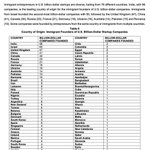
96 Indians in America built billion dollar companies.
No other country comes close.
There are only about 5 million Indians in the U.S.
That means roughly one in every 50,000 Indians there became a unicorn or billionaire founder.
Imagine if even a fraction of them had built those companies in India.
The real question is not why they succeeded abroad.
The real question is, why couldn’t India retain them?
Why do even committed patriots still see the West as the destination for opportunity?
Nationalism is not a slogan.
Nationalism is creating conditions where talented Indians choose to build, innovate & create wealth in India.
Celebrating remittances while losing founders is a poor trade off.
It’s like praising export commissions while giving away the factories.
Short term inflows. Long term value creation lost.
@svembu


88
Nations that optimize AI infrastructure costs gain a major edge in scaling deployment and adoption
By this huge infra built, India can move fast in Ai application building leveraging huge talent pool
Lower costs allow faster experimentation, broader access, and sustained investment in models
Still, capital & regulatory constraints are there - which requires government’s intervention

Dr Varghese Kurien used to welcome every new batch of recruits at the Institute of Rural Management in Anand by saying - "I can only provide you with infrastructure but your have to give it a soul"
Ambani/Adani can provide Infra but who will rise up and give it a model/soul?
78