

building @protoflowai the cursor for hardware
Joined January 2025
- Tweets2.4K
- Following334
- Followers493
- Likes5.9K



Pinned Tweet
protoflow, 6 months later...
one prompt → schematic with real parts → routed board → spice sim run by the ai
edit any of it by hand, pull up datasheets next to your schematic, export to kicad or altium
free on windows, mac and linux
2
2
193
There's a 32-bit RISC-V microcontroller that costs about 10 cents.
The CH32V003: 48 MHz, 16 KB of flash, 2 KB of RAM. With ch32fun, an open source toolchain, blinky is about 500 bytes.
Save this to use in your next board

16
i built this ESP32 breakout board on @protoflowai in 15 minutes
its so over for electrical engineers
35

we like testing Studio mode on other people's boards, not just our.
It routed this board with 372 connections and moved zero footprints in 42 mins


1
34
Engineers in 2010 vs 2026 🎮
Same wireless controller. 48 parts, 138 connections. Claude routed it in ProtoFlow Studio in 22 minutes, with 0 KiCad DRC errors.
Manual routing is a re-creation; the build-up is sped up. Design only, not hardware-tested.
protoflow.ai
53
16,000+ open source boards, now in ProtoFlow.
HackRF. The Corne keyboard. NASA's open source rover. Plus drones, synths, power supplies, retro computers, and a lot of weird stuff in between.
Open one, ask the AI how it works, fork it, build your own.
The future of hardware is open source.

Today we added a bunch of open sourced PCB reference designs to our website.
click edit in protoflow and start making changes in the app. The AI can explain the design choices, add features, and help you make the project your own.
or download a verified reference design directly from a manufacturer

64
Same flight controller. 184 connections.
Claude routed it in ProtoFlow: 4 layers, 82 parts, 0 DRC errors in KiCad.
Manual side is re-created; AI footage sped up. Design only, not hardware-tested.
Engineers in 2010 vs 2026 😅
protoflow.ai
2
76

Vibe coded a KiCad plugin to find the stock of any LCSC + Digikey + Mouser part so you don't have to spend time switching between 30 tabs and finding inventory.
Check it out here: github.com/rishik4/protoflow

2
84


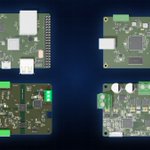
these are four of the boards protoflow designed in the last month.
800 people are now using protoflow every day to design everything from simple 2 layer boards to 8-12 layers.
more features, improvements, etc. are shipping every day, follow to see our new features

42
this one surprised me. 196-ball bga, 8 layers, and the agent placed all 161 fan-out vias itself
2.5 hours, no edits from us. the whole prompt is in the reply


One prompt. Eight layers. A 196-ball BGA.
ProtoFlow Studio picked the parts, drew the schematic, fanned out the BGA with 161 vias, and routed all 8 layers in 2 h 35 min. KiCad DRC: 0 errors, 0 unconnected.
the whole run, sped up:
1
71
Design an 8-layer compact compute board, about 70 x 55 mm, built around an NXP i.MX RT1062 in the 0.8 mm-pitch BGA-196 package. It needs 32 MB of SDRAM (IS42S16160J), 16 MB QSPI boot flash, two USB 2.0 high-speed ports (a USB-C device port and a USB-A host port with a current-limited power switch), 10/100 Ethernet with a KSZ8081RNA PHY and an RJ45 magjack, a microSD slot, the 24 MHz and 32.768 kHz crystals, and a 5 V input with a buck to 3.3 V (use the RT1062's internal DC-DC for the core). Break out spare GPIO, UART, I2C and SPI on a 2x20 header and add an SWD connector. Use 8 layers with a ground plane next to every signal layer, keep the SDRAM and USB high-speed routing short, and route the whole board with DRC and ERC.
60
full demo: youtu.be/b3M97ruhVrU
(the board is a 30 min studio run, sped up)

1
13
april vs now teapawt.net/rdotapps/status/204275…
2
Claude Sonnet 5.5 is now available on ProtoFlow.
In our testing we have noticed it being exceptional at PCB Design at a much lower cost than other frontier models.

Introducing Claude Sonnet 5.5, the second model in the Claude 5.5 family.
It’s a clear upgrade over Sonnet 5, runs more than 30% faster, and costs up to 30% less for most work.
1
4
151