

Decoding the future of RWAs & tokenization ◈ Turning complex ideas into content worth reading ◈ Exploring & building with AI ◈ Community operation @SpaceMworld
Researcher
Joined August 2026
- Tweets12.7K
- Following461
- Followers4.9K
- Likes15.1K





Pinned Tweet
We traded horses for airplanes, yet the global financial system is still running on carrier pigeons. Tokenization is the airplane.
Here is everything you need to know about the trillion-dollar RWAs economy. 👇

Renowned retweeted
Stablecoins are becoming too important to financial markets for governments to ignore and two major regulatory developments are helping reshape how they’re issued, backed, and redeemed.
In July 2025, the United States enacted the GENIUS Act, establishing its first comprehensive federal framework specifically for payment stablecoins. Then, on October 21, 2026, the Office of the Comptroller of the Currency (OCC) issued final implementing regulations. The framework is scheduled to take effect on January 18, 2027.
But what exactly are regulators trying to achieve?
Stablecoins are no longer used solely for crypto trading. They’re increasingly involved in international payments, institutional settlement, lending, and transactions involving tokenized financial assets.
That creates an important question. If billions of dollars move through privately issued digital tokens, what protects the people and institutions relying on them?
The GENIUS Act addresses this through requirements covering several important areas.
Reserve backing: Payment stablecoins must be supported by qualifying liquid assets on a one-to-one basis.
Transparency: Issuers must provide regular disclosures about the reserves supporting their tokens.
Supervision: Issuers must operate under an applicable federal or state regulatory framework.
Redemption: Issuers must establish policies governing how holders can exchange their stablecoins for the referenced currency.
Interestingly, the legislation also prohibits permitted payment stablecoin issuers from paying interest or yield directly to holders simply for holding their payment stablecoins.
This creates an important distinction between regulated payment stablecoins and separate yield-bearing financial products.
Now, let’s look at Europe. The European Union introduced its Markets in Crypto-Assets Regulation, commonly known as MiCA.
Its stablecoin provisions have applied since June 2024. Under MiCA, tokens referencing a single official currency are generally classified as electronic money tokens (EMTs).
These issuers face authorization, safeguarding, and redemption requirements.
Meanwhile, asset-referenced tokens (ARTs), which reference other assets or combinations of assets, operate under a different set of rules.
What interests me here is how regulation is beginning to distinguish between digital assets that might appear similar on a blockchain but serve different financial purposes, and this connects directly to RWA tokenization.
Consider a tokenized Treasury fund settling transactions using stablecoins. The fund’s legal structure determines what financial rights investors hold.
But the stablecoin used for settlement introduces another set of considerations involving reserves, redemption, issuer reliability, and regulatory oversight.
Both sides of the transaction matter.
A regulated tokenized security doesn’t automatically make its settlement asset reliable, just as a regulated stablecoin doesn’t eliminate the risks associated with the asset being purchased.
This is why regulatory clarity matters for the development of onchain capital markets. Institutions need to understand who is responsible for safeguarding assets, honoring redemptions, managing risks, and protecting participants.
Of course, regulation doesn’t guarantee that a financial product cannot fail, and different jurisdictions are still developing different approaches.
But there’s a broader development worth paying attention to. Tokenization is connecting blockchain infrastructure with established financial markets. Regulation is increasingly determining how those connections can operate at scale.
The future of onchain finance won’t depend only on how many assets are tokenized.
It will also depend on whether the infrastructure supporting those assets can earn and maintain the trust of the institutions and people using it.

Stablecoins are becoming too important to financial markets for governments to ignore and two major regulatory developments are helping reshape how they’re issued, backed, and redeemed.
In July 2025, the United States enacted the GENIUS Act, establishing its first comprehensive federal framework specifically for payment stablecoins. Then, on October 21, 2026, the Office of the Comptroller of the Currency (OCC) issued final implementing regulations. The framework is scheduled to take effect on January 18, 2027.
But what exactly are regulators trying to achieve?
Stablecoins are no longer used solely for crypto trading. They’re increasingly involved in international payments, institutional settlement, lending, and transactions involving tokenized financial assets.
That creates an important question. If billions of dollars move through privately issued digital tokens, what protects the people and institutions relying on them?
The GENIUS Act addresses this through requirements covering several important areas.
Reserve backing: Payment stablecoins must be supported by qualifying liquid assets on a one-to-one basis.
Transparency: Issuers must provide regular disclosures about the reserves supporting their tokens.
Supervision: Issuers must operate under an applicable federal or state regulatory framework.
Redemption: Issuers must establish policies governing how holders can exchange their stablecoins for the referenced currency.
Interestingly, the legislation also prohibits permitted payment stablecoin issuers from paying interest or yield directly to holders simply for holding their payment stablecoins.
This creates an important distinction between regulated payment stablecoins and separate yield-bearing financial products.
Now, let’s look at Europe. The European Union introduced its Markets in Crypto-Assets Regulation, commonly known as MiCA.
Its stablecoin provisions have applied since June 2024. Under MiCA, tokens referencing a single official currency are generally classified as electronic money tokens (EMTs).
These issuers face authorization, safeguarding, and redemption requirements.
Meanwhile, asset-referenced tokens (ARTs), which reference other assets or combinations of assets, operate under a different set of rules.
What interests me here is how regulation is beginning to distinguish between digital assets that might appear similar on a blockchain but serve different financial purposes, and this connects directly to RWA tokenization.
Consider a tokenized Treasury fund settling transactions using stablecoins. The fund’s legal structure determines what financial rights investors hold.
But the stablecoin used for settlement introduces another set of considerations involving reserves, redemption, issuer reliability, and regulatory oversight.
Both sides of the transaction matter.
A regulated tokenized security doesn’t automatically make its settlement asset reliable, just as a regulated stablecoin doesn’t eliminate the risks associated with the asset being purchased.
This is why regulatory clarity matters for the development of onchain capital markets. Institutions need to understand who is responsible for safeguarding assets, honoring redemptions, managing risks, and protecting participants.
Of course, regulation doesn’t guarantee that a financial product cannot fail, and different jurisdictions are still developing different approaches.
But there’s a broader development worth paying attention to. Tokenization is connecting blockchain infrastructure with established financial markets. Regulation is increasingly determining how those connections can operate at scale.
The future of onchain finance won’t depend only on how many assets are tokenized.
It will also depend on whether the infrastructure supporting those assets can earn and maintain the trust of the institutions and people using it.

Not every digital dollar moving on-chain is a stablecoin, and banks are making that distinction increasingly important.
On October 19, 2026, @jpmorgan expanded JPM Coin (JPMD), its dollar-denominated deposit token, to Ethereum.
Unlike a conventional stablecoin, JPMD represents commercial bank deposit money and is designed for eligible institutional clients.
But why would a major bank build a deposit token when stablecoins already exist?
The answer lies in understanding three different forms of digital money.
1. Stablecoins
These are digital tokens designed to maintain a stable value relative to an asset, typically a fiat currency.
Depending on their structure, holders rely on the issuer's reserves, redemption arrangements, or other mechanisms supporting the peg.
They can circulate across public blockchain networks and serve as payment and settlement instruments.
2. Tokenized Bank Deposits
Imagine the money in a commercial bank account being represented and transferred through blockchain infrastructure.
That's the basic idea behind tokenized deposits.
Instead of representing a claim against a separate stablecoin issuer, the token represents a deposit liability of a commercial bank.
JPMorgan's JPMD is a practical example. It allows approved institutional clients to transfer dollar-denominated deposit value on-chain, with access and operations governed by the bank's arrangements.
The key difference is that the money remains part of the commercial banking system.
3. Central Bank Digital Currencies (CBDCs)
CBDCs take a different approach.
They're digital forms of sovereign currency issued by central banks, and Nigeria already provides an example through the eNaira, issued by the Central Bank of Nigeria.
Unlike private stablecoins or commercial bank deposits, a CBDC represents a liability of the central bank. CBDCs can be designed for everyday retail payments or wholesale settlement between financial institutions.
They also don't necessarily require a public blockchain.
Now, here's what makes this relevant to tokenization. In May 2026, the @BIS_org announced that Project Agora had demonstrated how tokenized commercial bank deposits and central bank reserves could support coordinated cross-border settlement.
Think about the implications. A tokenized bond could potentially be exchanged using stablecoins, tokenized commercial bank deposits, or central bank money, depending on the market's infrastructure.
All three can support digital value transfers, but their issuers, legal claims, access requirements, and settlement risks differ.
Tokenizing money doesn't automatically make every form of digital money equivalent.
The bigger question isn't simply whether money exists on-chain. It's who issued it, whose liability it represents, what protections apply, and whether it can reliably settle transactions involving real financial assets.
As tokenized capital markets develop, those differences will matter just as much as the technology moving the tokens.


Renowned retweeted

NOW LIVE: Ondo's Tokenized Anthropic.
ANTon is live on Ondo Stocks with 24/7 minting & redemption, weekends & overnight included.
A new standard for IPO-day tokenization, with 24/7 access beyond limited onchain pools and outside traditional market hours.
Renowned retweeted
Another use for Ondo’s tokenized Anthropic.
ANTon is the latest Ondo Stock eligible as collateral on Ondo Perps.

Tokenized Anthropic can be put to work on day 1 of IPO.
Anthropic is officially public and Ondo Tokenized Anthropic (ANTon) is already live as collateral on Ondo Perps.
Ondo Perps is the first platform where tokenized Anthropic can be held, posted as collateral, and traded against the ANT perp.
This unlocks the ANT basis trade:
1. Hold ANTon as the long leg
2. Post it as collateral
3. Short the ANT perp
4. Earn funding when rates are positive
Using ANTon as collateral also makes the trade more capital efficient.
The same holding serves as both the long leg and the margin for the short, reducing the need for additional stablecoin collateral.
Renowned retweeted
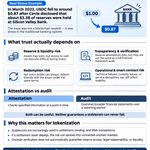
A stablecoin can be fully backed and still lose its $1 peg.
In March 2023, USDC temporarily fell to around $0.87 after Silicon Valley Bank (SVB) collapsed. The reason?
@circle disclosed that approximately $3.3 billion of its reserves were held at the failed bank. Those funds represented roughly 8% of USDC’s total reserves at the time. And suddenly, the market was questioning something fundamental: could holders reliably convert their tokens back into dollars?
The interesting part is that this wasn’t a smart contract exploit or a failure of blockchain technology. It was a problem originating in the traditional banking system.
Although $USDC eventually recovered its peg, the incident exposed an important reality about stablecoins. Having sufficient reserve assets isn’t the same as being able to access those assets immediately and that brings us to several risks worth understanding.
1. Reserve and liquidity risk
A stablecoin issuer might hold assets worth enough to cover its liabilities. But what happens if those assets cannot be converted into cash quickly enough to meet redemption requests?
During periods of financial stress, even otherwise reliable assets can become difficult to access or sell without disruption.
2. Transparency and verification
Reserve disclosures help people understand what’s supporting a stablecoin, but an attestation and a full financial statement audit aren’t identical.
An attestation generally provides assurance about specified information at a particular reporting date, while a financial statement audit examines a broader set of financial statements over a reporting period. Both can provide useful information, but neither guarantees that a stablecoin can never fail.
3. Redemption risk
A token trading near $1 on an exchange doesn’t necessarily mean every holder can redeem it directly with its issuer.
Eligibility requirements, operational restrictions, banking arrangements, and jurisdictional rules can affect redemption. And when confidence disappears, market prices can move away from the intended peg.
4. Smart contract and operational risk
Even when reserves are sound, blockchain-based assets can face technical vulnerabilities, transaction disruptions, and risks involving custodians or other service providers.
Now, why does this matter to the RWA ecosystem?
Because stablecoins are increasingly being used to settle tokenized securities transactions, support collateralized lending, and move liquidity between financial applications.
Imagine a lending protocol holding tokenized Treasury securities while its borrowers receive stablecoins. If the settlement asset suddenly depegs, the risk doesn’t necessarily remain isolated to the stablecoin itself.
It can affect collateral valuations, borrowing positions, liquidity, and other connected markets.
This is why I believe trust in onchain capital markets must extend beyond the tokens themselves.
A blockchain can verify that a transaction happened. It cannot, on its own, guarantee that the assets backing a token are accessible, sufficient, or legally redeemable and as traditional financial assets become more integrated with blockchain infrastructure, understanding these dependencies becomes even more important.


A stablecoin can be fully backed and still lose its $1 peg.
In March 2023, USDC temporarily fell to around $0.87 after Silicon Valley Bank (SVB) collapsed. The reason?
@circle disclosed that approximately $3.3 billion of its reserves were held at the failed bank. Those funds represented roughly 8% of USDC’s total reserves at the time. And suddenly, the market was questioning something fundamental: could holders reliably convert their tokens back into dollars?
The interesting part is that this wasn’t a smart contract exploit or a failure of blockchain technology. It was a problem originating in the traditional banking system.
Although $USDC eventually recovered its peg, the incident exposed an important reality about stablecoins. Having sufficient reserve assets isn’t the same as being able to access those assets immediately and that brings us to several risks worth understanding.
1. Reserve and liquidity risk
A stablecoin issuer might hold assets worth enough to cover its liabilities. But what happens if those assets cannot be converted into cash quickly enough to meet redemption requests?
During periods of financial stress, even otherwise reliable assets can become difficult to access or sell without disruption.
2. Transparency and verification
Reserve disclosures help people understand what’s supporting a stablecoin, but an attestation and a full financial statement audit aren’t identical.
An attestation generally provides assurance about specified information at a particular reporting date, while a financial statement audit examines a broader set of financial statements over a reporting period. Both can provide useful information, but neither guarantees that a stablecoin can never fail.
3. Redemption risk
A token trading near $1 on an exchange doesn’t necessarily mean every holder can redeem it directly with its issuer.
Eligibility requirements, operational restrictions, banking arrangements, and jurisdictional rules can affect redemption. And when confidence disappears, market prices can move away from the intended peg.
4. Smart contract and operational risk
Even when reserves are sound, blockchain-based assets can face technical vulnerabilities, transaction disruptions, and risks involving custodians or other service providers.
Now, why does this matter to the RWA ecosystem?
Because stablecoins are increasingly being used to settle tokenized securities transactions, support collateralized lending, and move liquidity between financial applications.
Imagine a lending protocol holding tokenized Treasury securities while its borrowers receive stablecoins. If the settlement asset suddenly depegs, the risk doesn’t necessarily remain isolated to the stablecoin itself.
It can affect collateral valuations, borrowing positions, liquidity, and other connected markets.
This is why I believe trust in onchain capital markets must extend beyond the tokens themselves.
A blockchain can verify that a transaction happened. It cannot, on its own, guarantee that the assets backing a token are accessible, sufficient, or legally redeemable and as traditional financial assets become more integrated with blockchain infrastructure, understanding these dependencies becomes even more important.
Renowned retweeted

There are over 6 million tokenized stock holdings onchain today. But if you asked Nvidia who its shareholders are, none of those wallets would show up.
Here's why.
- 24 issuers mint these tokens.
- approximately 94% of them buy the real shares through one @AlpacaHQ.
- Alpaca holds them at the DTC, the central depository.
- And the DTC's nominee, Cede & Co., is the name on the register.
Take Nvidia for example.
There are 710,063 wallets that hold tokenized Nvidia. On Nvidia's 10-K, there only just 1,226 holders on record.
And just to say that this isn't unique to just stock tokens holders. Most stocks bought through a regular broker are held the same way, in "street name."
If you want your own name on the register, there are three routes.
(1). Direct registration System (DRS)
(2). Certificated Shares
(3). issuer-sponsored tokens on an onchain register through @fairmint, @Securitize, or @SuperstateInc.

Renowned retweeted

Five Tokens, One Bet: Tracing the Residual Risk Inside "Diversified" Onchain Yield
Independent Research | @AlphaCyl
Not financial Advice
I. Counting Products Is Not Counting Risks
A yield product looks diversified when its dashboard lists several tokens from several issuers. An allocator measures diversification by independent risk factors: who holds the asset, who services it, who lends against it, and where the exit sits. When two tokens share an underlying fund, a custodian or a venue, the dashboard counts two positions and the portfolio holds one exposure.
This paper argues that most onchain "diversified" yield strategies combine products that share an underlying fund, a borrower, a curator or a venue, and that the shared layer is where the remaining risk sits. I trace six places this shows up, each with a disclosed number, and finish with a five question look through test.
II. Layer One: The Shared Underlying
Take @ethena 's ethereum:0xc139190f447e929f090edeb554d95abb8b18ac1c. An August 31, 2026 reserve examination (@Deloitte , via @Anchorage ) listed $525,205,527 in ethereum:0x7712c34205737192402172409a8f7ccef8aa2aec and $5,214,126 in bank demand deposits, so about 99% of reserves were BUIDL. A holder of USDtb is a holder of one BlackRock fund.pharos.watch/stablecoin/usdt…
The overlap spreads. A DeFi guide lists BUIDL as backing USDtb, feeding Frax's sFRAX reserves, sitting in @sparkfinance 's allocator behind ethereum:0xa3931d71877c0e7a3148cb7eb4463524fec27fbd , serving as margin collateral at FalconX, and underpinning @Ondo 's ethereum:0x1b19c19393e2d034d8ff31ff34c81252fcbbee92 .
The OUSG case shows how a product page can lag its holdings. AltStreet's reading of Ondo's page on October 23, 2026 shows $319.4 million of underlying assets: State Street's SWEEP at 47.49%, BUIDL at 31.96%, Franklin's BENJI at 12.18%, Fidelity's FYOXX at 7.38%, and about 1% cash. RWA.xyz's page still says OUSG primarily holds BUIDL, and the same AltStreet piece notes that Ondo's FAQ still describes the portfolio as mostly BUIDL. The holdings table changed, and the descriptions did not. Even after the shift, all four sleeves are tokenized government money funds, so their shared exposure is the Treasury bill and repo market.
altstreet.investments/guides…
Now ahttps://app.rwa.xyz/assets/ousg
hypothetical "diversified" vault with five tokens: ethereum:0xc139190f447e929f090edeb554d95abb8b18ac1c 30%, ethereum:0x1b19c19393e2d034d8ff31ff34c81252fcbbee92 25%, ethereum:0x80ac24aa929eaf5013f6436cda2a7ba190f5cc0b 20%, sUSDS 15% and $JAAA 10%. On the disclosed figures, USDtb contributes about 29.7% BUIDL (30% × 0.99) and OUSG about 8.0% (25% × 0.3196), so BUIDL alone is roughly 37.7% of the vault before looking through sUSDS. The top level weights give a Herfindahl index of 2,250, or 4.4 effective positions. The look through leaves fewer independent exposures than that.
III. Layer Two: The Borrower and the Collateral
@maplefinance 's syrupUSDC shows the credit version. @LlamaRisk 's July 17, 2026 analysis for @aave governance measured the USDC open term book at $1,330 million of principal against $1,834 million of collateral, a ratio of 1.379x. The top three borrowers hold 56% of principal and the top five hold 77%. The largest, at $345 million or 26.0%, posted ethereum:0x6c3ea9036406852006290770bedfcaba0e23a0e8 and USTB as collateral. A yield product backed by loans therefore holds collateral that is itself a tokenized Treasury product, which other sleeves may also hold.
governance.aave.com/t/arfc-o…
The same analysis lists the top holders of syrupUSDC: @SkyEcosystem 's AML proxy at 45.19% of supply, a cross chain pool at 18.98%, @Morpho at 10.05% and @grovedotfinance at 7.39%. @Dune 's May 2026 count found that $522 million of Maple's $1.8 billion syrup market capitalization is deployed across five venues, making one asset family nearly 30% of all RWAs in DeFi. The Yearn curation report from February 2026 split Maple's collateral as BTC at about 54%, XRP at 25.38% and USTB at 16%.
governance.aave.com/t/arfc-o…
dune.com/blog/tokenized-rwas…
IV. Layer Three: The Same Manager Under Different Allocators
@centrifuge 's ethereum:0x8c213ee79581ff4984583c6a801e5263418c4b86 and $JAAA are both Janus Henderson funds. A July 2026 snapshot found they made up 95.6% of Centrifuge's distributed assets, with Grove holding about $895 million across the two and @ethena allocating $250 million to JAAA in June 2026. Grove's June 2025 launch came with a $1 billion allocation from Sky to JAAA. Several "diversified" allocators therefore share one underlying manager.
businesswire.com/news/home/2…
V. Layer Four: The Same Venue and the Same Curator
Dune's April 2026 count put RWAs deposited into DeFi lending at about $2.7 billion, roughly 10% of $27 billion, with credit near 80% of deposits against 17% of AUM, and @Morpho , @kamino and @aave handling 83% of RWA lending activity.
dune.com/blog/the-rise-of-co…
cryptobriefing.com/dune-repo…
@RWA_xyz 's November 2 analysis traced the curators. Of $6.1 billion supplied to Morpho's variable rate stablecoin markets on October 28, 2026, the five largest curators (@SteakhouseFi , @SentoraHQ , @gauntlet_xyz , @SparkDao and @RockawayX ) oversee $5.0 billion, or 81%. Markets accepting tokenized collateral took $2.4 billion. The same report puts aggregate utilization near 90%, since about $5.5 billion is already borrowed. CoinbaseLend and Robinhood Earn both route into Steakhouse curated Morpho vaults, and Spark and Grove supply through that curator layer as well. Steakhouse also incubated Grove. A depositor who picks Coinbase, Robinhood or Sky for "diversification" meets one curator layer under three brands.
app.rwa.xyz/blog/the-lenders…
VI. Cases
Case One: @StreamDefi and @elixir , November 2025. The loss started with an "external fund manager" and reached lenders through shared collateral. Elixir lent $68 million in ethereum:0xa0b86991c6218b36c1d19d4a2e9eb0ce3606eb48 to Stream, about 65% of deUSD's backing. Stream held roughly 90% of the deUSD supply, so Elixir's backing was a loan to its largest holder. Analysts at YAM mapped about $285 million of debt across @eulerfinance , @SiloFinance , @Morpho and @GearboxProtocol , with @MEVCapital , @Re7Capital and TelosC among the exposed curators. Gauntlet had no xUSD exposure but paused some markets because of the Elixir contagion. RWA.xyz adds that fixed price oracles in affected markets did not reflect the decline, so liquidations did not trigger and lenders took bad debt. Several vaults chose different curators and the same collateral.
theblock.co/amp/post/377491/…
Case Two: USDtb and the regulators' question. The OCC's March 2026 proposal floated a 20% cap on tokenized reserve assets, and @BlackRock argued that risk depends on credit quality, duration and liquidity and not on whether an asset is held on a ledger. The final rule of October 21 permits tokenized reserves if they carry the same legal rights, drops prescriptive portfolio requirements, and limits exposure to a single counterparty to 40% of reserve assets, subject to exceptions. BlackRock had asked the OCC to confirm that issuers need not look through fund holdings when applying that limit to fund custodians or service providers. I did not find how the final rule resolves that point.
natlawreview.com/article/occ…
theblock.co/news/business/20…
Case Three: a shared exit. From @Ondo 's April 2025 post and @OpenEden_X 's docs: OUSG and base:0xad55aebc9b8c03fc43cd9f62260391c13c23e7c0 route instant exits through the same Circle facility for ethereum:0x7712c34205737192402172409a8f7ccef8aa2aec , and that facility had 23 hours of limited availability on March 27, 2025. The two products show up as separate lines on a dashboard and as one dependency in an outage.
VII. The Structural Question: Is Overlap Always Bad?
Not always. A Treasury bill fund from BlackRock is a lower risk place to concentrate than a thinly examined yield wrapper, and Spark's 2024 selection process shows allocators choosing winners on purpose. A single large underlying can be defensible if it is disclosed.
The risk in this paper comes from overlap the buyer cannot see. The dashboard says five tokens while the holdings table says three funds, two operators and one curator. Stream is the cost of that gap in a bad credit. A look through is cheap by comparison. Counts of tokens or issuers should not be shown as diversification until the shared layers are netted out.
The look through test. For any "diversified" yield product, ask five questions:
1. After look-through, which three underlying exposures are largest?
2. Which single operator (transfer agent, custodian, redemption facility) sits in the exit path for most sleeves?
3. Do two sleeves share a borrower, a collateral asset, or a manager?
4. What share of supply sits on one venue or with one curator?
5. Does the vault's accounting and oracle treatment differ by sleeve, or does one pricing assumption cover several?
VIII. Where the Research Points
This paper's thesis is that disclosure will move from product lists toward look-through exposures, because the shared layers are now measurable. Three things to watch:
1. How the OCC applies its 40% single counterparty limit to fund shares, and whether look-through becomes a requirement.
2. Whether vault curators publish netted exposure by underlying manager and operator.
3. Whether Morpho's utilization near 90% pushes lenders to price shared-collateral risk.
Independent research. Not financial advice. Always conduct your own due diligence.
Sources: protocol and issuer documents, governance, analytics publishers
- Business Wire, Grove launch (June 25, 2025); Centrifuge blog
- governance.aave.com/t/arfc-o… (LlamaRisk, July 17, 2026)
- app.rwa.xyz/blog/the-lenders… (Nov 2, 2026)
- dune.com/blog/the-rise-of-co…; dune.com/blog/tokenized-rwas…; dune.com/rwa-report
- Pharos USDtb page (Anchorage/Deloitte reserve report, Aug 2026)
- OCC final GENIUS rule summary, natlawreview.com (Oct 2026); The Block, BlackRock comment letter (May 2, 2026)
- curation.yearn.fi/report/map…

Africa is entering an important phase in the evolution of its financial infrastructure.
From commodity exports and agricultural supply chains to cross border payments, capital markets and digital finance, the continent has significant economic activity that increasingly requires more efficient financial infrastructure.
Yet several structural challenges remain.
According to the African Development Bank, Africa's trade finance gap stood between $74 billion and $92 billion in 2024. Commercial banks intermediated only 23% of the continent's total trade over the 2020–2024 period.
Meanwhile, the digital asset economy is expanding.
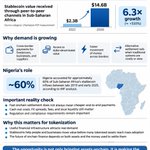
Chainalysis estimates that Sub Saharan Africa's crypto economy reached $101 billion between July 2025 and June 2026, representing 13.4% year-over-year growth.
Stablecoin activity is also gaining ground. The value of stablecoins received through P2P channels increased from $2.3 billion in 2022 to $14.6 billion in 2026.
These developments point towards several opportunities worth exploring.
Trade Finance & RWA Tokenization
Africa has significant agricultural, mineral and commodity trade flows. Tokenization, digital trade documentation and on-chain financing could create new ways to connect real-world assets with financial markets.
Stablecoins & Cross Border Payments
Businesses and individuals need more efficient ways to move value across borders. Stablecoin settlement and interoperable payment infrastructure offer opportunities to improve financial connectivity.
Capital Markets & Institutional Finance
Tokenized securities, private credit, commodities and other financial instruments could expand the ways assets are issued, represented and accessed, subject to appropriate regulatory frameworks.
Enterprise AI & Agentic Commerce
As AI agents begin interacting with financial applications, businesses and payment systems, the infrastructure supporting identity, verification, transactions and settlement will become increasingly important.
This is where blockchain infrastructure becomes an important part of the conversation.
@XDCNetwork operates across several areas, with an enterprise grade, EVM compatible Layer 1 built around real world financial applications, including trade finance, RWA tokenization, stablecoins, payments and emerging agentic commerce.
Its developments across institutional tokenization, trade finance and stablecoin payment infrastructure offer interesting examples of how these technologies are being brought together.
Africa has the trade flows, commodities, businesses, financial institutions and growing digital asset participation.
The opportunity is to connect these economic activities with infrastructure capable of supporting their next phase of development.
This is a conversation worth having across Africa.
Welcome to unofficial XDC Network Africa.
Renowned retweeted
Let's imagine receiving money through blockchain infrastructure without ever touching our crypto wallet. It sounds unusual, right? But that's increasingly what stablecoin payment infrastructure is being designed to make possible, and it reveals another important side of tokenization.
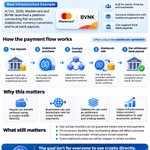
In October 2026, @Mastercard and BVNK launched their Global Money Platform, connecting fiat accounts, stablecoin balances, currency conversion, and local bank payouts.
The idea is to allow banks, fintech companies, and businesses to integrate these capabilities into their existing services, but what does that actually look like?
Imagine a business in Europe needs to pay a supplier in Nigeria.
Rather than requiring both parties to manage crypto wallets, a payment provider could coordinate the transaction behind the scenes.
Here's one possible arrangement: The European business pays through its usual financial account. A payment provider converts the funds into stablecoins and transfers them across a supported blockchain network.
On the receiving end, another provider converts those stablecoins into naira and sends the proceeds to the supplier's local bank account.
The supplier receives money through a familiar banking channel, even though blockchain infrastructure helped move the value internationally.
This arrangement is sometimes called the "stablecoin sandwich."
Traditional money goes in, stablecoins move value between payment providers, and traditional money comes out.
Interestingly, an October 2026 IMF paper examined this exact structure, tracing the transaction through five stages: fiat deposit, stablecoin purchase, onchain transfer, stablecoin sale, and fiat withdrawal.
But there's something people often overlook. A fast blockchain transaction doesn't necessarily mean the entire payment is instant or cheap.
Currency conversion, liquidity, service-provider charges, banking delays, and regulatory checks still affect the final experience.
Now consider what this means for businesses. Stablecoins can become part of their payment and treasury infrastructure without requiring every customer, supplier, or employee to understand blockchain technology.
Payment networks are already exploring this.
@Visa reported in April 2026 that its stablecoin settlement pilot had reached a $7 billion annualized run rate.
That's not the same as $7 billion in annual consumer purchases, but it demonstrates growing use of stablecoins within institutional settlement operations, and there's a broader connection to RWAs worth understanding.
We've discussed how stablecoins can settle purchases of tokenized Treasury funds and other financial assets, but their usefulness extends beyond tokenized investment markets.
The same underlying technology can support payment flows between businesses, financial institutions, and consumers.
Tokenization becomes more meaningful when the infrastructure connects to the financial services people already use.
The goal isn't necessarily for everyone to become a crypto user. It's for blockchain-based value transfer to become useful enough that people can benefit from it without needing to understand every technical process behind the transaction.
That's another important part of how onchain financial infrastructure is developing.

Let's imagine receiving money through blockchain infrastructure without ever touching our crypto wallet. It sounds unusual, right? But that's increasingly what stablecoin payment infrastructure is being designed to make possible, and it reveals another important side of tokenization.
In October 2026, @Mastercard and BVNK launched their Global Money Platform, connecting fiat accounts, stablecoin balances, currency conversion, and local bank payouts.
The idea is to allow banks, fintech companies, and businesses to integrate these capabilities into their existing services, but what does that actually look like?
Imagine a business in Europe needs to pay a supplier in Nigeria.
Rather than requiring both parties to manage crypto wallets, a payment provider could coordinate the transaction behind the scenes.
Here's one possible arrangement: The European business pays through its usual financial account. A payment provider converts the funds into stablecoins and transfers them across a supported blockchain network.
On the receiving end, another provider converts those stablecoins into naira and sends the proceeds to the supplier's local bank account.
The supplier receives money through a familiar banking channel, even though blockchain infrastructure helped move the value internationally.
This arrangement is sometimes called the "stablecoin sandwich."
Traditional money goes in, stablecoins move value between payment providers, and traditional money comes out.
Interestingly, an October 2026 IMF paper examined this exact structure, tracing the transaction through five stages: fiat deposit, stablecoin purchase, onchain transfer, stablecoin sale, and fiat withdrawal.
But there's something people often overlook. A fast blockchain transaction doesn't necessarily mean the entire payment is instant or cheap.
Currency conversion, liquidity, service-provider charges, banking delays, and regulatory checks still affect the final experience.
Now consider what this means for businesses. Stablecoins can become part of their payment and treasury infrastructure without requiring every customer, supplier, or employee to understand blockchain technology.
Payment networks are already exploring this.
@Visa reported in April 2026 that its stablecoin settlement pilot had reached a $7 billion annualized run rate.
That's not the same as $7 billion in annual consumer purchases, but it demonstrates growing use of stablecoins within institutional settlement operations, and there's a broader connection to RWAs worth understanding.
We've discussed how stablecoins can settle purchases of tokenized Treasury funds and other financial assets, but their usefulness extends beyond tokenized investment markets.
The same underlying technology can support payment flows between businesses, financial institutions, and consumers.
Tokenization becomes more meaningful when the infrastructure connects to the financial services people already use.
The goal isn't necessarily for everyone to become a crypto user. It's for blockchain-based value transfer to become useful enough that people can benefit from it without needing to understand every technical process behind the transaction.
That's another important part of how onchain financial infrastructure is developing.
Renowned retweeted

Another day to keep an eye on @rarelistio
Two days left before the @onlystreetsfun campaign on Rarelist comes to an end.
It's been a fun one so far. Let's make these last two days count and see how everything wraps up.

Renowned retweeted

@Wahoopredict is currently hosting a VERY massive campaign, and guys, you can't afford to miss this one!
@Wahoopredict is hosting a massive $1,500 Daily Race campaign, where the top 10 traders share $1,500 in USDT every single day. Honestly this is the biggest campaign I,be seen so far on prediction markets.
And there's more, you van also get
🔥 200% Deposit Bonus – Get up to 3x your deposit to trade. (T&Cs apply)
🎁 You can also get started with a FREE $5 bonus!
The leaderboard is already getting competitive, so don't wait until it's too late.
Secure your spot, climb the leaderboard and grab your share of the $1,500 prize pool! 😎
⏰ Race ends daily at 12 PM UTC.
Join here: wahoopredict.com/bonus?r=PYA…
Track your position: wahoopredict.com/en/events/l…
See you at the leaderboard! 🫡🔥
Let's fucking gooooooo 🔥
