

Silicon Valley Operator + Wall St Investor. Open to work on interesting opportunities. Tweets are just personal notes.
Dallas, TX
Joined January 2019
- Tweets8.9K
- Following1.8K
- Followers9.8K
- Likes17.5K




Uber is probably over earning rn and new competition might chip away at take rate slowly. This is a legitimate risk to watch out for. – at Rosemont, IL

Why I'm not an $UBER bull:
At its core, Uber is a franchise business. Just like McDonald's or Subway, the concept is the same. Uber allows "carefully" chosen people (anyone with a pulse and the proper license) to represent the brand. Folks sign up because they already own the big thing you need to get into business. The barriers to entry are much lower than a traditional franchise business, which should be good for both Uber and consumers. More drivers = lower prices.
The best franchises offer a good deal for both the parent and the franchisee. McDonald's does this. So does A&W (in Canada, anyway). If both the parent and the franchisee make good returns on their investment, then it's a model that will likely stand the test of time.
(An easy way to tell the strength of a franchise concept is to see how many owners own or want to own multiple locations. Existing franchisees voting with their wallet is super bullish.)
Subway did this for a while; locations were cheaper to open than other concepts, and sales were brisk. That went away as too many Subways flooded the market. We all know what's happening with Subway these days. It's an example of a franchise where the scale started tipping much more in favour of the parent.
Uber is one of the most one-sided franchise concepts out there. Numbers vary depending on the market, but I'm going to assume Uber takes a third of all revenue, while the driver keeps two-thirds. I've seen analysis that suggests Uber's take is closer to 50%, but we'll be a little generous here.
The driver keeps 66%, but has almost 100% of the expenses. The driver has to pay for gas, insurance, car upkeep, phone data, and they're making nothing while they wait for more rides. Meanwhile, Uber pays for the expense of maintaining the app and onboarding new drivers. Uber makes a terrific return on its investment; drivers barely make minimum wage, and they provide the only thing that takes up front capital -- the car. Drivers make a *terrible* return on their investment.
This is why I can't be an Uber bull. Incentives aren't properly aligned.
Uber Eats growing ~25%. Advertising, grocery, international and Delivery Hero provide ample runway. Uber's Mobility + Delivery ecosystem offers cross-selling advantages. Look at Uber One membership growth for value prop evidence. – at Bensenville, IL
In SF, Waymo captured ~25% of rideshare spending by 2025, pushing Uber's share from ~66% to ~55%. By mid-2026, Uber had regained share, reaching ~62%.
By 2031, major metros could support 4–6 AV providers, with 2–3 reaching scale. Many will need Uber for demand aggregation.
AV isn't a two-player race. Baidu, Ponyai and WeRide already operate scaled driverless fleets. Zoox and Wayve have proven they have the tech. Matter of time before they scale.
Tesla and Waymo will likely favor direct bookings, while Zoox, Wayve and others partner with Uber. – at Bensenville, IL
There's a clear path to $13B earnings and >$230B market cap by 2031.
13–15% IRR, assuming continued buybacks. – at Bensenville, IL
Took a 2% position in $UBER today at ~$68. Will increase if it trades further down.
$138B market cap earns $7–8B in earnings, trading at ~19× NTM earnings. Expecting ~20% gross bookings growth in the medium term. – at Bensenville, IL
Ngl, $EFX is very interesting here.
In a cyclical trough for mortgage and employment. Has a differentiated asset in TWN with meaningful cross sell synergies with Bureau business. OB3 2027 employment verification mandates is on the horizon.
HSD revenue grower at 14x NTM P/E.

Shout out to @chitchatstocks and @irbezek for introducing $INTR.
Very interesting bank, hopefully becomes a fintwit darling without the associated curse.
open.spotify.com/episode/63l… – at Coppell, TX
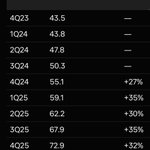
It's kinda wild that Uber One membership is growing 50% YOY.
For city dwellers the value proposition must slap them on the face for this kind of growth to be true.
$UBER – at Coppell, TX
