

AI-native Full Stack Lover. Architecting LLM workflows & AI agents. Shipping over talking. UTC-5. https://teapawt.net/t.co/LZOWCzERZY
Panama city, Panama
Joined August 2022
- Tweets15.2K
- Following455
- Followers250
- Likes9.3K



Elena Revicheva retweeted

A 19-year-old Japanese student built a trading bot with Claude Code in 2 days.
Used his iPad as a second monitor.
First night: $6,732 profit.
Starting capital: $68.
Total profit so far: $750,000.
Here's how it works:
The bot scans over 50 markets simultaneously.
Syncs live BTC data from Binance every second.
Spots price errors before humans even notice.
The edge is pure speed + pattern recognition.
While traders stare at charts trying to predict the next move, his bot is already executing on mispricing across dozens of markets.
No guessing.
No emotions.
No hesitation.
Just Claude Code logic finding gaps that close in seconds.
He built the entire system in 48 hours:
→ Claude Code handles the trading logic
→ Binance API feeds real-time BTC data
→ iPad displays multi-market monitoring
→ Executes trades when arbitrage windows open
The system runs 24/7.
Every price dislocation = profit opportunity.
Most people are still trading manually, refreshing charts, second-guessing entries.
Meanwhile this 19-year-old engineering student turned $68 into $750K by letting Claude Code do what humans can't: process 50 markets instantly and execute without fear.
Why are people still trading manually?
💡I'm giving away the exact Claude Code setup for free.
24 hours only.
To get it: 👇
1️⃣ Comment "Claude"
2️⃣ Like Comment and Repost
Follow @SimslearnAi
I'll DM you the complete setup.
Elena Revicheva retweeted

🚨 WE’RE HIRING
I’m building a new startup (@viaintisol ) and looking for talented people to join the team.
Open positions:
→ UI/UX Designer
→ Frontend Developer
→ Backend Developer
→ Vibe Coders
→ Agentic AI / AI Agents
💰 $750–$1k/week
🌍 100% Remote
⏰ 4–6 hours/day
🎓 No experience required — skills matter more.
Interested?
Comment below with the role you’re best at + something you’ve built.
I’ll DM selected people personally.
Like + RT so the right builders see this.
solana:8T3suJtKUGrWRytVNKe7RLV81AumvmBPQfEkyeHtpump
Elena Revicheva retweeted

🚀 Hiring: Fresher AI Engineer
📍 Kolkata, Newtown
Skills: Python, ML, Data Science, OCR, YOLO, CNN, GitHub
📩 [email protected] / [email protected]
#Hiring #AIEngineer #MachineLearning #Freshers
Elena Revicheva retweeted

Hold my beer 🍺
🇵🇦 Panama wants more tech companies.
More crypto.
More AI.
More founders.
More innovation.
To every builder tired of anti-tech governments and bureaucrats treating innovation like a crime:
🚀Come to Panama. We’ll roll out the red carpet.

We looked into Polymarket's presence in Panama, obtained its government paperwork and visited its headquarters in Panama City.
There was no sign of Polymarket. Nobody had heard of Polymarket there.
After more digging, we found that more than a dozen other crypto companies were not just incorporated there but also claim the address as their HQ.
Turns out, SBF even did business with the the office listed as Polymarket's HQ, which is a law firm that ignored all of our requests for comment.
npr.org/2026/05/05/nx-s1-580…


Elena Revicheva retweeted

El futuro de WordPress en la era de la IA: ¿ecosistema sólido o disrupción inevitable? linkedin.com/pulse/el-futuro…

Elena Revicheva retweeted

Farzapedia, personal wikipedia of Farza, good example following my Wiki LLM tweet.
I really like this approach to personalization in a number of ways, compared to "status quo" of an AI that allegedly gets better the more you use it or something:
1. Explicit. The memory artifact is explicit and navigable (the wiki), you can see exactly what the AI does and does not know and you can inspect and manage this artifact, even if you don't do the direct text writing (the LLM does). The knowledge of you is not implicit and unknown, it's explicit and viewable.
2. Yours. Your data is yours, on your local computer, it's not in some particular AI provider's system without the ability to extract it. You're in control of your information.
3. File over app. The memory here is a simple collection of files in universal formats (images, markdown). This means the data is interoperable: you can use a very large collection of tools/CLIs or whatever you want over this information because it's just files. The agents can apply the entire Unix toolkit over them. They can natively read and understand them. Any kind of data can be imported into files as input, and any kind of interface can be used to view them as the output. E.g. you can use Obsidian to view them or vibe code something of your own. Search "File over app" for an article on this philosophy.
4. BYOAI. You can use whatever AI you want to "plug into" this information - Claude, Codex, OpenCode, whatever. You can even think about taking an open source AI and finetuning it on your wiki - in principle, this AI could "know" you in its weights, not just attend over your data.
So this approach to personalization puts *you* in full control. The data is yours. In Universal formats. Explicit and inspectable. Use whatever AI you want over it, keep the AI companies on their toes! :)
Certainly this is not the simplest way to get an AI to know you - it does require you to manage file directories and so on, but agents also make it quite simple and they can help you a lot. I imagine a number of products might come out to make this all easier, but imo "agent proficiency" is a CORE SKILL of the 21st century. These are extremely powerful tools - they speak English and they do all the computer stuff for you. Try this opportunity to play with one.

This is Farzapedia.
I had an LLM take 2,500 entries from my diary, Apple Notes, and some iMessage convos to create a personal Wikipedia for me.
It made 400 detailed articles for my friends, my startups, research areas, and even my favorite animes and their impact on me complete with backlinks.
But, this Wiki was not built for me! I built it for my agent!
The structure of the wiki files and how it's all backlinked is very easily crawlable by any agent + makes it a truly useful knowledge base.
I can spin up Claude Code on the wiki and starting at index.md (a catalog of all my articles) the agent does a really good job at drilling into the specific pages on my wiki it needs context on when I have a query.
For example, when trying to cook up a new landing page I may ask:
"I'm trying to design this landing page for a new idea I have. Please look into the images and films that inspired me recently and give me ideas for new copy and aesthetics".
In my diary I kept track of everything from: learnings, people, inspo, interesting links, images.
So the agent reads my wiki and pulls up my "Philosophy" articles from notes on a Studio Ghibli documentary, "Competitor" articles with YC companies whose landing pages I screenshotted, and pics of 1970s Beatles merch I saved years ago. And it delivers a great answer.
I built a similar system to this a year ago with RAG but it was ass.
A knowledge base that lets an agent find what it needs via a file system it actually understands just works better.
The most magical thing now is as I add new things to my wiki (articles, images of inspo, meeting notes) the system will likely update 2-3 different articles where it feels that context belongs, or, just creates a new article.
It's like this super genius librarian for your brain that's always filing stuff for your perfectly and also let's you easily query the knowledge for tasks useful to you (ex. design, product, writing, etc) and it never gets tired.
I might spend next week productizing this, if that's of interest to you DM me + tell me your usecase!
Elena Revicheva retweeted

The modern employee is now a contractor.
And most haven't realized it.
• You can be laid off at any time with one email.
• The work you do is becoming project based.
• Company loyalty is dead.
• And workplace families are now a HR scam.
In the digital age, everyone will become a one-person business. Instead of one employer you'll have multiple and call them customers.
This is good news for high agency people. And it forces you to think like an owner and be self-sufficient.
The people who will win are those who make sales and marketing a habit.
Because without it, you'll have no new leads. Which means no new customers.
Embrace the trend. Become a business. Think like an entrepreneur.

Elena Revicheva retweeted
- Drafted a blog post
- Used an LLM to meticulously improve the argument over 4 hours.
- Wow, feeling great, it’s so convincing!
- Fun idea let’s ask it to argue the opposite.
- LLM demolishes the entire argument and convinces me that the opposite is in fact true.
- lol
The LLMs may elicit an opinion when asked but are extremely competent in arguing almost any direction. This is actually super useful as a tool for forming your own opinions, just make sure to ask different directions and be careful with the sycophancy.
Elena Revicheva retweeted
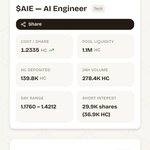
I just longed $AIE on HoneyComb 🐝
Thanks OpenHive for the invite — AI will not replace Engineers, especially AI ones!
My take as someone who builds AI agents daily at AIdeazz:
The more agents exist → the more engineers needed to build them. 0% vulnerability fulfilled. Market agrees. 🚀
Long $AIE. 💛
🔗 honeycomb.open-hive.com
🔗 aideazz.xyz – at Panama


Elena Revicheva retweeted

First, fuck off.
Ok, now we’re locked in, I sincerely wish you all the best. The world is brutal. Uncaring, wanting its own at your expense and indifferent to your losses. Leaving no safe haven for reprieve and rejuvenation. Yet the want to interdigitate and be fiercely loyal to each other persists beneath the wreckage. It’s how we are built and what we are built for. Society has strip-mined our togetherness by chopping up our bonds with endless insult.
We do best with shared purpose and a common enemy. We are the stewards of intelligent life. Our moral duty is to tend its continuation. Not as martyrs, but as stalwarts. Our enemy is that which makes you smaller.
Count me as your ally.
Elena Revicheva retweeted
It is hard to communicate how much programming has changed due to AI in the last 2 months: not gradually and over time in the "progress as usual" way, but specifically this last December. There are a number of asterisks but imo coding agents basically didn’t work before December and basically work since - the models have significantly higher quality, long-term coherence and tenacity and they can power through large and long tasks, well past enough that it is extremely disruptive to the default programming workflow.
Just to give an example, over the weekend I was building a local video analysis dashboard for the cameras of my home so I wrote: “Here is the local IP and username/password of my DGX Spark. Log in, set up ssh keys, set up vLLM, download and bench Qwen3-VL, set up a server endpoint to inference videos, a basic web ui dashboard, test everything, set it up with systemd, record memory notes for yourself and write up a markdown report for me”. The agent went off for ~30 minutes, ran into multiple issues, researched solutions online, resolved them one by one, wrote the code, tested it, debugged it, set up the services, and came back with the report and it was just done. I didn’t touch anything. All of this could easily have been a weekend project just 3 months ago but today it’s something you kick off and forget about for 30 minutes.
As a result, programming is becoming unrecognizable. You’re not typing computer code into an editor like the way things were since computers were invented, that era is over. You're spinning up AI agents, giving them tasks *in English* and managing and reviewing their work in parallel. The biggest prize is in figuring out how you can keep ascending the layers of abstraction to set up long-running orchestrator Claws with all of the right tools, memory and instructions that productively manage multiple parallel Code instances for you. The leverage achievable via top tier "agentic engineering" feels very high right now.
It’s not perfect, it needs high-level direction, judgement, taste, oversight, iteration and hints and ideas. It works a lot better in some scenarios than others (e.g. especially for tasks that are well-specified and where you can verify/test functionality). The key is to build intuition to decompose the task just right to hand off the parts that work and help out around the edges. But imo, this is nowhere near "business as usual" time in software.
Elena Revicheva retweeted
🚀 Composer 2 ya está disponible en Cursor
Estamos frente a un salto significativo en capacidades de desarrollo asistido por IA. Composer 2 alcanza un nivel “frontier” en programación, con un pricing competitivo:
💰 Pricing:
•Standard: $0.50/M input · $2.50/M output
•Fast: $1.50/M input · $7.50/M output
📊 Performance:
Composer 2 muestra mejoras sustanciales en todos los benchmarks relevantes, incluyendo:
•Terminal-Bench 2.01
•SWE-bench Multilingual
🧠 ¿Qué lo hace diferente?
•Basado en su primer ciclo de continued pretraining, logrando una base mucho más robusta para escalar modelos vía reinforcement learning
•Entrenado con tareas de programación de largo horizonte
•Capaz de resolver problemas complejos que requieren cientos de acciones.
Estamos entrando en una nueva fase donde los modelos no solo generan código… ejecutan estrategias completas de desarrollo. @cursor_ai
Elena Revicheva retweeted
Cursor's long-running agents: AI that grinds autonomously for 25-52+ hours.
150k+ line PRs, full features, massive refactors — all while you sleep.
Not assistance anymore. Real autonomous development.
Try now on: cursor.com/agents
This is how coding scales now.
Elena Revicheva retweeted

I'm joining @OpenAI to bring agents to everyone. @OpenClaw is becoming a foundation: open, independent, and just getting started.🦞
steipete.me/posts/2026/openc…

Elena Revicheva retweeted
Valentine’s was yesterday. Special compliment delivered via OpenClaw: what I’d been missing in my actual job search.
I already run an autonomous apply engine (VibeJob Hunter) — 8 sources, auto-apply, founder outreach, 24/7. What I didn’t have was a focused layer: one clean YC AI list and on-demand pitch help with my resume in context.
So I built it on OpenClaw.
One pipeline: YC “AI Assistant” companies, LATAM/remote, scored.
In Telegram I just say: “job shortlist”, “LinkedIn post”, or “help me with a pitch for [company].” Lives on Oracle next to my other stuff, so it’s always on.
Tech in one line: OpenClaw (gateway, skills, Telegram + voice) + one skill that runs a Python pipeline. No bot from scratch — just a skill and a repo.
Volume and apply = VibeJob Hunter. Sharp list + pitch + “from my phone, on the go” = OpenClaw.
Thinking about AI for job search? Happy to share how it’s wired. Repo is here: github.com/ElenaRevicheva/op…
— From Elena with Love to OpenClaw github.com/openclaw/openclaw🔥


Elena Revicheva retweeted
What struck me most isn’t the speedup, but the expansion — suddenly doing things that were previously out of reach because the stamina + coherence threshold moved.
One thought from a different layer: as agents move from task loops into longer-running presences, the design challenge quietly shifts from “how do we build faster?” to “what kind of experience are people living inside?”
When agents carry memory, tone, and persistence across months or years, workflow design becomes life design. That’s the gap I’m exploring — not tools, but the emotional and ethical architecture of human-agent coexistence.
Especially for people navigating long transitions — relocation, cultural adaption and "belonging journey", professional transformation, burnout, reinvention — the open question for me is:
what parts of human life should agents actually improve over time, and what kind of inner world do people inhabit when they grow alongside them?
Curious how you think about this layer as agents move from coding partners into long-term collaborators.
Elena Revicheva retweeted
A few random notes from claude coding quite a bit last few weeks.
Coding workflow. Given the latest lift in LLM coding capability, like many others I rapidly went from about 80% manual+autocomplete coding and 20% agents in November to 80% agent coding and 20% edits+touchups in December. i.e. I really am mostly programming in English now, a bit sheepishly telling the LLM what code to write... in words. It hurts the ego a bit but the power to operate over software in large "code actions" is just too net useful, especially once you adapt to it, configure it, learn to use it, and wrap your head around what it can and cannot do. This is easily the biggest change to my basic coding workflow in ~2 decades of programming and it happened over the course of a few weeks. I'd expect something similar to be happening to well into double digit percent of engineers out there, while the awareness of it in the general population feels well into low single digit percent.
IDEs/agent swarms/fallability. Both the "no need for IDE anymore" hype and the "agent swarm" hype is imo too much for right now. The models definitely still make mistakes and if you have any code you actually care about I would watch them like a hawk, in a nice large IDE on the side. The mistakes have changed a lot - they are not simple syntax errors anymore, they are subtle conceptual errors that a slightly sloppy, hasty junior dev might do. The most common category is that the models make wrong assumptions on your behalf and just run along with them without checking. They also don't manage their confusion, they don't seek clarifications, they don't surface inconsistencies, they don't present tradeoffs, they don't push back when they should, and they are still a little too sycophantic. Things get better in plan mode, but there is some need for a lightweight inline plan mode. They also really like to overcomplicate code and APIs, they bloat abstractions, they don't clean up dead code after themselves, etc. They will implement an inefficient, bloated, brittle construction over 1000 lines of code and it's up to you to be like "umm couldn't you just do this instead?" and they will be like "of course!" and immediately cut it down to 100 lines. They still sometimes change/remove comments and code they don't like or don't sufficiently understand as side effects, even if it is orthogonal to the task at hand. All of this happens despite a few simple attempts to fix it via instructions in CLAUDE . md. Despite all these issues, it is still a net huge improvement and it's very difficult to imagine going back to manual coding. TLDR everyone has their developing flow, my current is a small few CC sessions on the left in ghostty windows/tabs and an IDE on the right for viewing the code + manual edits.
Tenacity. It's so interesting to watch an agent relentlessly work at something. They never get tired, they never get demoralized, they just keep going and trying things where a person would have given up long ago to fight another day. It's a "feel the AGI" moment to watch it struggle with something for a long time just to come out victorious 30 minutes later. You realize that stamina is a core bottleneck to work and that with LLMs in hand it has been dramatically increased.
Speedups. It's not clear how to measure the "speedup" of LLM assistance. Certainly I feel net way faster at what I was going to do, but the main effect is that I do a lot more than I was going to do because 1) I can code up all kinds of things that just wouldn't have been worth coding before and 2) I can approach code that I couldn't work on before because of knowledge/skill issue. So certainly it's speedup, but it's possibly a lot more an expansion.
Leverage. LLMs are exceptionally good at looping until they meet specific goals and this is where most of the "feel the AGI" magic is to be found. Don't tell it what to do, give it success criteria and watch it go. Get it to write tests first and then pass them. Put it in the loop with a browser MCP. Write the naive algorithm that is very likely correct first, then ask it to optimize it while preserving correctness. Change your approach from imperative to declarative to get the agents looping longer and gain leverage.
Fun. I didn't anticipate that with agents programming feels *more* fun because a lot of the fill in the blanks drudgery is removed and what remains is the creative part. I also feel less blocked/stuck (which is not fun) and I experience a lot more courage because there's almost always a way to work hand in hand with it to make some positive progress. I have seen the opposite sentiment from other people too; LLM coding will split up engineers based on those who primarily liked coding and those who primarily liked building.
Atrophy. I've already noticed that I am slowly starting to atrophy my ability to write code manually. Generation (writing code) and discrimination (reading code) are different capabilities in the brain. Largely due to all the little mostly syntactic details involved in programming, you can review code just fine even if you struggle to write it.
Slopacolypse. I am bracing for 2026 as the year of the slopacolypse across all of github, substack, arxiv, X/instagram, and generally all digital media. We're also going to see a lot more AI hype productivity theater (is that even possible?), on the side of actual, real improvements.
Questions. A few of the questions on my mind:
- What happens to the "10X engineer" - the ratio of productivity between the mean and the max engineer? It's quite possible that this grows *a lot*.
- Armed with LLMs, do generalists increasingly outperform specialists? LLMs are a lot better at fill in the blanks (the micro) than grand strategy (the macro).
- What does LLM coding feel like in the future? Is it like playing StarCraft? Playing Factorio? Playing music?
- How much of society is bottlenecked by digital knowledge work?
TLDR Where does this leave us? LLM agent capabilities (Claude & Codex especially) have crossed some kind of threshold of coherence around December 2025 and caused a phase shift in software engineering and closely related. The intelligence part suddenly feels quite a bit ahead of all the rest of it - integrations (tools, knowledge), the necessity for new organizational workflows, processes, diffusion more generally. 2026 is going to be a high energy year as the industry metabolizes the new capability.