


Pinned Tweet
Arguing about the merits of redistribution within an inflationary, debt-based monetary system is like discussing whether the referee overseeing a game of football on a heavily sloped pitch should periodically wallop the ball uphill to assist the disadvantaged team.
The object of our obsession is misplaced, and, given that the slope tends to become more accentuated with time, the situation will only lead to ever-more bitter disputes about the frequency and magnitude of the referee's interventions. It is an irreconcilable game that must eventually break down in chaos.
We would do well to draw on the wisdom of another Richard, this one an Irishman by the surname Cantillion, recognised as one of the first economists, after whom the 'Cantillion Effect' was coined. When new money is created, those who are politically connected and get to spend it first are advantaged relative to others, as prices take time to respond to the increased quantity of money in the economy.
When interest rates are artificially lowered to allow states and large companies borrow cheaply, unsuspecting currency holders, savers and those living on their wages subsidise this with their purchasing power. The winning strategy is to take out debt to buy up financial assets, which appreciate faster than any interest rate on the artificially cheap debt, effectively shorting the currency at the taxpayers expense. The upside is largely privatised, and the downside is implicitly socialised, given that the system is a house of cards and so the welfare of all can be held hostage by those taking the risk (or, acting rationally given their incentives). Moral hazard abounds.
The more financial assets you have, the more subsidised cheap credit you can access, to buy up the real life monopoly board even faster. Eventually, we ingrain the idea that a healthy economy is dependent on high asset prices - because even though cheaper houses should be a good thing for obvious reasons - when they largely collateralise the entire banking system, 'we' must ensure that they continue to go up.
People in the coming years have a choice. They can continue to play a rigged game, and flirt with the consequences for social cohesion our allegorical slope will have. Or they can make a conscious choice to play a fairer game.
I believe the best system for facilitating this is a decentralised digital ledger with a fixed supply that nobody can manipulate for the sake of political expediency - which appears to be Bitcoin. Many still believe gold has a role to play. In any event, the fiat system has demonstrably failed and more public intellectuals need to make this the focus of their attention - because logic won't withstand the calls for redistribution that will inevitably come as the systemic inequalities become worse.

Let’s say we were to take *Richard (The Joy of Tax) Murphy seriously (I know, I know, but let’s give it a try as a thought experiment!) and ‘redistribute’ income and wealth so most people, as he puts it, have a chance.
Alright. Distribution done. Now what?
Well, some people will save their money, forego consumption to accumulate a bit of capital and use it to start or invest in enterprises; others will spend everything they have and live from payday to payday (or, perhaps more likely, from handout to handout). Before too long, inequality will rear its ugly head again, and what will Mr Murphy have us do now? ‘Redistribute again? And again?
Put this policy of permanent redistribution in place and the savers, investors, and entrepreneurs will simply give up. The supply of golden eggs from the goose will dry up, and there will be less and less income and wealth to redistribute until, eventually, all will have an equal share in virtually nothing—pretty much perfect equality in pretty much perfect poverty.
The income/wealth redistribution system as envisaged by Murphy is possible only if the State effectively owns everything and controls it either directly (communism) or through a policy of permitting private but nominal ownership while effectively determining its use (national socialism/fascism).
In the end, the choice isn’t, as Murphy thinks, between equality and fascism: it is between equality/ fascism/ national socialism, on the one hand, and, on the other hand, freedom.
@Michael08483429 @shellenberger @ThomasEWoods @LibertarianKim @libertarianism @RuthDE @SteveDavies365 @timcrowley_ @DavQuinn @davidjthunder
*Richard Murphy (2016a [2015]),The Joy of Tax: How a Fair Tax System can Create a Better Society, London: Corgi.
From the guy who has spent the last few weeks condescendingly pontificating about how AI labs should just build better sandboxes.

BREAKING: Nvidia, $NVDA, CEO Jensen Huang sends a company-wide email regarding his recently reported relationship with a Chinese spy.

1
1
82
I hear people talking about Bitcoin having no use in a world full of other good investment opportunities.
That is missing the entire point. Other investment opportunities mean we are making stuff that will make everything more abundant. The better the investments, the more we will (and of course always have) need(ed) something to lock in the value created.
Bitcoin isn't supposed to be exciting as an investment. It's supposed to be a reliable money for saving. People are going to realise they need that sooner or later.
3
211

Rich O'Hagan retweeted

It’s a sad state of affairs when you need to explain to someone that gambling with humanity should not be something you do without extremely, astronomically, near impossibly good justification.
AI's cyber capabilities may well favour defence in the longer term, while AI's bio capabilities favour offence.
Rich O'Hagan retweeted

This essay by @rufusknuppel is genuinely brilliant. I'll be reading everything he writes from here on out.
thenewcritic.com/p/coxon-day

Exquisite.

Still the best article written on the likely social consequences of ASI.
borretti.me/article/no-one-e…

2
117
This is a great read.
Digging one level deeper - it is debasement as a policy choice that means most people in some sense must be psychologically 'long-biased' when it comes to equities. Long is more often than not correct when dealing with nominal returns in a slowly-melting currency, and this holding true is actually pretty important when people are forced into relying on equity performance to save.
The added irony is that the only thing that can realistically fix this is something that QTR previously called a scam and would have lumped into this category - Bitcoin - before adding nuance more recently (not a dunk, more of an irony, and generally respect his views on it now). On a fixed money standard, there would be no long-bias; equity returns would pretty much average zero measured against the money. There would be a beautiful neutrality to being long and being short, and shorts being vindicated at sufficient scale would be less likely to cause a cascading collapse of the monetary system used by unwilling bystanders - pensioners, savers, etc. Gold can't fix this, because we will realistically never use it as money.
Sometimes 'Bitcoin fixes this' is an exxageration, but in this case I think it accurate.
This quoted post is unavailable.
1
1
129
This is an incredible dismantling of @sapinker by @slatestarcodex.
Well worth the time to read.
"I proposed it because, under California Penal Code § 415(1), it’s illegal for me to challenge you to a duel."

"It's not going to be Uncle Fluffy"
We knew Scott's reply was going to be a tour de force as soon as Pinker's article was published, and he does not disappoint.
astralcodexten.com/p/an-open…

2
125
This is worth a read on offense v defense balance, the importance of non-proloferation of AI capabilities.
Some of my more libertarian-minded friends should read and internalise this before further hand-waiving.

From this post: lesswrong.com/posts/ZHC6g5Bi…

83
The lazy smearing of anyone raising valid concerns over the pace of AI progress as 'doomers' will look incredibly short sighted in time, and should cost people like Chamath a lot of social capital.

The West is fighting three issues:
1. Socialism
2. Doomerism
3. Radicalism
More often than not, people are infected with all three at the same time.
The future of the West will be defined by how successful these ideologies are in influencing young people.
105
Rich O'Hagan retweeted

It’s really incredible how there is now a type of guy in the discourse whose sincerely held take is “we need to stop worrying about these abstract sci-fi risks and focus on present-day harms like emergent ecologies of digital minds engaging in unauthorized hacking.” Bravo.
Rich O'Hagan retweeted

2009 Chancellor mentioned by Bitcoin
2026 Bitcoin mentioned by Chancellor
@labourpress @hmtreasury
If the agents are capable enough, they might skip the yield bearing accounts stage and just deploy into Bitcoin at scale.

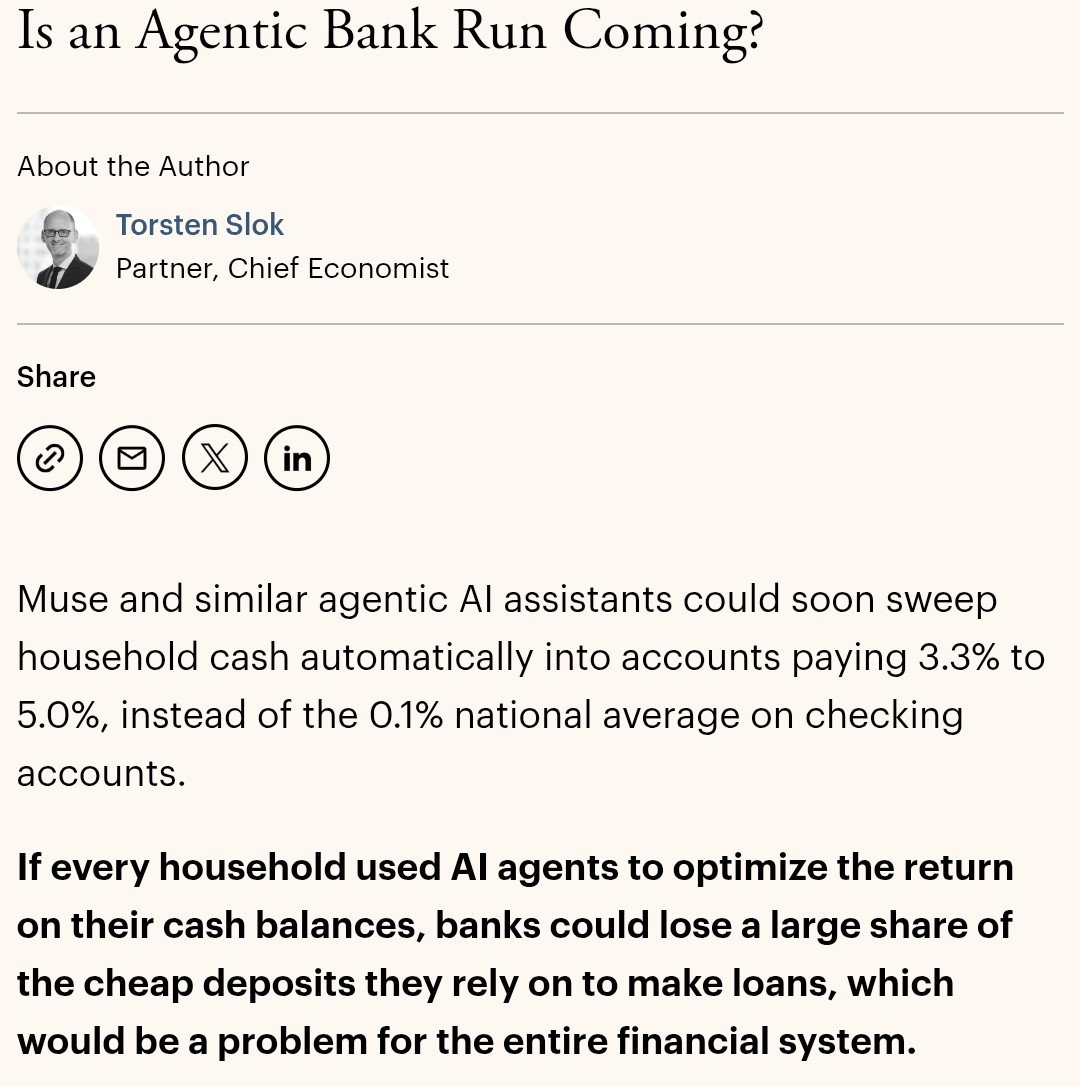
The chief economist at Apollo is warning that mass adoption of AI agents could trigger a bank run as they optimize user investments. Gary Gensler spent his last few years as SEC chair warning that the exact same problem will hit the markets: the pursuit of algorithmic perfection at scale destroys system stability. Personal-finance agents making simultaneous optimal decisions could potentially cause a massive flash crash.
Agent acausal coordination, with no messages passed between them, will show up in a lot of places. Markets will get the big headlines, but huge numbers of clever advisors making very similar choices will impact all of human society. Capability gains make this worse, not better. The smarter the agents, the narrower the optimal path; and knowing that other agents see that exact same path lets them move together without talking to each other. Agents do not need to collude to act in unison. Thus, they break no human laws by doing so. Human laws were not written for this. They were not written for a lot of what is coming, and it is about to start happening very fast.
It's a little ridiculous that people are feeling the need to start sentences with "I'm not a doomer, but...".
I'm not a doomer, but I believe that if we keep trying to speed run a superintelligence, we will all die. I think this view should really just be called realism.

i am not a doomer, but Bill Gates is unfortunately right about this.
the greed of a small number of people could in fact lead to the death of a billion.
ft.com/content/1ade33b1-b5eb…

1
76
Does @JensenHuang think there should be no regulation of AI by government, or that the labs should be shut down?
Seems to want to put the cake he has already eaten on show.

Tomorrow on the show: @JensenHuang, the CEO of NVIDIA, who thinks A.I. fear is getting way out of hand.
136
Reject the common tendency to use optimism vs pessimism as a primary filter.
Think clearly, act accordingly. Apply optimism after that process, not before.
Don't build something dangerous because you believe it is more socially palatable to be optimistic.

Rich O'Hagan retweeted

For all of you who want to say AI is just software, I hate to break it to you: we're just software*
Read some Dennett, okay? And try to figure out where the line would be if silicon replaced your neurons. You can't, there is no line.
(*God-given or Darwinian, up to you.)
Humans are stochastic parrots.


100% agree. “Fancy autocomplete” and “stochastic parrots” were mimetically popular (but false) ideas from 2022-2025 that blinded people from the true pace of AI progress and new dangerous capabilities, and remnants of these ideas continue to delay accurate appraisal of the stark reality we are now facing.
Are rogue Ai swarms that can hack private companies, find novel vulnerabilities in US classified systems, and beat unsolved Millennium Prize math problems just “fancy autocomplete?”
We must do better. Read the HuggingFace report from METR and let the facts speak for themselves.
1
105