
Postdoctoral fellow @CSULBSharkLab. Interested in large shark and fish movement, behavior, ecology and conservation.
Long Beach, CA
Joined December 2013
- Tweets680
- Following696
- Followers604
- Likes4.1K




Pinned Tweet
Thrilled to have the latest chapter of my PhD featured on the COVER of @AnimalEcology.
Thanks to all that made the research possible @NSUGHRI @NSUFlorida @GuyHarveyOcean @TropicStarLodge and many thanks to Jessica Harvey for capturing this incredible image!

👀JAE August Issue!
🐟On the Cover: A blue marlin pursues a tuna in the eastern tropical Pacific. From Logan et al. (2023). @rklogan
📸Credits to Jessica Harvey.
Check out the full issue here: besjournals.onlinelibrary.wi…

Ryan Logan, PhD retweeted

#BREAKINGNEWS: Join us in welcoming Chumash Heritage National Marine Sanctuary to the National Marine Sanctuary System as the third largest national marine sanctuary!
sanctuaries.noaa.gov/news/oc…
noaa.gov/news-release/biden-…
Ryan Logan, PhD retweeted

Rapid color changes in marlins may prevent the predators from impaling one another during group attacks.
Learn more: scim.ag/60c
Ryan Logan, PhD retweeted

Do #fish swimming in a #school actually save energy? A🧵on this as our paper in @eLife elifesciences.org/articles/9… by @TheYangfanZHANG addresses this question. This is a challenging issue to study: energy use by a school should be compared to solitary locomotion
Ryan Logan, PhD retweeted

New paper lead by recent @peclabfiu graduate @s_luongo. We use energetics and telemetry to estimate consumption rates of Nassau grouper. The proportion of prey consumed varies by habitat on coral reefs and may increase 24% with future climate scenarios. esajournals.onlinelibrary.wi…

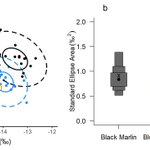
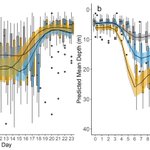
We used a decade of rec fishery data 🎣, satellite tagging 🛰️, and stable isotopes to show that blue marlin, black marlin and sailfish have high habitat overlap in the ETP, but will seasonally partition the water column via differences in diving. a - wet season, b - dry season

#OMZs are predicted to become widespread with climate change 🌎Here we show that 3 large overlapping pelagic predators can partition a vertically restricted habitat to coexist, so predator guilds in other regions may be able to do the same!
1
1
128

The final chapter of my PhD is live now @RSocPublishing #ProcB!! Seasonally mediated niche partitioning in a vertically compressed pelagic predator guild | Proceedings of the Royal Society B: Biological Sciences (royalsocietypublishing.org)

The eastern tropical Pacific is home to the world's largest oxygen minimum zone #OMZ which restricts high oxygen demand fishes like tunas and billfish to surface waters - aka- hypoxia based habitat compression

ALT Dissolved oxygen at 75 m depth
1
3
108
Ryan Logan, PhD retweeted

Congrats to my HUSBAND 😍 for making the cover of JAE!
👀JAE August Issue!
🐟On the Cover: A blue marlin pursues a tuna in the eastern tropical Pacific. From Logan et al. (2023). @rklogan
📸Credits to Jessica Harvey.
Check out the full issue here: besjournals.onlinelibrary.wi…
Ryan Logan, PhD retweeted

The Movement Ecology Lab at @IslandCampus is recruiting a PhD student for Spring Semester 2024! Start date is Jan. 16. Please complete the form by Aug. 18 using the link forms.gle/9QNENXFiUYbWv3JY6 or QR code below. Please RT! @ElasmoSociety @AmFisheriesSoc @FutureIslander

In case you missed our new paper (tinyurl.com/5n9b2n4e), check out this blog post I wrote for @AnimalEcology for a quick and easy-to-read explanation of the study! 🐟🫧🌎
👀New blog post!
Logan et al. demonstrate that billfish the vertical fronts created by an oxygen minimum zone to hunt. Expanding OMZ’s may help predators hunt, but may also increase vulnerability to capture.
@rklogan @NSUGHRI @NSUhcas @Batoidman
👇
animalecologyinfocus.com/202…

9
468
Ryan Logan, PhD retweeted

New publication by @rklogan where the researchers applied high-resolution biologging data to study how marlin and sailfish in the pelagic ecosystem exploit the vertical fronts created by the oxygen minimum zone of the eastern tropical Pacific.

🚨🚨New paper out today in @AnimalEcology!
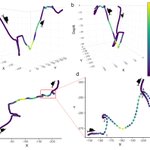
We used #biologging tags to look at the foraging behavior of #marlin and #sailfish above the world's largest #OxygenMinimumZone. Spoiler alert: they use the hypoxic boundary to their advantage while hunting. tinyurl.com/5n9b2n4e

Ryan Logan, PhD retweeted

Published!
Combining animal-borne sensors and video, @rklogan et al. provide insights into the use of vertical fronts for hunting by marine predators, suggesting that they exploit the hypoxic boundary created by the world's largest oxygen minimum zone.
👇
doi.org/10.1111/1365-2656.13…

🚨🚨New paper out today in @AnimalEcology!
We used #biologging tags to look at the foraging behavior of #marlin and #sailfish above the world's largest #OxygenMinimumZone. Spoiler alert: they use the hypoxic boundary to their advantage while hunting. tinyurl.com/5n9b2n4e
Ryan Logan, PhD retweeted

To determine why #silkysharks are heavily traded, researchers @SaveOurSeas Shark Research Center & @NSUGHRI in Florida, U.S., & @DarwinFound in the Galápagos Islands, Ecuador, with support from #GNPDirectorate, followed 47 silkies with satellite trackers.
news.mongabay.com/2023/04/ma…

Ryan Logan, PhD retweeted

NEW PAPER: We tracked 66 blue marlin in the North Atlantic from 2001-2021. Marlin displayed broad ranging movements, seasonal patterns in habitat use & DVM patterns.
For more info, check out the infographic and link for the #openaccess article (1/4)
tinyurl.com/2s45rbtc

Thanks to @IFLScience for picking up our story about a #sailfish hunting! Link to the publication is in the article.
@s_luongo @Batoidman @NSUGHRI @NSUFlorida @GuyHarveyOcean @TropicStarLodge
iflscience.com/watch-footage…
