
Career Paramedic and Senior Ambulance Manager (Ret.). Strategic, design and systems thinker schooled by EMS industry High Performance thought leaders.
Joined August 2021
- Tweets5.9K
- Following1.1K
- Followers303
- Likes2.5K




Pinned Tweet
Of the nine-million patients seeking help from the ambulance service last year, five-million were transported to hospital. Yet only 10% of those seeking help have a life-threatening health need, indicating the vast majority might be better served outside of hospital and nearer to home, cutting costs and improving patients’ quality of life.
As ambulance services strive to do their part in assessing, treating and referring patients outside of acute care settings, the time crews spend engaged on each task has increased from one to one and three-quarter hours. This increased "pace-of-care" strains resources, leaving fewer crews available and forcing patients to wait longer for help to arrive.
Queueing theory tells us that if, at the time of the patients call, the nearest resource is not busy then the patient is served immediately. As more resources become busy fewer patients will be served immediately and more will have to wait. When crew utilisation reaches 50% sometimes the newly arriving call finds a crew available, sometimes there are several calls already waiting, but the effect is to double average response times compared to there always being a crew available to respond. As utilisation goes beyond 70% fewer resources are available to respond and response times double again. The opposite is also true. Reducing crew utilisation will improve response times.
Restoring the pace-of-care to an hour (its historical norm) and ensuring crew utilisation does not exceed 50% (guaranteeing mandated response times) requires only two-thirds of the current 30,000-strong workforce.
Reassigning 10,000 experienced paramedics from emergency duties to an urgent/unscheduled care service, paired with an efficient emergency ambulance system, could double out-of-hospital care (25% Hear & Treat, 50% See & Treat), halving hospital transports (25% See & Convey) without the need for additional investment.
Decentralising ambulance services helps to ensure that those who are close enough to care are the ones empowered to make decisions. A national ambulance service could manage the delivery of each of the, 140 or-so, Medical Trade Economy Ambulance Systems (MedTeams), configured around the needs of local communities in England, with a single Board.
Improving emergency ambulance service productivity and efficiency will increase crew availability, improve response times, patient outcomes, recruitment & retention, crew rest breaks and shifts ended on-time while reducing staff sickness, stress & anxiety. Two-and-a-half million patients will no longer be transported to A&E, saving £0.5bn. The reliable responsiveness of the MedTeams system will significantly reduce the clinical risk of managing patients closer to home.
The ambulance service has the resources and financial capacity to transform urgent and emergency care. Within a few years, a national service for England could emerge, responsive to local communities, integrated with the medical trade economies around acute hospitals, and only-ever minutes away.
@ShaunLintern @AliJaneMoore @AACE_org @AnnaParry12
3
1,433
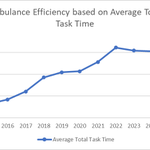
In 2015 the average task time was one hour and ten minutes, near to its historical norm. In 2024 it was one hour and forty-five minutes; reducing efficiency by 50%. The pace of clinical care has doubled.

1
1
110

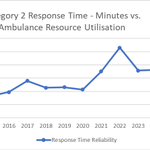
Did you know that the % of ambulance shifts spent engaged on task is a near perfect predictor (99.71%) of response time reliability. In 2025 crews have been busy for 63% of their shifts. To achieve response times that needs to reduce to 57%. @AACE_org @jasonkillens @AliJaneMoore @ShaunLintern @thelucyjohnston

1
506
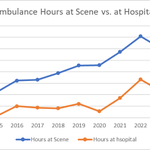
If ambulance delays are due to hospital handover delays then why does the ambulance service with the best national response times have the worst hospital delays, the ambulance service with the worst response times has the lowest conveyance rates to hospital, and the ambulance service with the best hospital turnaround cannot meet response times? @AACE_org
1
2
198

England’s ambulance services face a crisis of efficiency, and have all the resource they need to transform pre-hospital emergency and urgent care, restore reliable response times and halve the number of patients transported to Emergency Departments, within a single parliament
1
1
337
% resources utilised vs Category 2 response time for all services 2018-2024. Target utilisation to meet C2M 18 mins <> 63% (LAS) - 54% (YAS). @AACE_org @ShaunLintern @AliJaneMoore @sib313 @jasonkillens @NeillMoloney @simonweldonceo

@AliJaneMoore Response times are not wind dependent but on how busy crews are (utilisation) which can be reduced by more resources, less demand (> H&T, S&T) and/or quicker treatment times at scene or at hospital.

1
271


Just heard that Douglas Chamberlain passed away last night. A pioneer of pre-hospital cardiac arrest he changed the face of the ambulance service leading to the development of the paramedic profession. He lived long and we prospered. 🙏
2
11
957
To me, it's obvious. More time spent on task, as % of shift, response times increase. The data bears this out.
Want to get 30min Cat 2, don't exceed 63% utilisation. 20 min, 57%. Reducing time on task from 105mins to 90 (<15Mins) will achieve this 57%. @AACE_org @jasonkillens

2
214
Nobody knows how many Type 1 Accident & Emergency departments there are in England. Not even Grok. How are we to build community services when we don't know how many communities we need to serve? @wesstreeting @NHSEngland
146
When the ambulance response programme was introduced in 2018 2.5m incidents were classified as S&T; 29.5% of all incidents. Last year 2.7m incidents were classified as S&T; 29.8% of all incidents. That is a lot of squeeze for not much juice.
@AACE_org @ShaunLintern @AnnaParry12 @AliJaneMoore

1
173
Amanda Pritchard announced as Chief Executive of Guy’s and St Thomas’ NHS Foundation Trust
bing.com/ck/a?!&&p=0e3d60b06…
191
Cut ambulance crew use to 55%, restore 1-hr pace-of-care. 2/3 of 3,500 staff handle emergencies, 1,200 shift to urgent care. No extra funds needed. 25% H&T, 50% S&T, halves conveyance (25% S&C) saving £500m. @AACE_org @AnnaParry12 @jasonkillens
1
162
Riddle me this, Joker.
When average daily ambulance activity in February is on a par with that seen throughout 2018 and hospital handover is close to 30 minutes, why is the 30 minute target for Category 2 still not being met?
@AACE_org @AliJaneMoore @ShaunLintern

2
338